



This ends our live-blogging for April 3. Be sure to check back tomorrow for our continuing coverage.
Europe is now a petri dish for hybrid war. Events of the past decade, not to mention the last few years, have reaffirmed the value of a concept that sought to explain a range of diverse, coercive instruments across the operational spectrum of war. Hybrid warfare is a term that sought to capture the blurring and blending of previously separate categories of conflict. It uses a blend of military, economic, diplomatic, criminal, and informational means to achieve desired political goals. The Chairman of the Joint Chiefs of Staff, General Martin Dempsey, has referred to these hybrid threats as an “inflection point” in modern war. Indeed, in the disordered post-Cold War world, hybrid warfare remains an excellent framework for understanding the changing character of war.
So why, at a recent off-the-record Washington gathering of Baltic and Central Europeans concerned about Russia (it was not hard to fill the room) did a high-ranking Estonian with substantial experience working on Russian issues express his frustration with the concept? Indeed, why do many Estonians, as well as their Baltic neighbors and even some Poles, Swedes and Finns, dislike the phrase? These concerns are worth considering, particularly since Estonia and its neighbors are the prime targets of this form of warfare. There are two apparent reasons for their concern. First, many in the Baltic region view the concept as merely another mechanism by which the West can avoid decisive action against Russia, particularly because NATO has not developed, really, an operational concept to address hybrid threats. The concept, according to this Estonian official, allows NATO to avoid action because a range of activities – from the aggressive use of disinformation by Moscow, to economic pressure, to bribery and threats, to use of “locals” to stir up protests – become conveniently categorized as being under the threshold of war. Indeed as one expert, James Sherr, has observed, in the hands of Russia hybrid warfare could “cripple a state before that state even realizes the conflict had begun,” and yet it manages to “slip under NATO’s threshold of perception and reaction.” Sherr is right.
TUCKED away behind the Carpathian mountains, Ukraine’s Transcarpathian region has its share of problems. Ethnic separatism is not among the major ones. Nonetheless, this remote region's Ruthenian and ethnic-Hungarian communities have become a target for Russian propaganda aimed at dividing Ukrainian society. In mid-March Ukrainian news outlets reprinted a report that organisations of Transcarpathia's Ruthenes (a small Slavic ethnic group scattered across Ukraine, Slovakia and Poland) had held a congress “demanding recognition of their national identity and autonomy of their land”. It turned out that the congress had been made up out of whole cloth by TASS, the Russian news agency.
It was a postmodern tactic that might have been appreciated by the art world's most famous ethnic Ruthene, Andy Warhol. In Transcarpathia itself, the fake news caused a stir at the Ruthenian House in Mukacheve, a town just south of the Carpathians. Local Ruthenes say that Petro Getsko, a “Ruthenian leader” quoted by TASS who calls himself the “prime minister of Subcarpathian Rus”, has not been seen in Transcarpathia for several years. Mr Getsko, who is a wanted man in Ukraine, is believed to be in Russia.
OSCE monitors discuss visit to Donetsk's destroyed airport:
Russia's role in eastern Ukraine shifts to training separatist fighters, AP reports:
YENAKIEYEVE, Ukraine (AP) — On a recent spring morning, an important visitor watched Russian-backed rebels conduct infantry maneuvers on the sunlit training grounds outside this town in eastern Ukraine.
"The general is very pleased," rebel battalion commander Ostap Cherny told his troops, referring to the figure in camouflage encircled by five armed guards.
The man — almost certainly a Russian military officer — became alarmed when he saw two journalists approach. His entourage shielded him from all sides, warning that photos were forbidden, and the group soon sped off in a four-car motorcade, with the "general" safely inside a black Toyota SUV with no license plates.
Nearly a year into the conflict in Ukraine, the extent of Moscow's direct involvement has become clear: They may wear camouflage, but the Russians' presence in eastern Ukraine is hardly invisible.
At the same time, there has been a recent shift in tactics that appears aimed at minimizing Russia's military presence as part of an effort to persuade the West to lift its punishing economic sanctions.
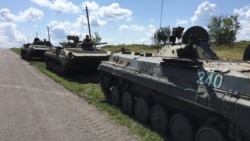
Visits by The Associated Press to training grounds like those near Yenakiyeve and interviews with dozens of rebels reveal that Russian armed forces spearheaded some of the major separatist offensives, then withdrew quickly before they could be widely noticed.
More recently, as a shaky cease-fire has taken hold, Russia has kept fewer troops in Ukraine but has increased its training of rebels to make sure they are capable of operating sophisticated Russian weaponry and defending the territory they control. NATO and an independent London-based Russian scholar estimate that Russia has several hundred military trainers in eastern Ukraine.