



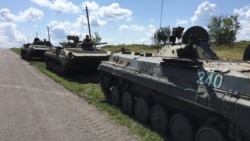
Three Ukrainian soldiers killed by mine:
Three Ukrainian servicemen have been killed and two wounded in a land-mine explosion in separatist eastern territories.
Ukrainian military spokesman Andriy Lysenko said on April 4 that the casualties happened near the town of Avdiyivka, referring to a government-held town north of rebel-held Donetsk.
The announcement came on International Mine Awareness Day.
The UN Children's Fund says unexploded mines and ammunition pose a special threat to children in eastern Ukraine, where government forces have fought pro-Russian separatists.
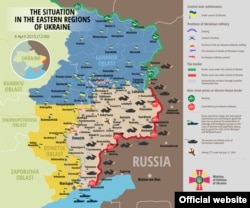
Here is today's map of the military situation in eastern Ukraine, according to te National Security and Defense Council:
This ends our live-blogging for April 3. Be sure to check back tomorrow for our continuing coverage.
Europe is now a petri dish for hybrid war. Events of the past decade, not to mention the last few years, have reaffirmed the value of a concept that sought to explain a range of diverse, coercive instruments across the operational spectrum of war. Hybrid warfare is a term that sought to capture the blurring and blending of previously separate categories of conflict. It uses a blend of military, economic, diplomatic, criminal, and informational means to achieve desired political goals. The Chairman of the Joint Chiefs of Staff, General Martin Dempsey, has referred to these hybrid threats as an “inflection point” in modern war. Indeed, in the disordered post-Cold War world, hybrid warfare remains an excellent framework for understanding the changing character of war.
So why, at a recent off-the-record Washington gathering of Baltic and Central Europeans concerned about Russia (it was not hard to fill the room) did a high-ranking Estonian with substantial experience working on Russian issues express his frustration with the concept? Indeed, why do many Estonians, as well as their Baltic neighbors and even some Poles, Swedes and Finns, dislike the phrase? These concerns are worth considering, particularly since Estonia and its neighbors are the prime targets of this form of warfare. There are two apparent reasons for their concern. First, many in the Baltic region view the concept as merely another mechanism by which the West can avoid decisive action against Russia, particularly because NATO has not developed, really, an operational concept to address hybrid threats. The concept, according to this Estonian official, allows NATO to avoid action because a range of activities – from the aggressive use of disinformation by Moscow, to economic pressure, to bribery and threats, to use of “locals” to stir up protests – become conveniently categorized as being under the threshold of war. Indeed as one expert, James Sherr, has observed, in the hands of Russia hybrid warfare could “cripple a state before that state even realizes the conflict had begun,” and yet it manages to “slip under NATO’s threshold of perception and reaction.” Sherr is right.