




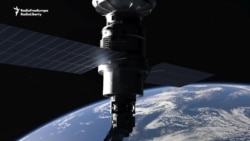
When a Russian “nesting-doll” satellite maneuvered into close proximity to a US satellite last June, it was the latest move in a dangerous game of cat-and-mouse in space.
Cosmos 2558 had been observed shadowing USA 326 ever since being launched in 2022. But now it had hatched a surprise by releasing a smaller module that started moving even closer to the US satellite.
“This is the second one we’ve seen do this from the Russian side,” said DeAnna Burt, who was chief operations officer at the US Space Force at the time of the incident.
“You have a satellite that then has another satellite within it that then, we believe, is a KK or Kinetic Kill vehicle that would go out and rendezvous with another satellite and potentially harm it or image it or do different things,” she added.

Burt retired in October 2025 and spoke to RFE/RL during a visit to Prague organized by the Aspen Institute. In a wide-ranging interview on January 30, she discussed threats to satellites from Russia, China, Iran, and North Korea, as well as a shadowy conflict already ongoing since the beginning of Russia’s full-scale invasion of Ukraine in 2022.
Close Encounter In Space
“We have seen what we would call rendezvous proximity operations, which means…flying around and surveying the other satellite,” Burt said, when asked about the incident last June.
The concern, she added, was “would they release a kill vehicle” or was it “purely surveillance and reconnaissance?” It turned out it was the latter. But it was still alarming, not only due to the risk of collision.
“What you're seeing in the development here, all of these are tests building up to capability…hypothetically, if I were going to launch a counter space capability, first I'd want to make sure I can acquire targets before I could then strike targets.”
Burt is not the first to warn of such Russian threats.
The previous incident was briefly discussed by the then chief of space operations of the US Space Force, General John Raymond, in comments to Time Magazine in 2020. “The way I picture it, in my mind, is like Russian nesting dolls,” he said. “The second satellite came out of the first satellite.”
In 2024, Raymond’s successor General Chance Saltzman warned of a “Day Zero” if Russia deployed a nuclear weapon in space to destroy satellite capabilities. That year, a claim by the Pentagon that Russia had “likely” deployed an anti-satellite weapon in space was denied by the Kremlin.
More recently, on January 21, an Atlantic Council report said the United States was “unacceptably vulnerable” to such threats and urged a shift to “resilient satellite architectures.”
Burt said this was something that was already a major US priority: “Having the ability to take a hit and to be able to recover…with satellites that are on the shelf ready to launch.”
An exercise in 2023, codenamed Victus Knox, saw a new record for a satellite launch, “from the warehouse to on-orbit capability in a week,” per a Space Force statement. But Burt said this was not enough.
“How do you do that at scale? We've done that in a singular sense. How do we get that at scale so that we can build that resilience?” she said.
But this is the worst-case scenario that Burt once described in a lecture as “a Pearl Harbor in space.” Any such large-scale attack would also be an act of self-harm, since it would cause damage indiscriminately – also destroying or incapacitating satellites belonging to Russia, China, and other nations.
Jamming, Lasers, And Robotic Arms
There are many other, more nuanced ways of taking satellites out of action than blowing them up, Star Wars-style.
“We saw in Ukraine, with one of the first attacks being a cyberattack against a satellite communications network...And we've continued to see GPS jamming and satellite communications jamming throughout that fight,” Burt said.
These are direct Russian attacks on US satellite capabilities.
“They've been very localized in effect, and they have been non-kinetic in effect, which means it's a jamming, taking it out for a period of time, and it comes back once it's out of the jammed area. So, it's very clear that it's meant to have a regional or theater effect rather than a global effect. So, we see that quite regularly,” Burt said.
“Our adversaries recognize the importance of space, the ultimate high ground, always above, as we call it, semper supra,” she added.
Other anti-satellite capabilities include Earth-based lasers to blind satellite communications. Burt said lesser powers such as Iran and North Korea also had “counter space capabilities” but the main threats came from Russia and China.
“The more alarming of the Chinese [technologies] is the grappling arm. So, the ability to reach out and grab a satellite and take it from a functional orbit to an unfunctional orbit basically kills the purpose of the satellite and takes it out of use,” she added.
Impacts On Earth
Satellite security has obvious implications for life on Earth. Everything from civilian GPS and weather forecasts to banking and communications depend on it.
The military impacts of disrupting satellites range from soldiers being unable to communicate, satellite images and other intelligence being cut off, to missile defense systems being blindsided.
“Everyone is vulnerable to this,” warned Burt.
“I don't necessarily say it's our Achilles heel. I do think everyone depends upon it. And yes, it would make fighting difficult. But I would also say that our warfighters would continue to keep, the rest of the joint force would continue, fighting....But it will definitely make it more difficult, and I do think there will be more lives lost if space were not available to the joint fight.”

