




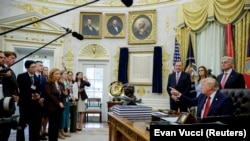
US President Donald Trump signed into law legislation aimed at increasing economic pressure on Russia over its war in Ukraine, including by targeting Moscow's energy revenues as well as countries that continue to buy Russian oil and gas.
The White House said on September 18 that Trump signed H.R. 5334, the Lindsey O. Graham Sanctioning Russia and Iran Act of 2026 -- the legislation named after the late South Carolina senator who championed tougher measures against Moscow.
The signing makes the Russia sanctions measure law after it passed the Senate by an 86-11 vote in August and the House of Representatives by 262-159 on September 16.
The law gives the Trump administration sweeping new authority to impose sanctions and tariffs on Russia, its energy sector, and foreign governments and entities that help Moscow evade existing restrictions.
But much of its practical impact will depend on decisions by Trump and his administration.
Targeting Russian Energy Revenues, Sanctions Evasion
Among its most consequential provisions, the law authorizes the president to impose tariffs of up to 100 percent on goods imported from countries that fall within specified categories tied to purchases of Russian oil and natural gas or the circumvention of US sanctions.
The legislation focuses in particular on five importers of Russian crude oil or natural gas, which purchased the largest amounts of these commodities during the 12-month period preceding its enactment, as well as countries identified as major facilitators of Russian sanctions evasion. The administration is required to reassess the countries covered by the provisions every 180 days.

The law also targets Russia's so-called shadow fleet -- the vessels and networks used to transport Russian energy and evade sanctions -- as well as foreign individuals and companies involved in supporting Russian energy production or sanctions evasion. The legislation can affect vessel owners, operators, managers, insurers, and other participants in activities within its scope.
The measure also contains provisions targeting major Russian liquefied natural gas (LNG) projects, including Yamal LNG and Arctic LNG 2, large facilities in the Russian Arctic designed to produce and export the fuel.
At the same time, the law gives Trump considerable discretion over how and whether some of its powers are used. He can waive sanctions, restrictions, or duties if he determines that doing so is in the national interest and provides Congress with an explanation.
That means the signing itself does not automatically impose a 100 percent tariff on countries such as China or India. Rather, it gives the administration the statutory authority to impose such duties under specified circumstances.
The legislation also extends the Iran Sanctions Act of 1996 through 2031.
Experts: Implementation Will Determine Impact
Daniel Fried, a former State Department sanctions coordinator, told RFE/RL on September 18 that Trump's decision to sign the measure was significant, but said the president had missed an opportunity to publicly use the moment to send a message to Moscow.

“It’s good that President Trump signed the bill into law,” Fried said. “But the lack of a public statement means that he has missed a chance to send a message to Putin that he needs to end the war.”
Luke Coffey, a senior fellow at the Hudson Institute who focuses on national security and transatlantic relations, said the legislation's symbolism was particularly important.
“One of the most important aspects of this new legislation is its symbolism and timing,” Coffey told RFE/RL.
He said the bipartisan support for the measure highlighted the role of Republicans in Congress, including lawmakers who had previously been skeptical about continued US involvement in Ukraine.
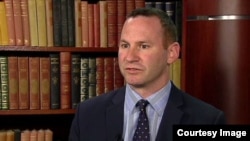
Coffey said he hoped the legislation could influence the debate among supporters of the Trump movement by demonstrating how support for Ukraine and pressure on Russia could be framed as being in US interests.
But he cautioned against expecting an immediate wave of new sanctions or tariffs.
“I would not expect major new sanctions or tariffs to be implemented overnight as a result of this legislation,” Coffey said.
Instead, he noted, the law codifies many existing sanctions, which he described as significant in itself.
Coffey also pointed to a provision that has received less attention: a restriction on US businesses pursuing new business deals or investments in Russia, or with Russian entities, until there is a peace agreement acceptable to Ukraine.

He said that provision could become particularly important because some political and business interests in Washington are waiting for an opportunity to restore commercial ties with Moscow.
Kerri Bitsoff, a former senior Treasury Department official who worked at the Office of Foreign Assets Control, said the bipartisan vote was an encouraging signal for Ukraine and demonstrated continued congressional support for maintaining pressure on Russian President Vladimir Putin.
“The bipartisan vote is an encouraging signal for Ukraine, and it shows our Congress still backs pressure on Putin across party lines,” Bitsoff told RFE/RL.

She said the bill contains relatively few new sanctions on Russia but gives the administration authority to impose tariffs of up to 100 percent on major buyers of Russian oil -- potentially including China and India.
Bitsoff cautioned, however, that tariffs have proved difficult to use against major purchasers of Russian energy.
She pointed to China's response to US tariffs in April 2025, when Beijing retaliated with tariffs of its own and restricted rare-earth exports.
“It will take resolve from the president and the American public to stick to the threat,” Bitsoff said.
She also pointed to the enforcement of sanctions already on the books as a key test of how the administration will use the new powers.
“There hasn't been movement from Treasury on the Russia sanctions already in place in almost eleven months,” she said. “Enforcement on those from Treasury will be a good indication of whether Trump will use this new authority or let it sit.”
Zelenskyy Welcomes Trump's Signature
Ukrainian President Volodymyr Zelenskyy thanked Trump and members of Congress for backing the legislation, while invoking Graham's longstanding advocacy for maintaining pressure on Moscow.
“When Lindsey Graham was here in Ukraine, he would always talk about how important it was not to ease pressure on Russia, to strengthen sanctions, and seek a path to peace,” Zelenskyy said.
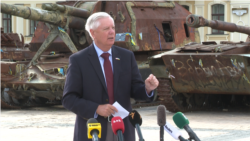
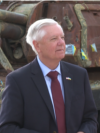

The Ukrainian leader specifically thanked Trump for signing what he called “this critically important legislation” and urged the administration to implement its provisions “fully and swiftly.”
Zelenskyy also thanked senators and House members who supported the measure.
“The best way to honor Lindsey’s memory will be to implement the provisions of this law fully and swiftly,” he said.
For Kyiv, the central question now shifts from congressional passage to implementation -- particularly whether the Trump administration uses the new tariff and sanctions authorities against countries that continue purchasing Russian energy or assisting Moscow in circumventing sanctions.
“Peace comes through strength,” Zelenskyy said. “Calm comes through security. And the best guarantee of security is resolve.”

