




WASHINGTON -- US President Donald Trump said Washington continues to share intelligence with Ukraine after President Volodymyr Zelenskyy said Kyiv had received no advance warning from its international partners before a new wave of Russian attacks on the capital and battlefield reports of a throttling of Starlink satellite access.
Seeking to dispel concerns that his recent moves toward Moscow could undermine a critical source of support for Kyiv, Trump told reporters on October 14 "no, we haven't" when asked whether the US had stopped sharing intelligence with Ukraine.
“We are helping them, and we are sharing intel. We want the war to end,” he said, adding that Washington was working with both Kyiv and Moscow to end the war.
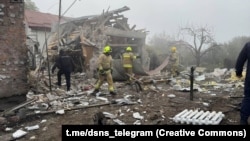
Zelenskyy said Russian forces launched 39 ballistic missiles at Kyiv and Kharkiv on October 13, including targeting a thermal power plant. Kyiv Mayor Vitali Klitschko said a strike that impacted a high-rise apartment building killed at least three people.


“Once again, no advance warning from our partners,” Zelenskyy wrote on social media, adding that Ukrainian intelligence indicated Russia was preparing further ballistic missile launches.
The absence of an early warning does not establish that Washington withheld intelligence. Ukrainian Foreign Minister Andriy Sybiha said Ukraine was still receiving US military intelligence and suggested the delay may have been related to the type of Russian weapon used.
Some analysts noted Zelenskyy's claims came after Trump struck a deal with Russian President Vladimir Putin to lift bans on the export of Russian diesel fuel. The timing of the reported intelligence lapse, they said, could indicate Trump is trying to ratchet up pressure on Kyiv to stop hitting Russian refineries.
Kurt Volker, a former US ambassador to NATO and special representative for Ukraine during Trump’s first administration, however, said he had been told that cloud cover had prevented American satellites from detecting the missile launch. He cautioned that he could not independently verify the explanation.
Such an explanation, experts said, would point to a limitation in intelligence collection rather than a deliberate suspension of intelligence sharing.
Ukraine relies heavily on American intelligence to defend against incoming missiles, drones and aircraft, when early warnings can help save civilian lives and protect critical infrastructure.

Although the exact number is not known, several analysts said the United States likely operates somewhere between 300 to 500 military intelligence satellites which orbit the Earth, providing multiple passes over any given location every hour. That compares with an estimated 15 to 20 military reconnaissance satellites operated by European countries.
Ukraine has developed independent intelligence capabilities and can identify many Russian military sites it wants to strike, but detecting incoming attacks is a different challenge, one for which Kyiv remains heavily reliant on American capabilities.
“For defense, I think it’s very important,” he said, describing US satellite-based intelligence as the best available source of early warning.
New AI Tool, Starlink Uncertainty
NATO also provides intelligence support to Ukraine through a combination of institutional alliance programs, artificial intelligence systems, and bilateral intelligence sharing from individual member states.
While the military alliance as an official body restricts its institutional role to nonlethal assistance to prevent direct conflict with Russia, individual allies, mainly the United States, provide highly granular, real-time tactical intelligence.
As part of its drive to boost its own defense, Ukraine said on October 13 that its forces will soon start using an artificial intelligence model -- jointly developed with NATO -- to predict where and when Russia's drone strikes will land.
Dubbed "Model No. 13," the tool analyzes past combat data, weather conditions, and battlefield conditions to determine, with "high probability," how Russian troops will use drones on the front lines, the ministry said in a statement.
The model can forecast the strike's time, location, intensity, and type of drone used, the ministry said.
"The solution has already been validated using real-world datasets. It has been refined and is ready for integration into the Armed Forces of Ukraine's situational awareness systems," its statement read.
Ukraine also relies heavily on SpaceX's Starlink satellite service to guide longer-range drone strikes in occupied southern and eastern Ukraine on Russian logistics and refineries inside Russia proper.
Serhiy Beskrestnov, an adviser to Zelenskyy, said on Telegram on October 14 that some Starlink services appear to have been limited: namely a halting in the operation of its military-grade version above 100 miles per hour (160 km/h).
Sources told RFE/RL that Ukriane has raised the "urgent issue" with SpaceX and the US government early on October 14 as the speed restriction could disrupt high-speed UAV, aircraft and helicopter operations -- including efforts to counter Russian Shahed drones.
SpaceX has not commented on the situation. The throttling of service has not been independently verified. SpaceX is controlled by Elon Musk, an ardent ally of Trump, who once cut off Starlink service to Ukrainian soldiers during an offensive that took a small amount of Russian territory.

“Nothing is more important in war than critical battlefield intelligence,” Sean Wiswesser, a former senior CIA operations officer, told RFE/RL.
“We should not underestimate the critical role US intelligence sharing has played for Ukraine in this war,” Wiswesser added, noting Washington had continued providing intelligence despite political disagreements and difficulties in the past.
Energy Cease-Fire?
The intelligence concerns also come amid a dispute over Trump’s announcement of an energy cease-fire between Russia and Ukraine and his decision to ease restrictions on Russian diesel exports.
Trump announced the proposed truce on October 9, but neither side has clearly confirmed such an agreement, while Trump said on October 12 that “they agreed [to the cease-fire]. You know why? Because I said, ‘You agree’ -- that's why. They agreed because I said they agreed, and that thing has to get settled.”
Volker said he had no reason to believe an energy cease-fire was in effect because neither government had formally agreed to one.
“What would convince me is if I heard from the Russians that they would agree to an energy cease-fire if Ukraine reciprocated,” he said, noting that Kyiv had already indicated its willingness to accept such an arrangement if Moscow did the same.
“We’ve not heard that, and Russia’s actions demonstrate that they do not agree with that,” Volker said.
Trump has repeatedly blamed Ukrainian attacks on Russian oil infrastructure for contributing to higher US fuel prices, a political concern for Republicans ahead of congressional midterm elections.
Many analysts have pointed instead to the US war in Iran as a much larger factor in the price increases, a view Zelenskyy has also expressed.

