




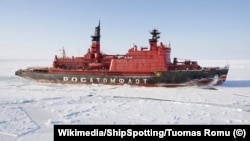
A group of sanctioned Russian tankers dropped anchor some 1,300 kilometers north of the Arctic Circle in July after getting stuck and hunkered down for a long wait in the frozen waters at the top of the world. Help from two nuclear-powered ice breakers was several days' voyage away.
The ships were stuck in the Vilkitsky Strait, a 55-kilometer-wide choke point between the coast of northern Siberia and Bolshevik Island, on Russia's Northern Sea Route (NSR) to China.
The Kremlin has heavily invested in the promise that retreating Arctic sea ice opens up a previously impassable route -- one that is farther from the reach of Ukrainian drone attacks or European naval interdiction of shadow fleet vessels.
The NSR saw Russian exports of crude oil and liquified natural gas (LNG) moving in record volumes this year. But, as the Arctic traffic jam underlines, it isn't always plain sailing.
"That is a good example of one of our main messages: that less ice doesn't mean easier navigation," Ksenia Vakhrusheva, head of the Arctic project at Lithuania-based environmental group Bellona, told RFE/RL.
"When the ice is melting, some parts are breaking and floating, and sometimes it happens that in certain places, especially in narrow straits, this ice gets packed, and a ship without an ice class cannot go through," she added.
Vakhrusheva was referring to a classification for the degree (if any) to which a ship is capable of dealing with sea ice. Russia's lack of such ships is one of several factors holding back development of the NSR, despite bullish rhetoric from President Vladimir Putin and other Russian officials about the route.
'A Safe Path'
The NSR "is crucially important in the current challenging international situation -- a reliable and safe path to the world's largest markets," Putin said last month, speaking at the launch of the flagship Vostok Oil project on the Taimyr Peninsula just south of the Vilkitsky Strait.
Putin said that 37 million tons of cargo had moved along the route (though not its entire length) in 2025 and predicted this would "almost double" by 2030. In fact, back in 2019, Kremlin officials were chasing Putin's target of 80 million tons by 2024.
This is just one way the numbers tell a more nuanced story about the NSR.

By end of last month, the Norway-funded Center for High North Logistics (CHNL) reported Russia had shipped some 2 million tons of primarily crude-oil cargoes, or about 15 million barrels, along the entire length of the NSR to China and other Asian destinations, mostly departing from the Barents Sea port of Murmansk.
By mid-October, the figure had increased to some 20 million barrels, Reuters reported, citing traders and shipping data. This is already a 50 percent increase on 2025. Yet, at the same time, it still represents around just 1 percent of Russia's total seaborne oil exports.
"There is definitely a surge of developments there. However, it's from a relatively low base," Tomas Alexa, a senior analyst at maritime security consultancy Ambrey, told RFE/RL.
"The messaging largely is internal, but also toward India and China. Russia is trying to reassert itself as a reliable partner that can deliver the volumes contracted or projected."

Alexa added that while Russia had launched a number of new, Arctic-capable vessels, it's ability to build and maintain these and other infrastructure in the region was seriously hampered by Western sanctions.
"Any spare parts, any construction materials often have to go through third parties to avoid the sanctions regimes because they could be only procured from the United States, Japan, South Korea, or Europe," he said, adding that maintenance and repairs had previously been handled by Norwegian, Danish, and Dutch companies that would no longer do so.
A New Front Line
While the lion's share of shipping along the route is Russian energy exports, other nations are also dipping their toes in the chilly waters.
On October 22, the South Korean government reported that the country's first container ship had used the route, praising it as a shortcut to Europe but noting difficult conditions including large ice flows in the Bering and Vilkitsky straits.
This year China, for the first time, ran a scheduled container service to Europe along the NSR that completed several voyages.
Catherine Sendak, head of the Transatlantic Defense and Security program at the Center for European Policy Analysis (CEPA), said there were big questions about how Russia might manage the route.
"Russia feels ownership of a lot of the Arctic -- the majority of it -- and feels that…it's an inner waterway," she told RFE/RL.


"There have been discussions about tolls…about what Russian authorities would provide commercial vessels transiting through the route," she added.
"I don't think there are good answers to that right now. I will be interested to see in a year from now if Russia still thinks it's in their best interest to use this route, but perhaps not open it up as much to other actors."
A CEPA report in September said "Russia is turning the Arctic into a fortress." Officials in Washington, Brussels, and elsewhere have used similar language.
"With Russia and China increasing their footprint and ambition, the Arctic has become a front line of global power competition," European Union foreign affairs chief Kaja Kallas said while outlining a new EU strategy on the Arctic on October 21. "Access to Arctic sea lanes and natural resources is of strategic interest to the EU."
NATO launched its new Arctic Sentry mission to boost its presence in February, and last month the United States announced plans for expanding its military boot-print in Greenland, as part of a deal that also aims to overcome a bruising battle within the alliance over US President Donald Trump's call for US sovereignty of the island.

Alongside these security concerns, groups such as Bellona continue to bang the drum about environmental risks from increased shipping in the region, particularly by aging, poorly maintained shadow fleet tankers like some of those that got stuck at the Vilkitsky Strait.
Only one made it through, while others eventually found a different route after waiting up to two weeks for the icebreakers and still being unable to navigate the strait.
"An oil spill in the Arctic environment is more dangerous for the environment than elsewhere in the world because natural degradation of oil in cold weather is way slower than in warmer regions, and then it also can spill over the ice, which can accelerate climate change effects," said Vakhrusheva.
"Russia doesn't publish any information about incidents or accidents along the Northern Sea Route, and the area is so big and remote that there are no independent organizations or activists who can report anything," she warned.

