Armenian Protesters Angry Over Karabakh Roadblock Detained Near Russian Base
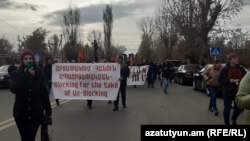
Armenian protesters march near the Russian military base in Gyumri on January 8.
Dozens of activists of a hard-line Armenian nationalist group were detained by local police on January 8 after attempting to block entrance to a Russian military base in the northwestern Armenian town of Gyumri.
Members of the National-Democratic Pole (AZhB), an extra-parliamentary bloc composed of several fringe groups that claim to be a pro-Western political force in Armenia, allege that Russian peacekeeping forces in Nagorno-Karabakh are colluding with Azerbaijan and Turkey to keep the only road linking the region with Armenia blocked.
The Moscow-brokered 2020 cease-fire agreement between Armenia and Azerbaijan put Russian peacekeepers in control of the region, including the Lachin Corridor, the only road to Armenia. The corridor has been blocked since December 12 by people claiming to be environmental protesters.
During the protest, the AZhB activists called for the Russian peacekeeping forces to be replaced with an international force and urged Armenia to quit the Collective Security Treaty Organization, a Russian-led defense bloc including Belarus, Kazakhstan, Kyrgyzstan, and Tajikistan.
The AZhB has been claiming without proof that Russia is secretly backing the roadblock to force Yerevan and the ethnic Armenians in Nagorno-Karabakh to make concessions, including supporting a Russian-controlled corridor from Azerbaijan to Turkey via Armenia as well as Armenia's accession to the proposed union state of Russia and Belarus.
The activists marched toward the military base with banners, one of which called for "de-occupation" of Armenia from Russia as well as for "de-Sovietization" and "de-Russification" of the country.
Armenian authorities sent dozens of police officers from Yerevan to maintain peace and prevent the protesters from approaching the street where the Russian military unit is located.
Armenia, a country of just 3 million people, agreed to host several thousand Russian troops at the base in Gyumri to protect its borders following the collapse of the Soviet Union in 1991.
The Gyumri base was built during the Soviet period to guard the Soviet Union's borders with Iran and NATO-member Turkey, with whom Armenia has tense relations. The Russian troops in Gyumri are separate from the Russian peacekeeping forces in Nagorno-Karabakh.
During the protest, one of the leaders of the AZhB, which also openly condemns Russia's invasion of Ukraine, called on Armenians around the world to start blocking roads to Russian embassies and organizations.
Police officials warned the protesters that such calls were "unlawful." As the march proceeded, police detained several dozen activists.
As a result of the blockade, more than a thousand ethnic Armenian residents of Nagorno-Karabakh, including many children, have not been able to get home for about a month now.
Stranded Karabakh Armenians Flood Border Town As Blockade Continues
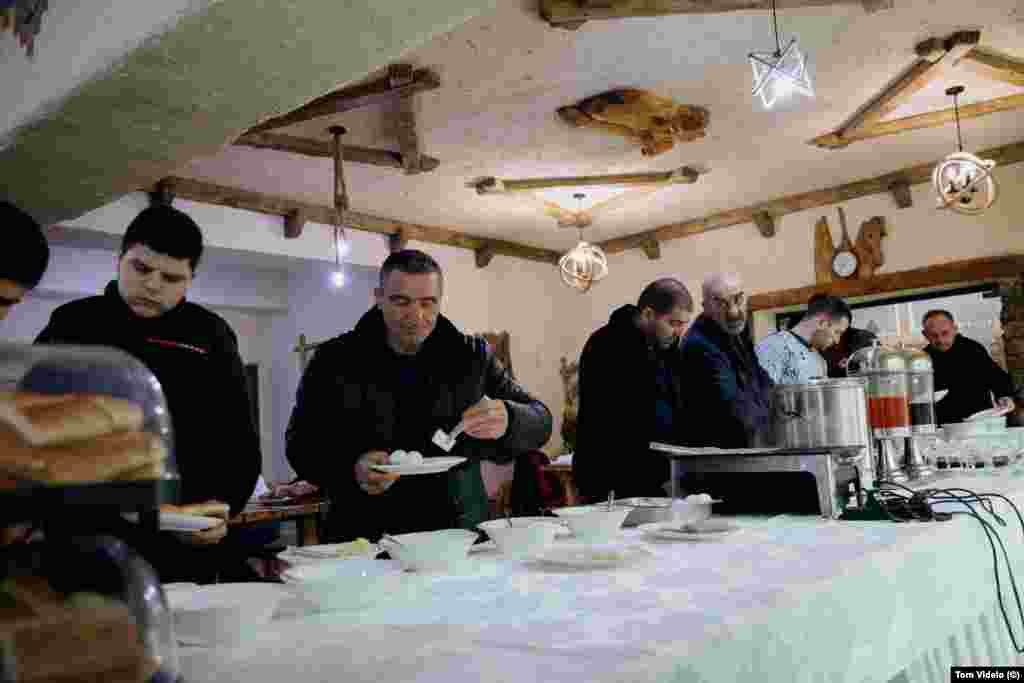
1/11This December 29 photo shows ethnic Armenian locals from the breakaway Nagorno-Karabakh region of Azerbaijan queuing for breakfast in a hotel in Goris, southern Armenia, on the 18th day of being locked out of their hometowns.
As tens of thousands of ethnic Armenians remain trapped inside the breakaway region of Nagorno-Karabakh, hundreds are currently locked out amid an ongoing blockade by Azerbaijani activists. Photojournalist Tom Videlo made the following report from southern Armenia.
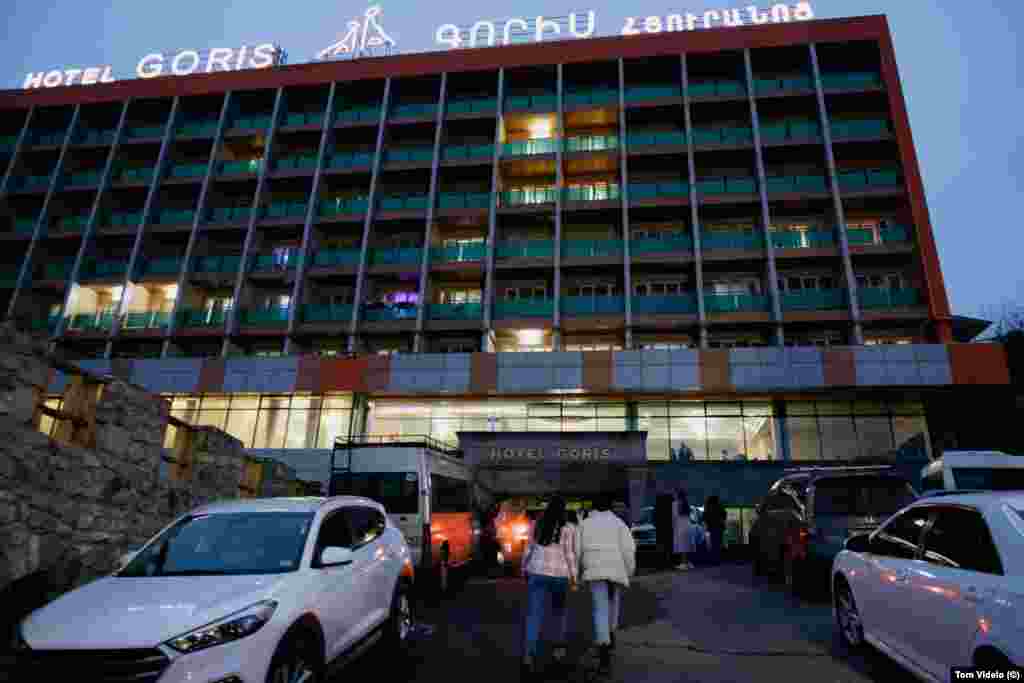
2/11People walk into the Hotel Goris. The Armenian town has become a base for many of the approximate 1,100 Karabakh locals who have been stranded since a blockade of Nagorno-Karabakh began on December 12, cutting off the flow of people and supplies, including medicines and food, from the breakaway region.
As tens of thousands of ethnic Armenians remain trapped inside the breakaway region of Nagorno-Karabakh, hundreds are currently locked out amid an ongoing blockade by Azerbaijani activists. Photojournalist Tom Videlo made the following report from southern Armenia.
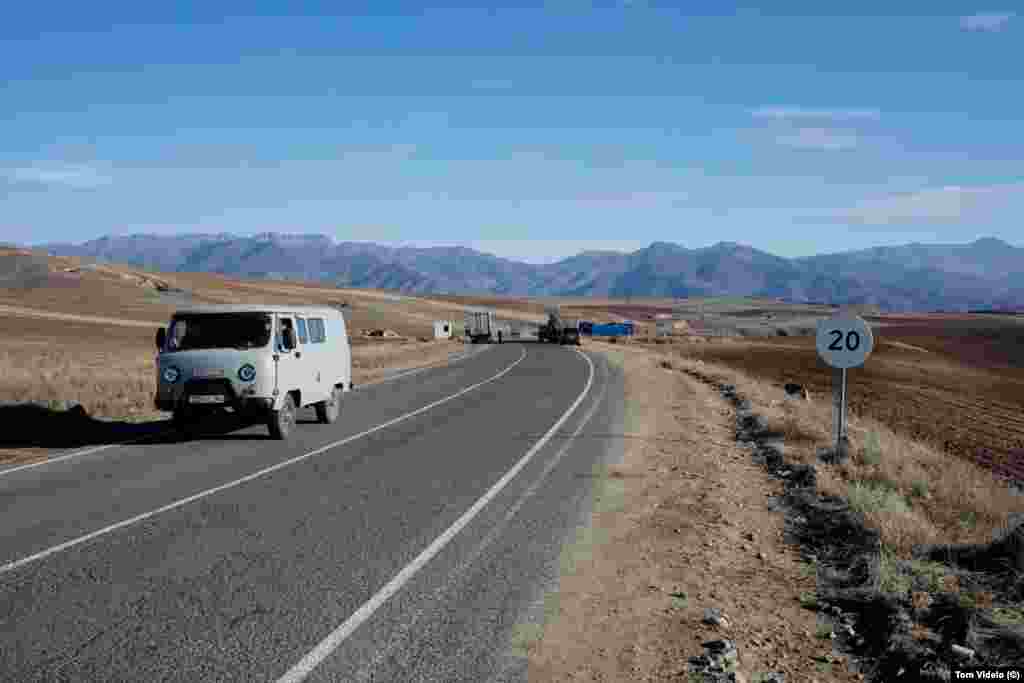
3/11An Armenian checkpoint outside Tegh, a village near the entrance to Nagorno-Karabakh.
A few kilometers farther from where this photo was taken on December 16, Azerbaijanis blocking the road have claimed to be protesting the activities of mines in Azerbaijani territory that are operated by ethnic Armenians. Many observers see the group as potentially state-backed actors intending to put pressure on Yerevan.
As tens of thousands of ethnic Armenians remain trapped inside the breakaway region of Nagorno-Karabakh, hundreds are currently locked out amid an ongoing blockade by Azerbaijani activists. Photojournalist Tom Videlo made the following report from southern Armenia.
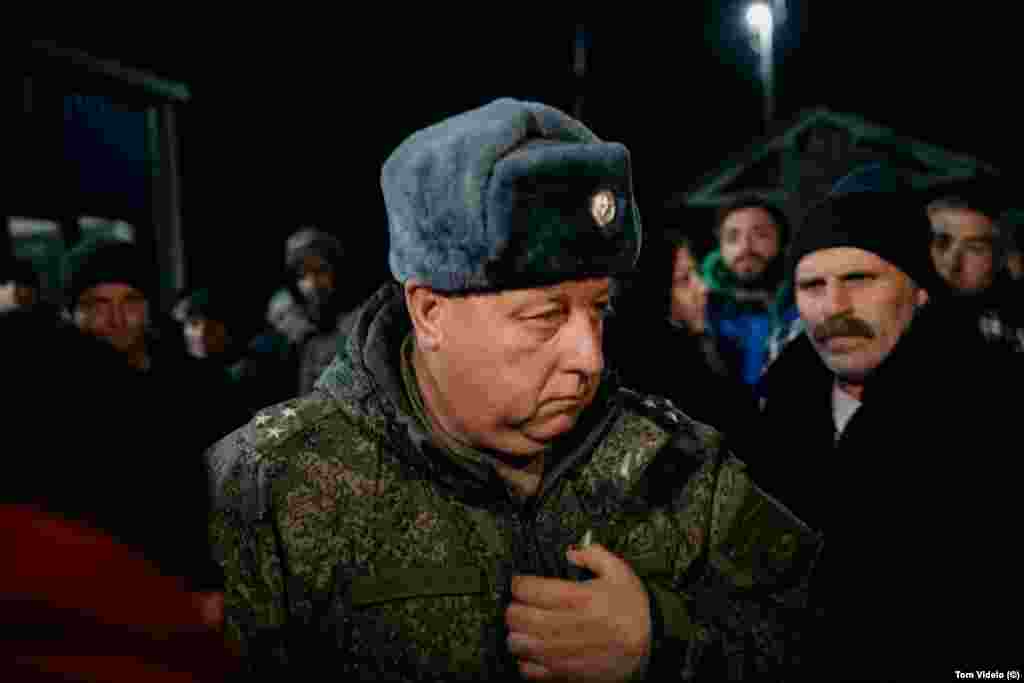
4/11Igor Sazonov, an officer in the Russian peacekeeping force, leaves the Tegh checkpoint on December 26, after speaking with ethnic Armenian protesters demanding the reopening of the Lachin Corridor.
As tens of thousands of ethnic Armenians remain trapped inside the breakaway region of Nagorno-Karabakh, hundreds are currently locked out amid an ongoing blockade by Azerbaijani activists. Photojournalist Tom Videlo made the following report from southern Armenia.
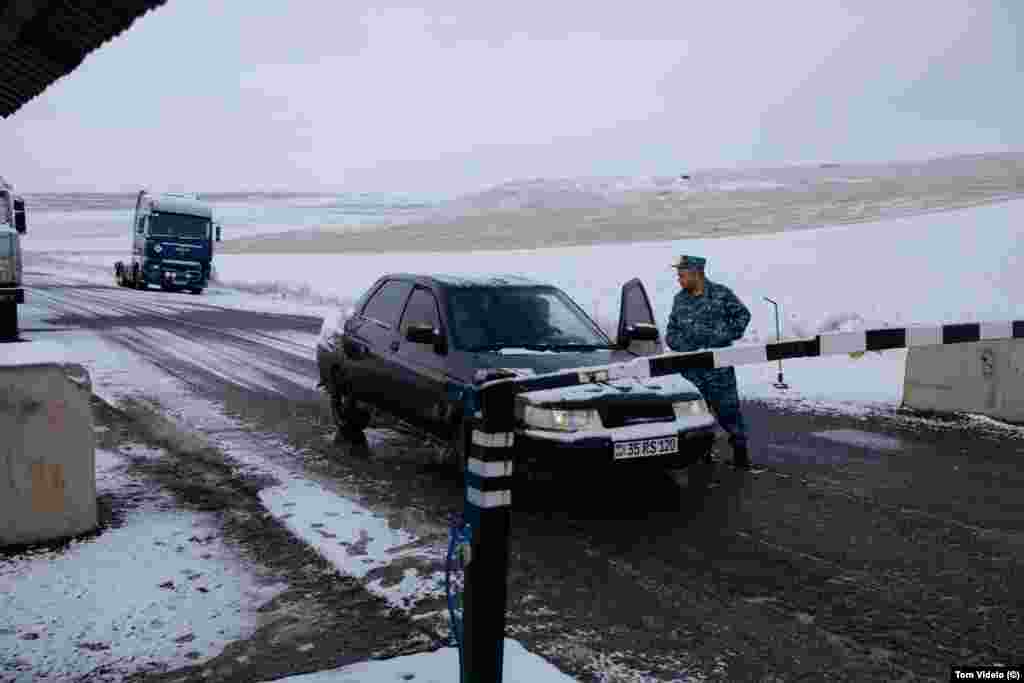
5/11An ethnic Armenian policeman speaks to a driver at the Tegh checkpoint. Armenian authorities began preventing anyone except local villagers from proceeding past this post shortly after the blockade began on December 12.
As tens of thousands of ethnic Armenians remain trapped inside the breakaway region of Nagorno-Karabakh, hundreds are currently locked out amid an ongoing blockade by Azerbaijani activists. Photojournalist Tom Videlo made the following report from southern Armenia.
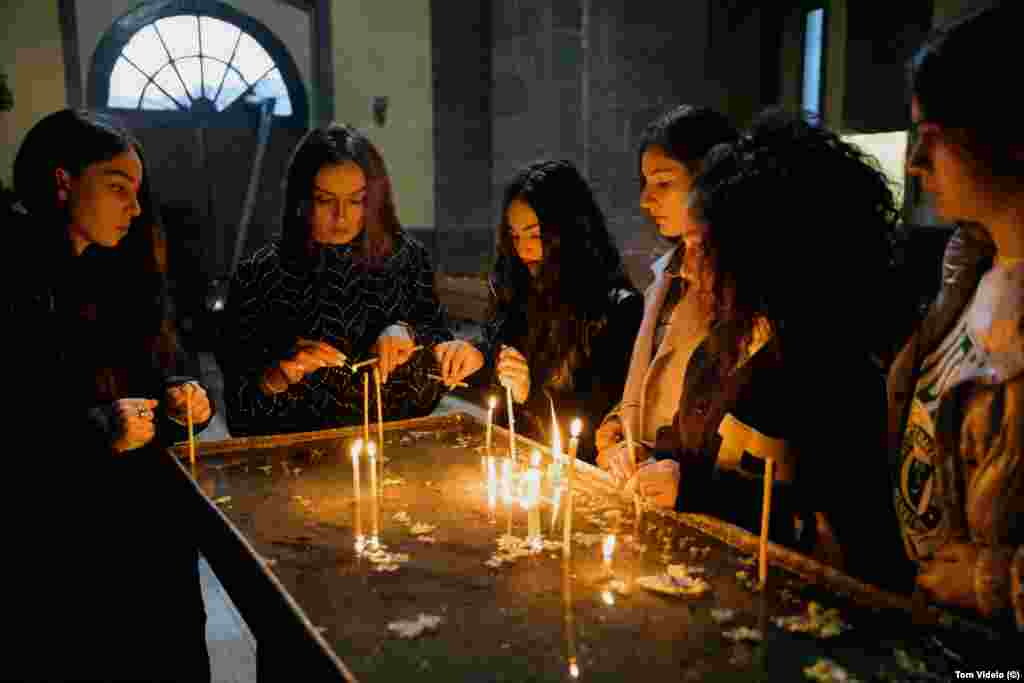
6/11Members of Asparez, a dance group from Stepanakert, light candles in a church in Goris. The teenagers were traveling with their teacher, Lari Avanesian (second from left), to compete in a dance contest in Tbilisi, when the road back to their homes was shut.
As tens of thousands of ethnic Armenians remain trapped inside the breakaway region of Nagorno-Karabakh, hundreds are currently locked out amid an ongoing blockade by Azerbaijani activists. Photojournalist Tom Videlo made the following report from southern Armenia.
7/11The Asparez dance group performs in Goris on December 25, nearly two weeks into the blockade.
Fifteen-year-old dancer Samantha Boghosian said the performance was held in part because "we are trying to show that everything is OK because the situation for children in [Nagorno-Karabakh] is much worse than ours." The teenager added, "By keeping ourselves strong, we aren’t creating extra worries for our families."
As tens of thousands of ethnic Armenians remain trapped inside the breakaway region of Nagorno-Karabakh, hundreds are currently locked out amid an ongoing blockade by Azerbaijani activists. Photojournalist Tom Videlo made the following report from southern Armenia.
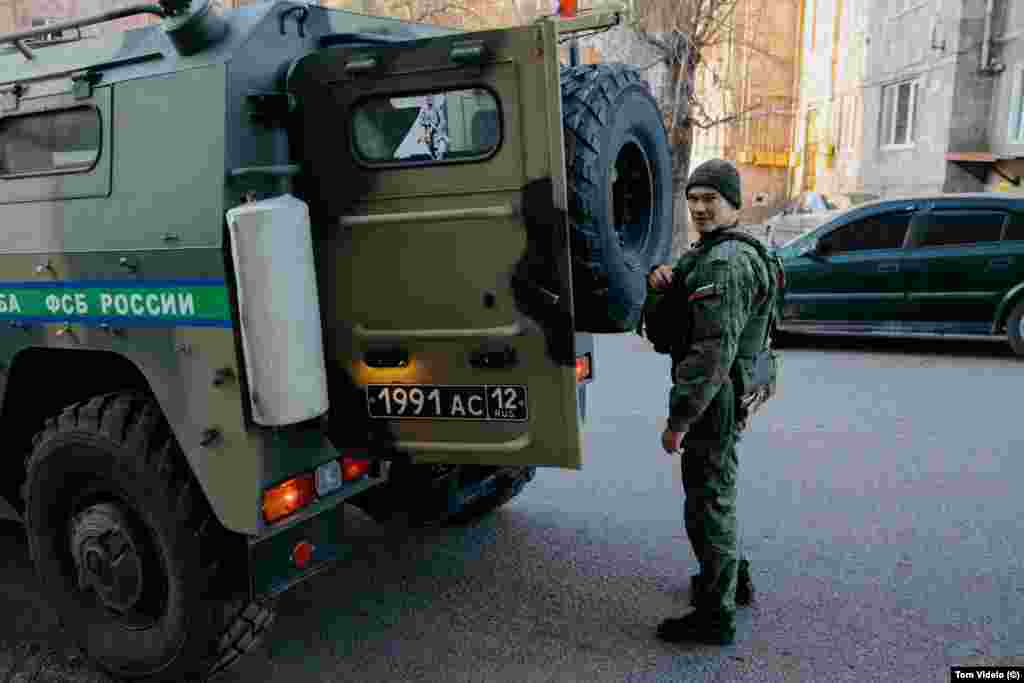
8/11A Russian peacekeeping soldier stands next to a vehicle with a "Z" marking associated with support for the invasion of Ukraine.
Photographer Tom Videlo says many Karabakh locals see the ongoing inaction of Russian peacekeepers to clear the Lachin road as a calculated political move to exert pressure on Yerevan for Russia's own geopolitical goals.
As tens of thousands of ethnic Armenians remain trapped inside the breakaway region of Nagorno-Karabakh, hundreds are currently locked out amid an ongoing blockade by Azerbaijani activists. Photojournalist Tom Videlo made the following report from southern Armenia.
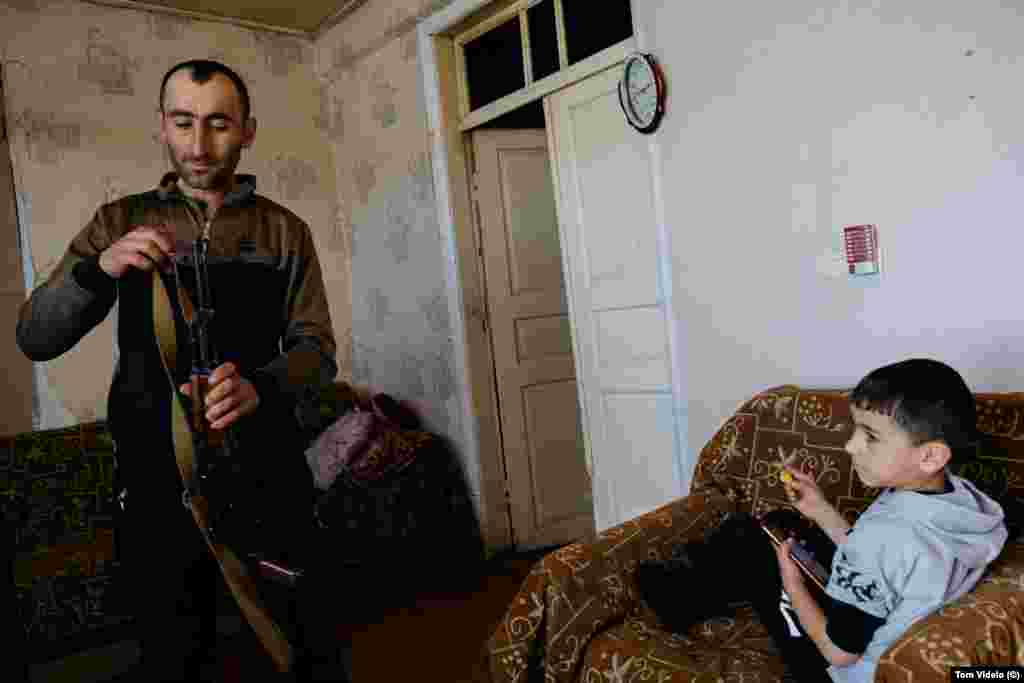
9/11Ruben Balian and his son Garnik in their house in Kornidzor, a village near the blockaded road connecting Armenia with Nagorno-Karabakh.
Balian is a member of Armenia’s territorial defense organization and keeps an AK-47 rifle at home. Many fear another breakout of all-out war could be possible amid the ongoing tensions over Nagorno-Karabakh.
As tens of thousands of ethnic Armenians remain trapped inside the breakaway region of Nagorno-Karabakh, hundreds are currently locked out amid an ongoing blockade by Azerbaijani activists. Photojournalist Tom Videlo made the following report from southern Armenia.
10/11An Armenian soldier uses a listening device at a position near the Lachin blockade during a foggy day on December 21. At some points near the southeastern border, military outposts of Azerbaijan and Armenia are just meters apart.
As tens of thousands of ethnic Armenians remain trapped inside the breakaway region of Nagorno-Karabakh, hundreds are currently locked out amid an ongoing blockade by Azerbaijani activists. Photojournalist Tom Videlo made the following report from southern Armenia.
11/11Gor, a local of Nagorno-Karabakh, has been stuck in southern Armenia with his father since the blockade began.
On December 28, it was announced that operations of a major mine in the Nagorno-Karabakh region would be suspended until an environmental review could be completed. Environmental concerns around mineral extraction were one reason given for the Azerbaijani blockade of Nagorno-Karabakh.
As tens of thousands of ethnic Armenians remain trapped inside the breakaway region of Nagorno-Karabakh, hundreds are currently locked out amid an ongoing blockade by Azerbaijani activists. Photojournalist Tom Videlo made the following report from southern Armenia.
Previous slide
Next slide
The blockage is disrupting supplies of goods to Nagorno-Karabakh, causing a shortage of food and essential goods, including medicines, in the region.
Azerbaijan, which considers the region to be part of its territory, has denied that the environmental activists are interfering with the movement of humanitarian supplies.
It said that vehicles belonging to Russian peacekeeping forces and the International Committee of the Red Cross (ICRC) have been able to enter and exit with medication. They have also transported seriously ill patients to Armenia.
The Russian Ministry of Defense has said it is holding talks with Azerbaijan and Armenia about the resumption of full traffic along the Lachin Corridor.
Russia currently has about 2,000 peacekeepers deployed in Nagorno-Karabakh after brokering a cease-fire between Armenia and Azerbaijan following their 44-day war over the region in September-November 2020.
Armenia and Azerbaijan have been locked in a conflict over Nagorno-Karabakh for years. Some 30,000 people were killed in a war in the early 1990s that left ethnic Armenians in control of the breakaway region and seven adjacent districts of Azerbaijan proper.
Azerbaijan regained all of the adjacent districts and seized some territory of Nagorno-Karabakh proper during the 2020 war in which close to 7,000 people were killed on both sides.
Nagorno-Karabakh is internationally recognized as part of Azerbaijan.