Russian President Vladimir Putin attends a ceremony in Volgograd, formerly known as Stalingrad, as it marks the 75th anniversary of one of the bloodiest battles in World War II on February 2.
Russian President Vladimir Putin has visited the city formerly known as Stalingrad to participate in celebrations of the 75th anniversary of victory in one of the bloodiest battles of World War II.
The battle of Stalingrad "opened the path to the complete destruction of the enemy," Putin said on February 2.
A Victory Of Courage And Coercion: British Historian On Stalingrad's Legacy
Antony Beevor
February 2, 2018, marks the 75th anniversary of the end of the Battle of Stalingrad, a ferocious and brutal siege that proved to be a major psychological and military tipping point in World War II.
RFE/RL correspondent Coilin O'Connor spoke with prominent British historian Antony Beevor -- author of Stalingrad -- about how this engagement between two totalitarian armies helped turn the course of the global conflict.
Putin congratulated and thanked war veterans and urged Russians to build the future of their country on "the foundation" he said they had laid.
"We have no right to let them down, to demonstrate cowardice or indecisiveness," Putin said. "In our actions, we must rise to the level of the achievements of our fathers and grandfathers."
The five-month Battle of Stalingrad became a symbol of Soviet resilience in the face of the Nazi onslaught in 1942-43 and marked a major turning point in the war.
Well over 1 million people are believed to have died in the bloodshed at Stalingrad as Soviet forces halted and then turned the tide on the invading Nazi forces.
The ceremonies in the city now known as Volgograd included a parade with 75 armored vehicles -- one for each year since the victory – headed by a vintage T-34 tank, the warhorse of the wartime Soviet army.
Some 1,500 military personnel and 60 aircraft were featured in the ceremonies in the city center, near the spot where German Field Marshal Friedrich Paulus surrendered the tattered remains of his 6th Army.
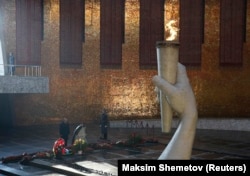
Before his short speech, Putin laid a wreath at the monumental Mamayev Kurgan memorial complex on the banks of the Volga River. He also paid respects at the grave of Soviet Marshal Vasily Chuikov, who commanded Soviet forces during the battle.
Earlier in the day, Putin sent a telegram of congratulations to Valentina Shulgina, the only known living veteran of the Battle of Stalingrad. The 91-year-old doctor lives now in the breakaway Georgian region of Abkhazia.
PHOTO GALLERY: The Battle of Stalingrad (click to view)
75th Anniversary Of Victory In The Battle Of Stalingrad
1/15Stalingrad's main railway station in late 1942
The Battle of Stalingrad (August 23, 1942-February 2, 1943) was one of the most brutal and bloody battles of World War II. Germany's disastrously ill-fated attack on the Russian city is widely considered to have been a major turning point in the conflict, as its army suffered massive military losses and a huge psychological blow from which it never recovered.
Show moreShow less
2/15Street combat, October 1942
The Battle of Stalingrad (August 23, 1942-February 2, 1943) was one of the most brutal and bloody battles of World War II. Germany's disastrously ill-fated attack on the Russian city is widely considered to have been a major turning point in the conflict, as its army suffered massive military losses and a huge psychological blow from which it never recovered.
Show moreShow less
3/15A downed German fighter lies amid the ruins of Stalingrad. Huge air battles were waged over the city during the course of the siege.
The Battle of Stalingrad (August 23, 1942-February 2, 1943) was one of the most brutal and bloody battles of World War II. Germany's disastrously ill-fated attack on the Russian city is widely considered to have been a major turning point in the conflict, as its army suffered massive military losses and a huge psychological blow from which it never recovered.
Show moreShow less
4/15The brutal battle conditions were exacerbated by the harsh Russian winter.
The Battle of Stalingrad (August 23, 1942-February 2, 1943) was one of the most brutal and bloody battles of World War II. Germany's disastrously ill-fated attack on the Russian city is widely considered to have been a major turning point in the conflict, as its army suffered massive military losses and a huge psychological blow from which it never recovered.
Show moreShow less
5/15With supplies running out, most Germans were in an exhausted and emaciated condition by the time the fighting ended.
The Battle of Stalingrad (August 23, 1942-February 2, 1943) was one of the most brutal and bloody battles of World War II. Germany's disastrously ill-fated attack on the Russian city is widely considered to have been a major turning point in the conflict, as its army suffered massive military losses and a huge psychological blow from which it never recovered.
Show moreShow less
6/15Street fighting in the Battle of Stalingrad (TASS)
The Battle of Stalingrad (August 23, 1942-February 2, 1943) was one of the most brutal and bloody battles of World War II. Germany's disastrously ill-fated attack on the Russian city is widely considered to have been a major turning point in the conflict, as its army suffered massive military losses and a huge psychological blow from which it never recovered.
Show moreShow less
7/15Columns of Nazi German Wehrmacht soldiers pass through the streets of Stalingrad on February 1, 1943.
The Battle of Stalingrad (August 23, 1942-February 2, 1943) was one of the most brutal and bloody battles of World War II. Germany's disastrously ill-fated attack on the Russian city is widely considered to have been a major turning point in the conflict, as its army suffered massive military losses and a huge psychological blow from which it never recovered.
Show moreShow less
8/15Clouds of smoke rise from besieged Stalingrad in this aerial picture that reached London and the United States via "neutral sources." Despite repeated German bombings like this, the Russian city was still holding out. (White markings on the photo are not explained.) (AP)
The Battle of Stalingrad (August 23, 1942-February 2, 1943) was one of the most brutal and bloody battles of World War II. Germany's disastrously ill-fated attack on the Russian city is widely considered to have been a major turning point in the conflict, as its army suffered massive military losses and a huge psychological blow from which it never recovered.
Show moreShow less
9/15German troops passing through a wrecked generating station in the factory district of Stalingrad on December 28, 1942, where fierce fighting had been raging for months. (AP)
The Battle of Stalingrad (August 23, 1942-February 2, 1943) was one of the most brutal and bloody battles of World War II. Germany's disastrously ill-fated attack on the Russian city is widely considered to have been a major turning point in the conflict, as its army suffered massive military losses and a huge psychological blow from which it never recovered.
Show moreShow less
10/15Heavy fighting on the grounds of the Red October Factory during the Battle of Stalingrad. (TASS)
The Battle of Stalingrad (August 23, 1942-February 2, 1943) was one of the most brutal and bloody battles of World War II. Germany's disastrously ill-fated attack on the Russian city is widely considered to have been a major turning point in the conflict, as its army suffered massive military losses and a huge psychological blow from which it never recovered.
Show moreShow less
11/15German troops in Stalingrad on September 10, 1942. (TASS)
The Battle of Stalingrad (August 23, 1942-February 2, 1943) was one of the most brutal and bloody battles of World War II. Germany's disastrously ill-fated attack on the Russian city is widely considered to have been a major turning point in the conflict, as its army suffered massive military losses and a huge psychological blow from which it never recovered.
Show moreShow less
12/15Smoke billows from an industrial area of Stalingrad following an attack by German Stuka dive bombers on November 24, 1942, according to a caption passed through German government censors. (Buro Laux/F. Marquis de Costa via AP)
The Battle of Stalingrad (August 23, 1942-February 2, 1943) was one of the most brutal and bloody battles of World War II. Germany's disastrously ill-fated attack on the Russian city is widely considered to have been a major turning point in the conflict, as its army suffered massive military losses and a huge psychological blow from which it never recovered.
Show moreShow less
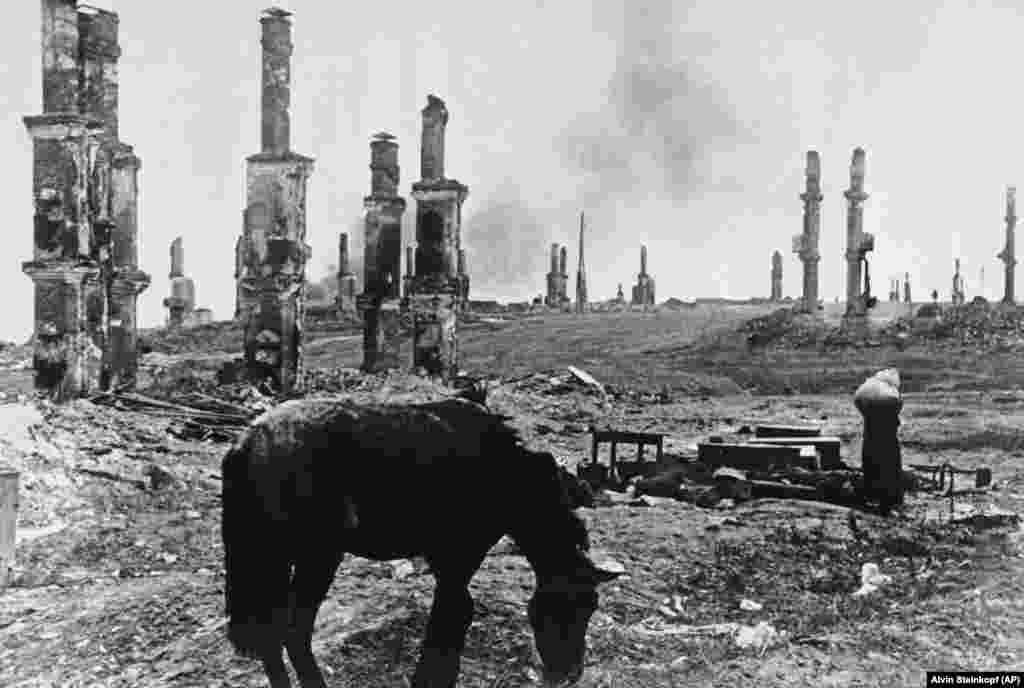
13/15An abandoned horse grazes among the ruins of Stalingrad on December 18, 1942. In the background, at right, Russian women leaving their battered homesteads make their way through the ruins. (AP/Alvin Steinkopf)
The Battle of Stalingrad (August 23, 1942-February 2, 1943) was one of the most brutal and bloody battles of World War II. Germany's disastrously ill-fated attack on the Russian city is widely considered to have been a major turning point in the conflict, as its army suffered massive military losses and a huge psychological blow from which it never recovered.
Show moreShow less
14/15German Field Marshal Friedrich Paulus is pictured after his capture at Stalingrad in early 1943. (TASS/A. Tarantsev)
The Battle of Stalingrad (August 23, 1942-February 2, 1943) was one of the most brutal and bloody battles of World War II. Germany's disastrously ill-fated attack on the Russian city is widely considered to have been a major turning point in the conflict, as its army suffered massive military losses and a huge psychological blow from which it never recovered.
Show moreShow less
15/15"Stalingrad Has Fallen" blares a newspaper the Germans printed in advance in Belgium in 1942. But as underground agents who confiscated the newspapers wrote in the lower left corner: "Mais Stalingrad Tient Toujours (But Stalingrad Stands Eternally)."
The Battle of Stalingrad (August 23, 1942-February 2, 1943) was one of the most brutal and bloody battles of World War II. Germany's disastrously ill-fated attack on the Russian city is widely considered to have been a major turning point in the conflict, as its army suffered massive military losses and a huge psychological blow from which it never recovered.
Show moreShow less
Previous slide
Next slide
Although the victory at Stalingrad was the common achievement of the entire Soviet Union, only Russian military units and Russian flags were seen at the Volgograd celebrations.
The city on the Volga River, some 940 kilometers southeast of Moscow, was called Tsaritsyn under the tsars. Its name was changed to Stalingrad in 1925 by the Soviet government to honor then-leader Josef Stalin.
Putin attends a wreath-laying ceremony at the eternal flame at the Mamayev Kurgan memorial complex in Volgograd on February 2.
It was renamed again in the early 1960s during the political thaw that followed Stalin's death in 1953.
In his remarks, Putin did not mention Stalin. However, the Soviet dictator has seen something of a rehabilitation since Putin took over the Kremlin in 2000.
State media have played up Stalin's role in industrializing the country and winning the war, while playing down his part in Soviet purges, forced collectivization, and gulags.
Polls show that Russian public opinion has become markedly more positive toward Stalin under Putin, although he is reviled across much of the former Soviet Union and the West.
RFE/RL's Russian Service is a multi-platform alternative to Russian state-controlled media, providing audiences in the Russian Federation with informed and accurate news, analysis, and opinion.