




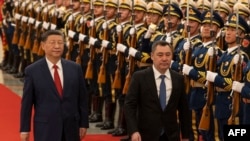
China's expanding role in Kyrgyzstan has become increasingly hard to ignore.
During the first half of 2026, Kyrgyzstan issued some 61,000 work visas, according to the Foreign Ministry's Consular Department, with about 60 percent going to Chinese citizens.
That influx of Chinese workers is part of a wider economic expansion.
Nearly 7,000 Chinese companies, associations, and other organizations have been registered in Kyrgyzstan over the past three years, according to official statistics.

Chinese firms are involved in many of the country's largest infrastructure, mining, and energy projects, some involving leases of state land for up to 49 years.
China is also Kyrgyzstan's largest bilateral creditor. The Export-Import Bank of China holds about $1.6 billion, or 28 percent, of Kyrgyzstan's $8.9 billion external public debt.
In a country of just more than 7 million people where hundreds of thousands leave to work abroad, mainly in Russia, and remittances sustain many households, the arrival of so many Chinese workers has been difficult to accept for many Kyrgyz.
The situation has fueled concerns over jobs, land, natural resources, and national sovereignty, with many ordinary Kyrgyz expressing concerns that the Central Asian nation's leaders are not taking their interests into account.
Small Incidents, Big Reactions
Those concerns have increasingly surfaced online, where even small incidents involving Chinese nationals can quickly become national controversies.
Public discontent flared in recent days after videos of several incidents involving Chinese nationals circulated widely online.
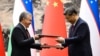
Videos appeared showing Chinese citizens allegedly using electric equipment to catch fish in the protected Arpa highlands. The incident prompted public anger online and calls for authorities to investigate possible violations of environmental rules.
More backlash erupted after footage circulated showing Chinese visitors swimming in restricted areas along the shores of Issyk-Kul, areas where locals are prohibited from entering.
Social media users also shared allegations that Chinese nationals had illegally captured wild birds.

The posts quickly tapped into broader public frustration over what many saw as unequal enforcement of the law and special treatment for Chinese citizens in Kyrgyzstan, turning individual incidents into a wider debate about China's role in the country.
One widely shared Facebook post asked, "Is China taking over Kyrgyzstan?" after publishing registration documents showing that Kyrgyz authorities had registered an organization called the Association for Peaceful Reunification of Central Asia and China.
Comments ranged from concerns about Kyrgyzstan's sovereignty to calls for legal and linguistic review of the claims.
Another widely circulated comment criticized Kyrgyzstan's visa-free regime with China, sarcastically thanking President Sadyr Japarov "for introducing a visa-free regime for the Chinese" and arguing that the policy benefits Chinese visitors while Kyrgyz citizens still require visas to travel to China.
Fuel For Public Frustration
Political scientist Venera Saipidin said she believes the government has failed to address public concerns by providing clear information about Chinese migration and employment.
She said the authorities have not been transparent about how long Chinese citizens remain in Kyrgyzstan after arriving for work, leaving many public questions unanswered.
"The authorities should clearly state how many Chinese have entered and how many have left. Otherwise, vague disputes among the public are intensifying day by day."
Bishkek-based political analyst Kuban Abdymen warned that authorities risk deepening public frustration if they fail to ensure equal enforcement of the law for all foreign nationals.
"The government should take public opinion into account and strictly enforce the law to prevent Chinese citizens in Kyrgyzstan from acting arrogantly or taking matters into their own hands," he said.
The China Taboo
The latest backlash has revived a broader political dispute that intensified last month when activist and politician Mavlyan Askarbekov was detained after criticizing the growing presence of Chinese citizens in Kyrgyzstan, including their involvement in small and midsize businesses. Authorities accused him of inciting ethnic, national, religious, and regional hatred over his social media posts. He remains in pretrial detention.

A day after his arrest, Japarov defended the use of foreign workers for major projects and criticized those who, he said, exaggerated China's role.
"Bloggers, opposition figures and self-promoting populist politicians are creating obstacles by spreading claims such as 'they have flooded in, they have taken over.' We must put an end to this and stop such actions decisively," he said.
"Where we have the capacity, we build ourselves. But for things that we cannot do -- where we lack engineers, experience, or the necessary expertise -- we seek assistance from neighboring countries. If we simply sit and say, 'We will build everything ourselves,' projects built by our engineers would take 15-20 years," Japarov added.
Securitization Of Chinese Investment
While the government has defended Chinese involvement as necessary for development, concerns over how such projects are decided and implemented remain widespread.
Filip Noubel, editor at large at Global Voices and an expert on China and Central Asia, said the disconnect between decision-makers and local communities has fueled resentment around Chinese investment.
"It is all decided with elites in Bishkek who benefit directly and indirectly from such contracts, with little or no consideration of what local communities might think, need, and how, if ever, they can benefit directly economically, or also be affected negatively -- from environmental issues to daily interaction with Chinese workers and colleagues.
"Most importantly, nationalism can be instrumentalized by groups who portray any Chinese investment as a threat."
For Noubel, this environment has contributed to what he describes as the "securitization" of Chinese investment abroad, when the safety of Chinese investors and workers becomes part of official state-to-state security cooperation rather than simply a matter of business operations.
"Such environment explains partially why Chinese companies, often but not always state-owned and embedding themselves in the larger narrative of [the Belt and Road Initiative], seek protection -- legal, physical, political -- and rely on their government to negotiate or impose a diverse set of rules, documents, and best practice that can better ensure their safety, and the safety of their employees."
Forced To Respond
Despite Japarov's efforts to defend China-related policies and criticize their opponents, growing public anger online prompted authorities to respond.
On July 14, officials said they had begun briefing foreign construction workers across the country on complying with Kyrgyz law following a series of incidents involving alleged illegal fishing, hunting, public disorder, and drinking alcohol in public.
The same day, bloggers seen as close to Japarov's administration published what they said was the passport of a Chinese citizen accused of illegal fishing, claiming he had been deported.
Separately, the Justice Ministry confirmed it had revoked the registration of the Association for Promoting the Peaceful Reunification of Central Asia and China, after the organization became the focus of widespread criticism on social media. The ministry did not immediately explain the reasons for its decision.

