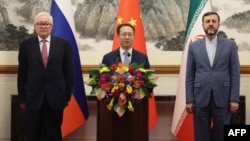
Beijing and Moscow are both close partners of Tehran. With the US-Israeli strikes approaching a third week and Iran retaliating across the region, the conflict is poised to possibly -- and significantly -- affect those ties, the broader roles Russia and China play in the Middle East, and their relations with Washington.
Zineb Riboua is a research fellow with the Hudson Institute's Center for Peace and Security in the Middle East and an expert on Chinese and Russian involvement in the region. She spoke to RFE/RL's Georgian Service about how China and Russia are responding to the war and what they stand to lose or gain.
RFE/RL: How is this war reshaping Beijing's role in the Middle East, its interests, its limits, and perceptions of China across the region?
Zineb Riboua: By attacking Iran, the United States is also indirectly weakening China's posture in the Middle East. For a few reasons, obviously China has a very good relationship with Gulf countries as well has a trade relationship, very transactional, some of them mainly because of the oil.
Obviously for China, it's beyond just [the] Belt and Road initiative and the Digital Silk Road. Why? Because Iran is a very aggressive partner to have. They terrorize the whole region. They have militias. These militias are very useful when you are openly contesting US power in the world, in a very important region due to its energy flows and to its importance.... You want that to happen because it's the only way you can gain a better posture.
There's also the fact that Iran plays a big role in sanctions evasion. China does not want to be a victim of US sanctions and does not want to be in the same position as [Russian President Vladimir] Putin. Using Iran as a way to go around sanctions and financial channels is very important for China, especially when we're thinking about a possible crisis in Taiwan.
Lastly, Iran, because of its geography, is very interesting for China, which is why they had this 25-year cooperation agreement where the Chinese pledged for $400 billion worth of investment -- so that every single thing the Chinese would do would reverberate beyond just the Middle East, but also in Central Asia and other regions.
On many levels, it's very noticeable how China also benefited from a very aggressive Iran, to the point where Iran's own military arsenal was basically built by China --- the missiles, the components, the chemicals, a lot of it came from China. Also, there's the surveillance part, and Iran's own regime is obviously very repressive. They relied heavily on Chinese technology to identify people.
That just tells you the depth of China's involvement in Iran, but also how it spread towards the region. And so, Operation Epic Fury is actually dismantling a lot of this. Because whatever comes next, they will have to be a non-hostile US actor. Otherwise, the United States will not approve it.... So, I think that's a very dangerous thing for China to not have access to a regime that is as willing, as open, as submissive. That, I think, is a big deal.
RFE/RL: What can China realistically do to prevent the loss of this hugely important asset?
Riboua: This is a certain type of asset that is very hard to replicate. It's very hard to just replicate what the Islamic republic was doing. What they are doing right now is adopting a balancing position, condemning Iran's aggression against Gulf countries, because at the end of the day, all these things were actually for China so that they can get access to US allies, especially Saudi Arabia, the UAE, and these countries are very important.
I think they are going to recalibrate, but they will have to look at some other country where they can use it as a laboratory for sanctions and so on. I don't think a lot of countries will be open to doing that. You can see that by the fact that Trump is going not just after the Islamic republic, but also Venezuela, Ecuador, Cuba.
The whole world is going to think twice about dealing with China precisely because China did not help Iran. It did not help Iran during the 12-day war and even now.
RFE/RL: Why didn't China help? If so much riding on it for Beijing, how long can it remain on the sidelines?
Riboua: They did not help and can't help because they see Iran [as] a dying regime. In [Iran], way before the strikes, you could see their inflation rate, youth unemployment, bad water management, incapacity to basically have a monetary policy.... There were all of the indicators that show that it's a dying republic, a dying regime. There is maybe a discussion about whether China basically just decided to do the rational thing, which is to not help a dying regime.
RFE/RL: What would be the cost of that? As you said, other actors are watching -- they're seeing that a strategic ally of China is being dismantled and China is not doing anything. What does that do for China's reputation?
Riboua: China cannot change what is already being done. There is little actually they can do when a military campaign is dismantling every single launcher, ballistic missile.
The military superiority of the Israelis and Americans has been quite extraordinary, to the point where even these leaks and these assessments showing that China maybe is sending targeting [intelligence] to the Iranians will not change the balance of power.
In fact, China helped and sent a lot of weapons prior to that. It's not working.... It's just a reality of it that even if China tries to help, it cannot do much. Other countries are watching, but they are also looking at the fact that Iran is just not popular.
One of the things Iran did was that they were hitting oil infrastructure [of] Gulf countries despite the fact that these very Gulf countries -- for example, Qatar -- played a very good role for Iran as they were transmitting a lot of messaging, etc. And they still hit them. China is basically in a weird position where it cannot totally dismiss the Islamic republic but it also cannot alienate Gulf countries.
RFE/RL: [If] we were to look at possible end games where China loses or where it comes out ahead, is it fair to say anything short of maximalist US objectives -- a US-compliant Iran where Trump gets to say who the next ayatollah is going to be -- would be manageable for Beijing?
Riboua: I think so. If the operation leaves even a spark of hope for the Islamic republic to continue, China can still capitalize on some of the gains because there is already a structure for it. But it will be very hard for China to use Iran as a tool as it used to. Gulf countries [are] already discussing how to expand their security partnership with the US. The security dividend [of] aligning with Israel is already paying off. The UAE, for example, sees that....
There's also a calculus that China was doing for a very long time: that there is a US fatigue with foreign policy intervention, that the United States would just not do anything about deterrence or preemptive action. This operation just breaks that model. It just shows that America is going to do things. And that changes...the thinking of China, [which] actually made a huge bet that the US is in decline.
RFE/RL: The Strait of Hormuz -- its closure, partial closure, or effective disruption -- has emerged as a potential trump card, no pun intended, for Iran. For how long and how effectively can Iran play this card?
Riboua: Not for long. It's a very risky card that can only be played once. And it needs to have the maximum pressure effect on a US president that just sees oil prices increasing and says, OK, we need to stop. But Trump just didn't. He absolutely did not change his posture. He doubled down.... The Iranians were hoping that it would be a huge debate in the United States and trigger some sort of reaction. It just didn't happen, really. I mean, it happened for a day.
RFE/RL: Does that also mean it won't happen if it drags on?
Riboua: I don't think it can drag on precisely because it's harmful for China. China will either directly or indirectly make sure it doesn't go on because it's not just about the oil -- it's also about fertilizers, and [planting] season is happening very soon. So Iran is hurting its own partners in this operation.
I also just don't think they have the necessary military dominance to do so for very long. Every single military operation needs to have a political effect, and it needs to, in this case, happen very fast. It just didn't. So even if they try to continue, the Israelis are still continuing their decapitation strategies. [Iran doesn't] have enough weapons or ammunition to continue. So I'm less pessimistic than many analysts on this one.
RFE/RL: As one of the responses to the Strait of Hormuz closure, a potential seizure of Kharg Island appears to be on the table. And it may not be particularly difficult to take, but how difficult and costly would it be to hold, including political costs?
Riboua: I don't have a good sense of the cost, but what I can say is I think Trump spoke about it in 1988 in an interview, so he's been looking at it for a very long time.... It just actually shows, however, that even if the Iranians accelerate their threats, the US is just doubling down on the operation, that it's escalating so that it can establish deterrence.
This is the real story that matters: that the Iranians have very few options left. And every day they have fewer. So I think they are being cornered.
RFE/RL: How much of a game changer would Kharg Island's capture be?
Riboua: It would be a huge game changer, at least for Gulf countries. It would show the United States is actually willing to follow through every single one of its threats.... It already is, at this point. But yes, if it goes through and it happens, I think it will have a huge effect.
RFE/RL: There's an ongoing debate whether Moscow is winning or losing in this, and one camp points to the degradation of yet another Kremlin strategic partner. The other camp points to higher oil prices and the temporary lifting of sanctions. So which is it, really? Is Russia a winner or loser in this?
Riboua: Russia definitely loses a key partner that was helpful in countering NATO. People, when they think about NATO, they always think about the eastern flank. But the southern flank is as important. And Iran played a huge role in weakening it. The Russians were also in Syria, but in Libya as well. And the Iranians obviously played a big role in that. So because NATO explicitly considers Iran as a threat, I think that it's overall bad news for Russia.
However, [the Russians] kind of decoupled from Iran after what happened in Syria and the fall of Bashar al-Assad. They don't need Iranians in Syria anymore. They're speaking to Al-Sharaa.
They don't need Iran in Armenia or Azerbaijan anymore. It's a US-led coalition right now. Even on the drones, Putin took all the know-how for the drones and transferred it to Russia in a facility in Tatarstan.
Russia is not as dependent on Iran as it used to be, but it was a very critical partner in pushing against NATO.... Obviously, people are talking about the sanctions and how they are making some gains. It's true -- the numbers speak for themselves. However, we have to also take into consideration the fact that Russia's deficit and economy, no matter how much gain they're making, will not cover up for their structural economic failures. They're not in a very good shape. So that's also something to take into consideration because it will be important in negotiations with the United States.
Because of this, the Russians and the Chinese are exploring perhaps wider negotiations or cooperation on energy between Russia and China -- but the Chinese will expose themselves to Russian sanctions. Deepening ties with China will be very difficult to publicly state with a United States that is very adamant to break that.... My personal view is that it depends on what the United States does to make sure that it's a loss for Russia.
RFE/RL: Will there be consequences for Russia providing intelligence support to Iran, even at the level of a slap on the wrist? What we've seen is quite the opposite -- sanctions relief, even if it's temporary.
Riboua: Yeah, I think [the Russians] are doing payback for the United States providing intelligence to Ukrainians. But they also playing with fire because for the last two years -- last year, especially -- they had a Trump that was willing to actually sit down and think about Russian interests.... I think they are closing that window.
RFE/RL: He'll be less inclined to do so?
Riboua: I think so.... Russia showing once more that it is targeting the United States -- I think it will change a lot of the administration's calculus.