




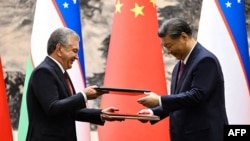
China has surpassed Russia as the biggest direct foreign investor in Central Asia, a resource-rich region that has long been in Moscow’s sphere of influence but is being increasingly courted by Beijing, according to data from the Eurasian Development Bank (EDB).
China’s cumulative direct investment in Central Asia over the past decade exceeded $35 billion in 2025, the EDB said in a report published in December. Founded in 2006 by Russia and Kazakhstan, the bank promotes trade and economic integration among seven former Soviet republics.
During a regional summit in October, Russian President Vladimir Putin said Moscow’s cumulative direct investment in Central Asia, in comparison, was around $20 billion, a figure he admitted was “rather modest.”
Moscow’s investment in Central Asia has dropped since 2022, driven by the economic toll of its full-scale invasion of Ukraine and subsequent Western sanctions. In that time, China has expanded its economic footprint in the region.
Focus On Energy
China, the world’s largest energy importer, has invested heavily in Central Asia’s oil and gas sector even as it expands its investments in clean energy, mining processing, and transit infrastructure in the region.
Kazakhstan and Uzbekistan, Central Asia’s two biggest economies, and energy-rich Turkmenistan have been the main recipients of Chinese investment. The three countries account for about 90 percent of total Chinese capital invested in the region, according to the EDB.
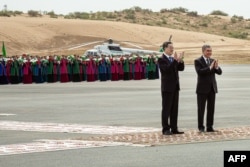
Beijing's largest projects include the state-run China National Petroleum Corporation’s $9.4 billion investment in developing Turkmenistan’s Bagtyyarlyk oil field. Another Chinese state-run company, Sinopec, has invested $2.1 billion in Kazakhstan’s Aqtobe oil field. China Energy, a government-owned company, has invested some $2 billion in new solar power plants in Uzbekistan.
China’s investments in Uzbekistan have surged from $2.1 billion to $10.7 billion over the last five years, outpacing all other countries in Central Asia.
Uzbekistan’s economy is largely based on the export of natural resources, including gold and strategic minerals, as well as agriculture.
Central Asia expert Nargiza Muratalieva said Tashkent has secured Chinese investment in its energy and manufacturing sectors as it attempts to move away from a “raw-materials-based economy.”
“Tashkent is focusing on investment in manufacturing and energy, while climate challenges have made renewable energy and grid modernization a strategic priority,” Muratalieva told RFE/RL’s Azattyk Asia.
In Kyrgyzstan and Tajikistan, Central Asia’s smallest economies, Chinese investment has focused on major infrastructure and energy projects, including transport corridors, logistics hubs, and hydropower development.
Russia Remains A Key Player
Experts say Russia remains an important economic and strategic partner for Central Asia, despite China’s growing investment in the region.
They point to Central Asia’s reliance on transit routes through Russia and the millions of migrant workers employed in the country.
“Almost every household in rural Tajikistan and Kyrgyzstan, and perhaps to a lesser degree in other Central Asian countries, depends on remittances from Russia,” said a university professor in Tajikistan’s northern city of Khujand, who spoke to RFE/RL on condition of anonymity for fear of retribution.
“Moscow remains an important power regardless of its level of financial investment,” the professor added.
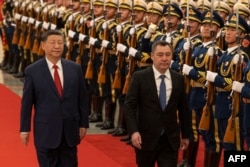
Zhanibek Arynov, an international relations expert in Kazakhstan, said “the notion of competition between Russia and China in Central Asia” is often overstated. Instead, he said, Central Asian countries are attracting investment in their strategic sectors from both countries.

Arynov, though, added that “from a political perspective” it is often easier for Central Asian countries to do business with China.
“Because China’s approach is usually 'business is business,'” he said. “In the case of Russia, however, we sometimes see that Russia cares not only about economic benefits and profits, but also about, for example, the status of the Russian language in the region, as well as other issues related to the domestic politics of these countries.”