




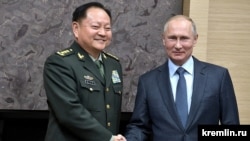
Chinese leader Xi Jinping's decision to place the country's top-ranking general under investigation raises deep questions for China's neighbors about Beijing's ambitions to take control of Taiwan, long-term competition with the United States, and its regional image as a stable power.
The stunning January 24 move to probe his top general and one-time ally Zhang Youxia leaves Xi virtually alone at the top of the country's military hierarchy, and China analysts who spoke to RFE/RL said it holds major implications for succession and Beijing's partners and rivals will be closely watching for further turmoil in the Chinese Communist Party's ranks.
"For decades, China has projected an image that it is a country with long-term plans to project influence and rival the United States as a superpower," Temur Umarov, a fellow at the Carnegie Russia Eurasia Center in Berlin, told RFE/RL. "But this brings lots of questions and doubts about what is happening in China and whether Xi is as in control of his inner circle as he seems."
Zhang, who is now facing a corruption investigation, was China's most prominent military official, serving as vice chairman of the Central Military Commission (CMC), the top military leadership body of the Chinese Communist Party. Through that role, he's played a leading role in China's deepening military partnership with Russia, which has expanded on issues like joint production and missile defense since Moscow's 2022 full-scale invasion of Ukraine.
"Zhang Youxia was central to the Russian relationship," Dennis Wilder, an expert on the Chinese military and former head of China analysis at the CIA, told RFE/RL.
What Happened And Why Does It Matter?
While China's opaque political system makes it difficult to ascertain Xi's precise motivations, Zhang's detention comes ahead of a potential summit in Beijing with US President Donald Trump in April and amid a period of political maneuvering leading up to a once-in-five-year leadership reshuffle in 2027 where Xi is expected to seek a fourth term as leader.
According to a statement from the Defense Ministry, Zhang was placed under investigation for alleged "serious disciplinary and legal offenses."
Liu Zhenli, another general and CMC chief of staff, also came under a probe for the same allegations.
A January 25 editorial published in the army newspaper Liberation Army Daily said Zhang and Liu "seriously betrayed the trust and expectations" of the Communist Party and the CMC and "fostered political and corruption problems that undermined the party's absolute leadership over the military and threatened the party's ruling foundation."
The Wall Street Journal, citing people familiar with a high-level internal briefing about the allegations, reported that Zhang was accused of leaking information to the United States about the country's nuclear weapons program and accepting bribes in exchange for promotions to top military roles.
RFE/RL has not been able to independently corroborate the report.
Some analysts say they're skeptical of the intelligence leak claims. Neil Thomas, a fellow for Chinese politics at the Asia Society Policy Institute's Center for China Analysis, questioned them in a post on X, asking why a "battle-hardened general" like Zhang would "betray everything that gave his life meaning for the last few decades" to pass secrets to China's top rival.

Like Xi, Zhang, a member of the party's elite Politburo, is one of China's "princelings," as the descendants of revolutionary elders and high-ranking party officials are known. Zhang's father fought alongside Xi's father during the Chinese civil war that led to Mao's Communist forces seizing power in 1949, and both men later rose to senior roles.
Zhang is also among the few Chinese generals with combat experience, having fought in the Sino-Vietnamese conflicts in the 1980s.
The probe also adds to a wider purge of top Chinese military officials that has been under way in recent years. From 2023 to the fall of 2025, around 20 generals were purged. Six were from the Rocket Force, which controls China's arsenal of land-based missiles, both nuclear and conventional.
Following those removals, and Zhang and Liu now being placed under investigation, the seven member CMC is down to just one active uniformed officer and two standing members in total, with the other being Xi himself.
What Does It Mean For China's Neighbors?
The episode with Zhang -- China's most powerful general and one of the few people with the influence to oppose any of Xi's succession plans -- raises questions about the level of discontent within the ranks of China's elite.
That's certainly on the radar of Beijing's regional partners in Central Asia who see China's political system as a beacon of stability and one resistant to some of the elite upheaval that Central Asian governments have faced since the collapse of the Soviet Union.
"This purge and the sense of instability it brings will be on the minds of Central Asian decision-makers," Umarov told RFE/RL.
Zhang routinely met with top leaders around the world, making high-profile visits to the United States over the years and engaging with officials from Pakistan to Vietnam. He was also the co-chairman of the Russian-Chinese Intergovernmental Commission for Military-Technical Cooperation and made multiple visits to Moscow to meet with top officials, making his last visit in November to meet with Russian Defense Minister Andrei Belousov.
Umarov argues the move is unlikely to affect security cooperation with China's neighbors, which he said has become "institutionalized" over the years and takes place on multiple levels, from policing to arms sales.
Wilder, who was also a top White House China adviser to former US President George W. Bush, says that "all around the region, people are going to take a fresh look at the question of succession in China."
"This adds a dimension that hadn't been there before for concern," he said. "China's neighbors will be watching very closely how we will be filling the empty seats on the [CMC]."
What Does This Mean For Taiwan?
The move also comes with potential implications with its neighbors in the Pacific, particularly Taiwan, the self-governing democracy that China views as its own territory.
Analysts say Zhang's removal could affect China's military readiness and future ambitions toward Taiwan. Xi has repeatedly called unification with the island as "unstoppable" and vowed to take the island by force if necessary.
At the end of 2025, China launched some of its biggest military drills around Taiwan so far and China regularly sends jets and ships into Taiwan's airspace and waters to test its resolve.
"We will continue to closely monitor abnormal changes among the top levels of China's party, government, and military leadership," Taiwan Defense Minister Wellington Koo told reporters on January 26. "We won't let the downfall of any one person make us lower our guard or slacken the level of war preparedness we should maintain."
Drew Thompson, a former Asia strategist at the Pentagon now at the S. Rajaratnam School of International Studies at Nanyang Technological University in Singapore, said that purge also raises implications for Taiwan and the United States, which is Taipei's main backer and provides it with vital military support.

"For a US deterrence strategy to be effective we need Xi Jinping to be surrounded by competent generals who will give him objective advice," Thompson wrote in his newsletter.
Thompson said Xi's consolidation of the CMC comes with "operational risks of Xi being advised by and trying to command a million-man army through a one-man committee" and that he worries "about the consequences of someone other than Zhang Youxia providing Xi Jinping with military advice."
"Without Zhang Youxia on the CMC, the risk of miscalculation goes up," he added.