





More than a month after a pair of attacks killed five Chinese nationals working at a gold mine near Tajikistan's remote border with Afghanistan, questions remain over what led to the high-profile incidents that could reshape both countries' relations with China.
Authorities in Afghanistan and Tajikistan moved quickly to say that the security situation along their volatile border was under control following the events. Those include a November 26 attack launched from Afghanistan that left three Chinese nationals dead where assailants used a drone equipped with firearms and grenades and a November 30 incident where two Chinese roadworkers were shot dead. Five other Chinese workers were wounded in the attacks.

Relations with China are crucial for both countries. Amid biting sanctions and international isolation, the Taliban has chased Chinese investment since it retook power in 2021, while China is Tajikistan's largest trade partner, foreign investor, and lender, with Beijing owning more than half of Dushanbe's foreign debt.
Following the attacks, China's ambassadors in Dushanbe and Kabul pressed Tajik and Taliban authorities to ensure safety and prevent a disruption in their bilateral ties. Mounting instability along the shared border could jeopardize relations with Beijing and make Chinese firms less willing to operate and invest in both countries, something that some experts believe could be a motive behind the attacks.
"These incidents will raise concerns in China around the Taliban and Tajikistan's ability to maintain control in the country and ensure the safety of foreign investors," Edward Lemon, a Central Asia expert at Texas A&M University, told RFE/RL. "China is concerned about the security of its citizens. While there are rewards from mining in this unstable area, the risks are also high."

No group has yet claimed responsibility for either assault and the motives are unclear, but following the initial attack in Tajikistan's southwestern Shamsiddin Shohin district, Tajik authorities blamed drug smugglers and criminal groups. The Taliban has since claimed publicly that two individuals have been arrested on suspicion of involvement in the attacks.
"So far, it's not clear which country they're from. Information is still incomplete," a senior Taliban official told Radio Azadi, RFE/RL's Afghan Service, speaking on condition of anonymity to discuss an ongoing investigation. "We believe certain groups that want to harm Afghanistan's relations with other countries could be behind such incidents."
Chinese Gold Mining And Tensions Along The Afghan-Tajik Border
The growth of Chinese mining along the Panj River, which marks the border for both countries, adds to an already volatile mix in the region.

The area that stretches along both banks of the river in Afghanistan and Tajikistan is a well-known drug smuggling route where Tajik security forces have repeatedly conducted operations in recent years, but have not been able to fully control the area or enforce the border due to a lack of roads and difficult geography.

Clashes along the volatile border are also not uncommon, with Taliban fighters and Tajik border guards sometimes exchanging gunfire amid lingering tensions between Dushanbe and the Taliban since the group took Kabul in 2021.
Two separate Tajik border officials in Khatlon Province, which contains the district where the attacks on Chinese workers took place, told RFE/RL's Tajik Service that at least three border incidents this year stemmed from disputes over water from the Panj River being redirected due to gold mining on both sides of the border.
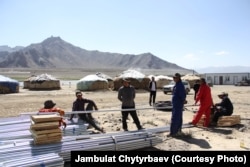
The officials said that a week before the first attacks on Chinese workers, there had been a verbal dispute between employees of gold companies on both sides of the river.
"The [Afghan side] wanted to divert the flow of the Panj River to their direction, as the land where they mine gold was flooded, but the Tajik side said they could not do this, as their own gold mining land on the bank would be flooded," one of the officials said, who asked to remain anonymous to avoid reprisals for speaking to the media.
Shohin SM, the mining company where the slain Chinese workers were employed, is a joint Tajik-Chinese firm that was founded in 2020 and has been active on the banks of the Panj River since 2023.
Whether the mining operations are part of the motivations behind the attack are unclear, but a Chinese national was also killed and five others were injured in the same area in November 2024.
What Triggered The Attacks?
Amid this uncertainty, attention has turned to how the Taliban and Dushanbe intend to prevent similar attacks.
In the aftermath of the attacks, the foreign ministers of Tajikistan and the Taliban government spoke over the phone in a sign of their diplomatic thaw. A few days earlier, the Chinese embassies in Dushanbe and Kabul urged its citizens to leave border regions immediately.
In their readout from the December 2 call, both ministers condemned the killing of Chinese nationals and promised to boost border security.
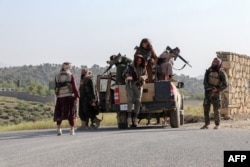
Zabihullah Amiri, a spokesperson for the Taliban governor in Badakhshan, the Afghan province that borders the area of the attacks, told Radio Azadi -- without explicitly referring to the recent incidents -- that plans were being drawn up to establish a large military unit specifically for mining areas.
"There is some disorder around the mines. Armed groups operating outside the government interfere heavily in mining operations, which can spark disputes," Amiri said. "The government has therefore decided to create an organized force, possibly absorbing those already guarding the mines and recruiting unemployed youth."
He added that the new units would help prevent clashes along the border, where "irresponsible armed groups" could cause instability.
Both drug trafficking and extremist groups operate in the shared border regions.
Who Could Have Carried Out The Attacks On Chinese Workers?
Speaking at a December 10 UN Security Council meeting, Fu Cong, China's UN ambassador, called on the Taliban to investigate killings of Chinese nationals near the Tajik-Afghan border and strengthen border security with Tajikistan.
Fu took specific aim at militant and terrorist groups like Islamic State (IS), Tehrik-e-Taliban Pakistan (TTP), and the East Turkestan Islamic Movement (ETIM), a Uyghur militant group whose size and scope is debated by experts .
Lucas Webber, a senior analyst at Tech Against Terrorism, a research group monitoring terrorist activity, told RFE/RL that the culprits of the attack are still unknown, but it's unclear whether the narrative of traffickers mentioned by the authorities adds up.
"Smugglers have ample motive to resent Tajik border forces and may possess or access small drones, yet their business model depends on stealth and low visibility, not high-profile attacks that trigger security crackdowns and international scrutiny," he said.
"If revenge on Tajik forces were the core aim, border posts or patrols would be more logical targets than foreign workers at a fixed camp," Webber added.
Webber says that the cross-border attacks on Chinese in Tajikistan highlight how "crowded and murky the militant and criminal ecosystem in northern Afghanistan has become."
According to the United Nations Security Council's 2024 Analytical Support and Sanctions Monitoring Team report , several jihadist groups remain active in Taliban-ruled Afghanistan including Islamic State – Khorasan Province (IS-K), Al‑Qaeda, the Turkistan Islamic Party (TIP) and Jamaat Ansarullah.
Webber believes that IS-K is an unlikely perpetrator because the group generally claims its attacks, but has been silent in the case of the incidents targeting Chinese workers despite these assaults being "ideal material for its media" and serving "its propaganda goals."
He also considers the Turkistan Islamic Party (TIP) an unlikely actor. TIP is an extremist group Beijing blames for unrest in Xinjiang and still refers to as ETIM, which is the name of an older militant group that many experts believe may no longer be operational and whose impact has been exaggerated by China for political purposes.
TIP members are in Afghanistan, but Webber says the group is "formally under Taliban pressure," since the Taliban have promised China and neighboring states that they will not allow TIP to launch external attacks.

Jamaat Ansarullah, a Tajik jihadist group based in Afghanistan, "fits both the geography and political logic of the attacks unusually well", Webber said.
"Striking Chinese workers in Tajikistan could simultaneously embarrass the Tajik government, complicate the Taliban-Tajik rapprochement, and shake Chinese confidence in both partners, all without the group needing to openly claim responsibility," he added.
Another plausible possibility, Webber says, is that local Taliban units, or mixed groups of Taliban and foreign fighters, carried out the attacks without approval from Taliban leadership.
Webber says that the lack of a clear claim of responsibility complicates how regional authorities can deal with the situation.
"Strategically, this ambiguity complicates the response for Tajikistan, China, and the Taliban authorities," he said.
"Any premature accusation risks political fallout or misdirected countermeasures, while waiting for more evidence or a clear claim of responsibility prolongs uncertainty and leaves Chinese nationals exposed to further attacks."