



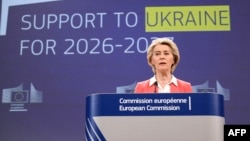
The European Commission has formally unveiled a 90-billion-euro ($105 billion) loan for Ukraine, intended to cover a large part of Kyiv’s financing needs for the next two years.
The move comes on January after EU leaders in December opted for a loan backed by the EU budget instead of a much-publicized “reparation loan” using frozen Russian assets in the bloc as a collateral.
Last year, the International Monetary Fund (IMF) estimated that Ukraine would need around 135 billion euros ($158.3 billion) in financing for 2026 and 2027, with Kyiv already facing a budget shortfall of 71.7 billion euros as early as this spring.
The EU has committed to covering a large share of that gap, particularly as the United States has signaled it will scale back financial support for the war-torn country.
Speaking in Brussels during the announcement, European Commission President Ursula von der Leyen said that the loan “reaffirms Europe's unwavering commitment to the security, defense, and future prosperity of Ukraine”, adding that the Kremlin’s recent missile barrages over Ukraine indicates that “Russia shows no sign of abating. No sign of remorse. No sign of seeking peace. On the contrary. “
The first tranche of the loan could be paid out in April, if EU member states and the European Parliament give the green light in the coming weeks -- a step widely expected to be a formality. Ukraine will not have to repay the loan until Russia begins paying reparations for war damage.


The funds will be raised by EU countries jointly borrowing on financial markets, backed by what Brussels calls EU budget “headroom” -- the gap between the bloc’s maximum borrowing capacity under its long-term budget, which runs until 2027, and its actual spending levels. The EU used a similar mechanism in 2024 to raise 50 billion euros ($58 billion) for Ukraine, which has been used over the past two years.
This time, however, the Czech Republic, Hungary, and Slovakia have all secured carve-outs meaning that this is a deal involving 24 EU countries, not 27.
Of the 90 billion euros, 30 billion ($35 billion) should go to budgetary support, conditional upon rule-of-law reforms and anti-corruption measures. Sixty billion euros ($70 billion) will go to military spending.
Much of the debate ahead of the announcement focused on what conditions would apply to arms procurement, with Brussels keen for the money to be spent primarily on European-made weapons.
In the end, a compromise was reached whereby the money will be going to Ukrainian or other European countries’ weapons production but purchases from outside Europe will be allowed if no viable alternatives exist, with Von der Leyen confirming a policy of “European preference first, and then if not possible, purchasing abroad.”