


The EU has warned Bosnia that designating a private US company as the main investor in a planned gas pipeline, aimed at ending four decades of dependence on Russian gas imports, could undermine the its EU accession and put access to aid from Brussels at risk.
In a letter dated April 13, the EU ambassador to Sarajevo, Luigi Soreca, warned that legislation adopted specifically for the gas pipeline project (lex specialis) could jeopardize Bosnia's access to the European energy market, as well as about 1 billion euros ($1.16 billion) in funding under the EU Growth Plan for the Western Balkans.
The Bosnian Federation, an autonomous region, adopted amendments to the law designating the private, US-based company AAFS Infrastructure and Energy as the investor and developer of the project.
A spokesperson for the EU Delegation told RFE/RL that any energy-sector legislation must remain consistent with Bosnia's accession obligations and should be submitted for review under EU procedures, and that any other interpretation of this letter is wrong and misleading.
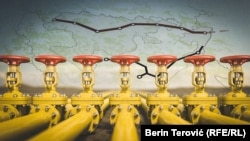
The Southern Interconnection is a planned gas pipeline intended to link Bosnia with Croatia's gas network and the liquefied natural gas terminal on the island of Krk.
The terminal is a key EU-backed infrastructure hub aimed at reducing reliance on Russian energy supplies.
Bosnia imports virtually all of its gas from Russia via pipelines running through Serbia and Bulgaria along the TurkStream route.
Annual imports total roughly 225 million cubic meters, according to national statistics, with payments to Gazprom estimated at around 75 million euros ($87.7 million) per year.
The EU has announced plans to end imports of Russian gas by January 2028, increasing pressure on states dependent on Russian supply routes.
Bosnia, although not an EU member, is directly affected because its energy infrastructure is integrated into the EU.
Under the amended legislation, the Southern Interconnection would be implemented through AAFS Infrastructure and Energy d.o.o., a company founded in November 2025, registered in Sarajevo, and wholly owned by the US firm.
According to company and project disclosures, the director of AAFS Infrastructure and Energy is Jesse Binnall, a former member of US President Donald Trump's legal team, while Vice President Joseph Flynn is the brother of former US National-Security Adviser Michael Flynn.
Binnall said at a press conference with Bosnian Energy Minister Vedran Lakic on April 2 that the Southern Interconnection was "one of the priority projects for the Trump administration. "
The US Embassy in Sarajevo has publicly supported the project and hosted meetings between Bosnian officials and company representatives.
John Ginkel, the top US diplomat in Bosnia, wrote on X after the first meeting in December that Washington was "ready to act quickly to back the Southern Interconnection" and that the Bosnian legislation "was expected to be adopted by spring 2026 so construction could begin."
He also referenced discussions in November in Athens involving US Interior Secretary Doug Burgum and Energy Secretary Chris Wright, who said American efforts were under way to reduce Europe's dependence on Russian gas.
On February 24, in Washington, Bosnia joined the American initiative to strengthen the region's energy supply.
Bosnia's foreign minister, Elmedin Konakovic, welcomed US interest in the project, RFE/RL's Balkan Service after the Washington meeting that "it was economically significant for the country."
The EU has raised concerns about governance, market structure, and compliance with internal energy market rules. European legislation argues that the legal framework "must ensure transparency, competition and open access to infrastructure," rather than granting exclusive control to a single operator.
The Energy Community, which extends EU energy market rules to Western Balkan countries, requires liberalized markets, independent system operators, and "nondiscriminatory third-party access to infrastructure."
"To maintain momentum in the EU accession process, it is essential that any legislative developments in the energy sector contribute to fulfilling Bosnia and Herzegovina's obligations," Soreca wrote to Borjana Kristo, chair of the Council of Ministers, and Nermin Niksic, prime minister of Bosnian Federation.
A European Commission spokesman, Guillaume Mercier, told RFE/RL the EU's position is intended to support Bosnia's integration process and ensure compliance with agreed reforms.
"Bosnia has an obligation to submit draft laws to the relevant services of the European Commission, including those in the energy sector," Mercier said.
Bosnia, as a member of the Energy Community, has previously faced sanctions within the framework for failing to meet its obligations, including the suspension of its voting rights.
Neither AAFS nor the Bosnian government has commented on the EU's latest assessment or responded to repeated inquiries from RFE/RL over recent months.
Bosnia was granted EU candidate status in 2022, and accession negotiations were formally opened in March 2024. However, progress remains conditional on judicial, constitutional, and regulatory reforms, including alignment with EU energy and climate policy.
Bosnia operates a single gas entry point and lacks supply diversification. It also relies heavily on coal-fired power plants for roughly 80 percent of electricity generation, many of which are more than four decades old.
The proposed Southern Interconnection would create Bosnia's second gas supply route by linking it to Croatia's network and, through it, to the Krk LNG terminal.
The new law adopted specifically for the project also removed a previous provision assigning state-owned company BH-Gas as project developer.

Government officials have argued that bringing in a foreign investor would accelerate implementation.
Audit reports citing BH-Gas's limited financials have suggested the state-owned company is unable to finance a project estimated at 1 billion euros.
Lakic said in March that the US investor would finance the project, select contractors, and had expressed interest in developing gas-fired power plants and obtaining concessions for airports in Sarajevo and Mostar.
Despite its strategic framing, analysts caution that infrastructure alone does not guarantee supply diversification.
"Countries seeking to reduce dependence on Russian gas must also secure reliable supply contracts," Sophie Corbeau of the Center on Global Energy Policy in Paris told RFE/RL.