




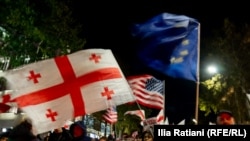
The European Union is set to follow through this month on a plan to suspend visa liberalization for all Georgian diplomatic and service passport holders after saying Tbilisi has “violated numerous commitments undertaken during the visa liberalization dialogue.”
The European Commission hinted the move was imminent when it issued its annual report on December 19 on how countries that enjoy visa liberalization with the bloc have fared on a number of issues.
The Georgia assessment was scathing, with Brussels slamming Tbilisi’s controversial legislation on “transparency of foreign influence” and “family values and protection of minors," noting that “in most areas, no corrective measures were reported and, in several others, the situation has further deteriorated.”
While Brussels will suspend part of the visa-free regime due to democratic backsliding, other issues were also highlighted in the report, including a lack of alignment with EU visa policy for those from some third countries.
The report notably highlights the growth of the Russian diaspora in the South Caucasus country, with the document stating that 160,000 Russian citizens have emigrated there since Russia's full-scale invasion of Ukraine nearly four years ago.
“There is an increasing concern that Russian presence in Georgia may be exploited to carry foreign influence operations. Another area of concern is the potential misuse of Georgian citizenship, especially when obtained via simplified naturalization procedures by Russian nationals,” the text states, adding: “Such cases raise both illegal migration risks and broader security implications for the EU.”
Other complaints include Georgian nationals “remaining illegally in the EU to access medical care or to apply for asylum on medical grounds,” as well as the lack of progress on anti-corruption measures such as the need for a dedicated asset recovery office or the recent gutting of the anti-corruption bureau.
There are, in other words, quite a few reasons for the European Commission to make use of the suspension mechanism. And with new European legislation entering into force at the end of 2025, making it easier to trigger the mechanism, the EU executive is wasting no time.
One of the changes is that the commission in theory can decide on its own to suspend the visa-free regime for certain passports. It will, however, still consult with the 27 EU member states and a vote will be held.
The process is known as an “implementing decision,” meaning that the European Commission will start by presenting a legal act. This document can be already ready by the week that started on January 12, sources told RFE/RL.
Then something known in the EU as “comitology” begins. This means that a specific “comitology committee” will convene at a yet unknown date. All EU member states are represented here, and the European Commission should then ask for a formal opinion on the act in question.
This formal opinion usually takes the shape of a vote that isn’t legally binding but tends to be respected. If a qualified majority of the 27 capitals (55 percent of EU countries representing 65 percent of the total EU population) vote in favor of the proposed implementing act, it is adopted.
It is widely believed among EU diplomats that RFE/RL has spoken with that such a majority exists. To prevent the act from becoming valid, a qualified majority must vote against whereas the European Commission must come back with a revised act if there isn’t a qualified majority either for or against.
The timeline is not yet known but the vote is likely to take place in January. There is, however, a visa working party on January 23 in the council where home affairs experts of all the member states sit. They expect that they will get a briefing from the European Commission on the road ahead on this issue.
While suspending visa liberalization is very rare, the European Commission has taken a lighter version by just targeting diplomatic and service passports, not the entire Georgian population. And while Brussels has hinted that this might be the next step if things don’t improve, few EU member states have so far shown any desire to go for a blanket suspension.
This also means that the step is largely symbolic as all diplomats and bureaucrats also have regular passports they can travel on.
In many ways, the move is a way to tighten an EU decision made in early 2025 when the bloc decided to suspend parts of a visa-facilitation agreement with Georgia, meaning that Georgian diplomats had to apply for visas to travel to the EU member states that decided to implement the decision.
Nineteen out of 27 have so far done so. With the impending suspension of visa liberalization for diplomats and other officials, all 27 will have to carry out the decision.