



Accessibility links

Breaking News

News

Updated

EU Commission Chief Unveils Mandatory Migration Crisis Plan

European Commission President Jean-Claude Juncker announces a quota plan for refugees as he makes his State of the Union address to the European Parliament in Strasbourg on September 9.

European Commission President Jean-Claude Juncker has unveiled an emergency plan for dealing with Europe's biggest influx of migrants and asylum seekers since World War II.

Delivering his first EU state-of-the-union speech to the European Parliament on September 9, Juncker outlined a proposal for a compulsory program to relocate across the European Union a total of 160,000 refugees who are currently in Greece, Hungary, and Italy.

Juncker said the program would involve mandatory quotas on the number of refugees, mostly from Syria, that each EU country should host.

He said the program would expand on a proposal made by the European Commission in May for the relocation of 40,000 refugees in Italy and Greece -- adding an additional 120,000 refugees to the program.

"We are not talking about 40,000," Juncker said. "We are not talking about 120,000. It’s 160,000. That’s the number Europeans have to take in charge and have to take in their arms."

"This has to be done in a compulsory way," Juncker said, urging EU member states to support the plan at a meeting of EU interior ministers scheduled for September 14.

Juncker said the EU should create a "permanent relocation mechanism" that would allow national authorities to deal with refugee crises more swiftly in the future.

"Where Europe has clearly under-delivered is on common solidarity with regard to the refugees who have arrived on our territory," Juncker told the European Parliament.

"To me, it is clear that the member states where most refugees first arrive -- and at the moment, these are Italy, Greece, and Hungary -- cannot be left alone to cope with this enormous challenge," he said.

Germany, the main destination for many migrants, supports quotas. But some EU countries such as Hungary, a key point on a migrant route, oppose a compulsory system.
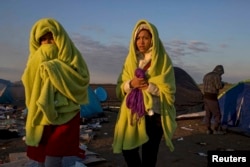
Migrants wrap themselves in blankets to warm up as the sun rises at a collection point in the village of Roszke, Hungary, on September 9.

After Juncker's speech, Slovakia's Foreign Minister Miroslav Lajcak repeated Bratislava's rejection of proposals on how many migrants must be taken by each EU member state.

He said Slovakia also opposed giving the Europe Commission too much power in dealing with the refugee crisis.

Czech Prime Minister Bohuslav Sobotka said Prague also opposed mandatory quotas, but he welcomed the commission’s plan to put more focus on long-term measures to deal with increasing numbers of refugees reaching its borders.

Sobotka reacted to Juncker’s speech by saying that Europe neeed to implement measures that it already has agreed upon in recent months, rather than drafting new plans.

Another proposal by the European Commission is to create what Juncker called a "list of safe countries" that would allow national authorities in each EU member country to more quickly streamline their efforts to cope with the unprecedented flow of refugees arriving in Europe form war-torn Syria.

"The list of safe countries is only a procedural simplification," Juncker explained. "It cannot take away, and I would act strongly against that, the fundamental right of asylum for asylum seekers coming from Albania, Bosnia and Herzegovina, the former Yugoslav republic of Macedonia, Kosovo, Montenegro, Serbia, and Turkey," Juncker continued.

"But it allows national authorities to focus on those refugees which are much more likely to be granted asylum -- notably those from Syria," he said. "And this focus is very much needed in the current situation."

Juncker also said countries on the proposed safe list would be obliged to maintain a good record on human rights.

"The countries being on the list of safe countries have to know that if they are taken off of this list because fundamental rights would not be ensured in these countries, they are losing their chance to join the European Union," Juncker warned. "These two things are going together."

Juncker also announced that the European Commission would propose an integrated legal migration policy early in 2016 that opens legal channels for migrants.

He said that migration policy would discourage human smuggling by criminal organizations and reduce the number of tragedies involving ships and trucks that smuggle migrants illegally.

Juncker also argued asylum seekers should be given the right to work and earn money in their host countries while their asylum applications are being processed.

He vowed that the European Union's borderless Schengen system "will not be abolished" under the mandate of the current European Commission.

But he said EU member countries in the Schengen area must work more closely together in order to manage their internal borders.

Juncker said Europe had seen an influx of nearly 500,000 migrants and refugees since the start of 2015, including those from the Middle East and Africa.

With reporting by Reuters, AP, AFP, and BBC

All Of The Latest News

Russian Media Regulator Blocks Website Of Britain's Telegraph

Russia's media regulator, Roskomnadzor, has blocked the website of Britain's The Telegraph daily as Moscow attempts to control the flow of information related to its unprovoked invasion of Ukraine.

According to Roskomsvoboda, a group that promotes uncensored online media in Russia, the decision was made in April at the request by the Prosecutor-General's Office, which considered one of the periodical's articles "fake." The decision only took force on June 20, it said.

Roskomsvoboda added that online materials from The Telegraph are now available only via subscription.

According to web-monitoring group GlobalCheck, The Telegraph is accessible in Russia only through a virtual private network (VPN).

Roskomnadzor has not explained the move.

Roskomsvoboda says that since Russia invaded Ukraine on February 24, Moscow has blocked more than 2,300 websites, including those of RFE/RL's Russian Service, Current Time, Voice of America, Deustche Welle, Bild, and Meduza.

Also, on June 20, Russia's Justice Ministry added the organization First Scientific to the registry of "foreign agents."

The ministry explained the move by saying the organization was established by noted blogger, showman, and historian Yevgeny Ponasenkov, who was already labeled a "foreign agent."

Ponasenkov has harshly criticized the Russian government over its war against Ukraine.

First passed in 2012, Russia's "foreign agent" legislation initially targeted nongovernmental organizations accused of having received foreign funding. But it has undergone numerous modifications to include foreign media organizations as well as individuals.

Human Rights Watch has criticized the legislation -- which subjects those blacklisted to restrictions, fines, and bans -- as "restrictive" and intended "to demonize independent groups."

Russia Says Now Broadcasting Throughout Ukraine's Kherson Region

Russian soldiers stand next to their trucks during a rally against Russian occupation in Kherson on March 7.

Russia says it has reconfigured communications infrastructure in Ukraine's Kherson region and is now broadcasting Russian television channels to the region as Moscow continues to impose control on the southern area near Crimea.

"Specialists of the communication units of the Armed Forces of the Russian Federation connected and reconfigured the last of the seven television towers in the Kherson region to broadcast Russian television channels," Russia's Defense Ministry said in a statement on VKontakte.

"Connecting the seventh tower has extended the broadcasting network across the entire region and made it possible to transmit 24 Russian television channels across its entire territory," the ministry added.

Russia gained control of Kherson, located just north of annexed Crimea, shortly after it launched its invasion of Ukraine in February and later installed a Moscow-friendly administration.

Since April it has been broadcasting to some parts of Kherson region.

The war prompted thousands of local residents to flee Kherson for Ukrainian-controlled territory and Russia has since placed Federal Security Service officers brought in to help maintain control of the region in apartments belonging to those who left, according to Serhiy Khlan, deputy chief of the Kherson regional council in exile.

Player Avoids Wimbledon Ban By Switching Nationality To Georgian

Natela Dzalamidze takes part in the French Open in Paris in 2019.

A Moscow-born women's tennis player has avoided Wimbledon's ban on Russian and Belarusian players by changing her nationality to Georgian.

Natela Dzalamidze, 29, is listed as being from Georgia in Wimbledon's roster for the women's doubles event. Her nationality is Georgian on the Women's Tennis Association tour's website.

Dzalamidze is currently ranked 43rd in doubles. She will play with partner Aleksandra Krunic of Serbia at Wimbledon, which begins on June 27.

The All-England Lawn Tennis Club (AELTC) said in April it would not allow players from Russia or Belarus to compete at the grass-court tournament this year because of the war in Ukraine.

The AELTC said it had no involvement in a player’s change of nationality.

"Player nationality, defined as the flag they play under at professional events, is an agreed process that is governed by the tours and the ITF [International Tennis Federation]," a spokeswoman for the AELTC said in an e-mail message quoted on June 19 by news agencies.

Wimbledon has been stripped of its ranking points by the men's and women's tours over its decision to exclude players from Russia and Belarus.

No other Grand Slam tournament has followed Wimbledon's lead. The U.S. Tennis Association, sponsor of the U.S. Open in New York, said earlier this month that Russian and Belarusian players would be allowed to compete at the U.S. Open under a neutral flag.

Wimbledon's ban has ruled out several top players, including Russian Daniil Medvedev, the men's world No. 1 and winner of the 2021 U.S. Open, as well as two-time major winner and world No. 20 Victoria Azarenka of Belarus.

With reporting by Reuters, AP, and AFP

Citing Threat From Russia, Canada Announces Major Investment In Air Defense

Canadian Defense Minister Anita Anand attends a ceremony to lay flowers at a memorial to fallen defenders of Ukraine in Kyiv on January 31.

Canada has announced a major investment to modernize the North American Aerospace Defense Command (NORAD), the joint U.S.-Canadian defense organization designed to detect security threats.

Defense Minister Anita Anand cited growing threats from Russia and new technologies as she announced the C$4.9 billion ($3.8 billion) upgrade plan on June 20.

The spending will roll out over the next six years and upgrade the aging Cold War-era North Warning System, whose radar stations from Alaska to northern Quebec are incapable of responding to modern missile threats.

The funds are to be spent on land- and satellite-based radar that can spot incoming bombers or missiles "over the horizon," as well as a network of sensors capable of monitoring Arctic air and sea approaches to the continent.

The new spending represents "the most significant upgrade to NORAD from a Canadian perspective in almost four decades," Anand said at a news conference at Canada's largest air base in Trenton, Ontario. It will push the "line of sight" farther to the north, "ensuring that we will be able to respond to fast-moving threats."

Anand cited Russia's invasion of Ukraine and as one of the reasons the investments are coming now.

"As autocratic regimes threatened the rules-based international order that has protected us for decades, and as our competitors develop new technologies like hypersonic weapons and advanced cruise missiles, there is a pressing need to modernize Canada's NORAD capabilities," Anand said.

Canada's Arctic region represents about 40 percent of its total landmass. Much of Russia's Arctic area, which is about one-fifth of its landmass, faces Canada and Alaska.

With reporting by AFP, Reuters, and AP

Unrest In Iran Continues As Workers Strike Over Worsening Conditions

A view of Mahmoudabad

Workers in the industrial town of Mahmoudabad in Isfahan continued their strike for a third consecutive day as a wave of unrest across Iran over living and work conditions shows no signs of letting up.

Truck drivers in Tehran rallied in the capital on June 20, while more than 300,000 stone factory workers in the industrial town of Isfahan remained off the job despite threats from authorities.

Sources quoted officials as saying the decision to strike in Isfahan was announced last week in a speech by a union leader who was arrested by security forces afterward.

Two days later, under duress, he called for an end to the action, but was ignored, with many workers and others joining together in protest.

At the same time in Tehran, truck drivers gathered in front of the Road Administration building on June 20 with social media reports showing several had spent the night.

A heavy law enforcement presence was seen at the site during the day.

Labor protests in Iran have been on the rise in response to declining living standards, wage arrears, and a lack of insurance support. Labor law in Iran does not recognize the right to form independent unions.

At the same time, pensioners and other groups have been protesting in recent weeks against economic conditions, blaming the government for spiraling inflation and failing to deliver on promises to increase wages and improve living conditions.

With writing and reporting by Ardeshir Tayebi
Updated

Russians Inflicting 'Catastrophic' Damage In Lysychansk As Offensive Intensifies

Smoke from artillery strikes rises over damaged buildings amid fighting in Toshkivka, in Ukraine's Luhansk region, on June 19.

Russian forces have caused "catastrophic" damage as they continue to bombard Lysychansk and its twin city of Syevyerodonetsk in eastern Ukraine, where the situation has become "extremely difficult," Ukrainian officials say, as Moscow intensifies its offensive in ahead of an EU decision on granting Ukraine candidate status.

"Fighting in the Syevyerodonetsk industrial zone and catastrophic destruction in Lysychansk," the Luhansk region's military governor, Serhiy Hayday, said in a statement on social media on June 21, adding that Lysychansk had suffered from heavy Russian strikes over the previous day.

Ukrainian forces continue to defend Lysychansk and Syevyerodonetsk, where the most intense fighting is taking place, Hayday said.

Live Briefing: Russia's Invasion Of Ukraine

RFE/RL's Live Briefing gives you all of the latest developments on Russia's ongoing invasion, how Kyiv is fighting back, the plight of civilians and refugees, and Western aid and reaction. For all of RFE/RL's coverage of the war, click here.

Earlier, Hayday said on national television that Russian forces controlled most of Syevyerodonetsk but not the Azot chemical plant, where hundreds of civilians have been sheltering for weeks. He said the road connecting Syevyerodonetsk and Lysychansk to the city of Bakhmut was under constant shellfire.

"Lysychansk has been suffering from massive Russian shelling all day. It is impossible to establish the number of casualties as of yet," he said, adding that the shelling has been perhaps the heaviest the city had yet experienced.

However, the Russians have failed so far to complete an encirclement of Ukrainian forces, who were inflicting "significant losses" on them, he said.

While Russia has been concentrating its firepower on the Donbas, advanced Western weapons systems donated to Ukraine have begun to make their mark elsewhere on the front line, British military intelligence said in its daily bulletin on June 21.

Ukrainian forces last week claimed their first successful use of Harpoon anti-ship missiles, the British Defense Ministry said on Twitter.

"The target of the attack was almost certainly the Russian naval tug Spasatel Vasily Bekh, which was delivering weapons and personnel to Snake Island in the northwestern Black Sea," it said, adding that Ukraine had largely neutralized Russia's ability to establish control in the northwestern Black Sea.

In Ukraine's biggest Black Sea port, Odesa, which is blockaded by the Russian Navy, a Russian missile destroyed a food warehouse on June 20, Ukraine's military said.

The leader of Moscow-annexed Crimea, Sergei Aksyonov, said on June 20 that three people were wounded and seven more missing after Ukrainian forces attacked oil drilling platforms in the Black Sea off the Crimean coast. The information could not be independently verified.

President Volodymyr Zelenskiy, meanwhile, warned that Moscow was "very nervous" about the approaching decision of the European Council on granting Ukraine candidate status for EU membership.

Zelenskiy predicted Moscow would escalate attacks ahead of the EU summit later this week, and he was defiant again on June 20 in his evening address to the nation.

"Step by step we are going through a crucial week and we are doing everything every day so that no one has any doubts that Ukraine deserves” EU candidate status, he said. "We are proving every day that we are already part of united Europe."

Ukraine applied for EU membership days after the Russian invasion began on February 24 and was followed by bids from nearby Moldova and Georgia in the face of the regional threat posed by Russia's unprovoked attack.

Leaders of all 27 EU states will consider the three applications at a summit on June 23-24.

Zelenskiy said Russia "is very nervous about our activity" and again shelled the major cities Kharkiv and Odesa on June 20 and also continued its offensive in the Donbas region.

"This is an evil that can be appeased only on the battlefield," Zelenskiy said. "The occupiers are receiving answers to their actions against us."

Russian news agency Interfax reported on June 21 that two Americans captured in Ukraine earlier this month while fighting with Ukrainian forces are currently located in separatist-controlled Donetsk. Interfax was citing an unnamed source.

The report comes after the Kremlin said on June 20 that the two were mercenaries not covered by the Geneva Conventions. Kremlin spokesman Dmitry Peskov's comments were the first formal acknowledgment that the two men, identified in U.S. reports as Andy Huynh, 27, and Alexander Drueke, 39, were being held. He said they should take responsibility for their "crimes."

Western governments have said the men were fighting with Ukrainian military forces when they were captured and therefore should be treated as prisoners of war under the Geneva Conventions.

Earlier this month, two Britons and a Moroccan were sentenced to death by a separatist court after being captured while fighting for Ukraine.

With reporting by Reuters, TASS, and AFP

Russian Journalist Sells Nobel Prize For Record $103.5 Million, Will Donate To Ukrainian Child Refugees

Nobel Peace Prize laureate Dmitry Muratov poses with his 23-carat medal before it is auctioned at the Times Center on June 20 in New York.

The Nobel Peace Prize that Russian journalist Dmitry Muratov won last year has been auctioned off for a record-shattering $103.5 million.

All of the proceeds from the sale, which concluded on June 20, will go to UNICEF's Humanitarian Response for Ukrainian Children Displaced by War, according to Heritage Auctions, which handled the sale.

The buyer was an unidentified phone bidder.

The previous record for a Nobel Prize medal was $4.76 million, paid by a bidder in 2014 for the prize won in 1962 by James Watson, for the co-discovery of the structure of DNA. Three years later, the family of his co-recipient, Francis Crick, received $2.27 million for his medal.

Muratov, who helped found the independent Russian newspaper Novaya gazeta, put his Nobel Prize medal up for auction to raise funds to help the millions of Ukrainians who have fled the country since Russia invaded on February 24.

He already announced he was donating the $500,000 cash award for the Nobel Prize to charity.

In an interview with AP, Muratov said he was particularly concerned about children who have been orphaned because of the conflict in Ukraine.

“We want to return their future," he said.

Muratov shared the 2021 Nobel Peace Prize with Maria Ressa, who co-founded Rappler, a news website critical of the Philippine government.

Muratov was Novaya gazeta's editor in chief when it shut down in March amid the Kremlin's clampdown on journalists and public dissent in the wake of Russia's invasion of Ukraine.

With reporting by AP and AFP

U.S. Actor Ben Stiller Tells Zelenskiy 'You're My Hero' During Meeting In Kyiv

Hollywood actor and UN goodwill ambassador Ben Stiller (left) meets with Ukrainian President Volodymyr Zelenskiy in Kyiv on June 20.

Hollywood actor and UN goodwill ambassador Ben Stiller hailed Ukrainian President Volodymyr Zelenskiy as his hero on June 20 during a visit to Kyiv.

"What you've done, the way that you've rallied the country, the world, it's really inspiring," said the 56-year-old American star, referring to Zelenskiy's speeches to parliaments around the world to rally support for his country.

"It's a great honor for me...you're my hero," said Stiller, who was named global goodwill ambassador to the United Nations High Commission for Refugees (UNHCR) in 2018.

Stiller's visit to Kyiv and meeting with Zelenskiy coincided with World Refugee Day.

Zelenskiy and Stiller discussed the needs of temporarily displaced people in Ukraine and Poland, which Stiller visited the day before, Zelenskiy's office said in a news release.

The two men also "discussed ways of further cooperation of the Ukrainian authorities with UNHCR," according to the release.

Earlier in the day, Stiller visited the Kyiv suburb of Irpin, the scene of fierce battles early on in the war.

"I feel it's hard to understand what's actually going on here if you haven't been here," he told Zelenskiy.

"I was in Irpin this morning...and the actual level of destruction, you see it on TV, you see it on social media, but it's something else to actually see it, feel it, and then to talk to the people," he said.

Speaking in English, Zelenskiy thanked Stiller for coming and told him it was "very important for us that people don't forget."

The pair also acknowledged they both had careers as comedic actors.

"You quit a great acting career," said Stiller, who is best known for his roles in the comedy films Meet The Parents, There's Something About Mary, and Night At The Museum, in a nod to Zelenskiy's career as an actor.

"Not as great as yours," Zelenskiy quipped.

Before being elected in 2019, Zelenskiy was best known for his role in Servant Of The People, a television series in which he played a high-school teacher who unexpectedly becomes Ukraine's president.

With reporting by AFP, The Hill, and dpa

Tens Of Thousands Rally In Tbilisi To Show Georgia's Commitment To EU Membership

Tens Of Thousands Rally In Tbilisi In Support Of Georgia's EU Bid
please wait

No media source currently available

0:00 0:01:15 0:00

Tens of thousands of people demonstrated in Tbilisi on June 20 in a show of support for Georgia’s EU membership bid after the European Commission recommended deferring its candidacy.

Demonstrators waving Georgian, Ukrainian, and EU flags gathered outside the parliament building for the March for Europe rally organized by the country’s leading pro-democracy groups.

Many held posters reading We Are Europe surrounded by a circle of yellow stars as the EU anthem, Ode to Joy, played. Participants marched to Europe Square, and at the end of the rally wrote messages on the plaza and signed Georgian and EU flags.

The size of the crowd was estimated at 120,000 by AFP, which said it based the estimate on video footage taken by drone cameras.

The opposition parties that supported the rally said they wanted to "demonstrate the commitment of the Georgian people to its European choice and Western values."

Joining the EU is a “historical choice and an aspiration of Georgians, for which all generations have given sacrifices," the rally organizers said on Facebook.

Shota Digmelashvili of the Shame civic rights movement read out a manifesto and announced the launch of a new popular movement that will include opposition parties, civil society organization, journalists, and labor unions to make demands on the government.

"Failure to comply with our demands will lead to mass disobedience,” the manifesto says. “All regions and cities of Georgia will stand up so that a wave of nonviolent resistance will disburse all those who block our country on the way to Europe."

According to the manifesto, the country’s main obstacle on its European path is Bidzina Ivanishvili," the billionaire founder of the ruling Georgian Dream party who is widely believed to be the top decision-maker in the South Caucasus country even though he does not hold office.

Earlier this month, the European Parliament passed a nonbinding resolution calling on the EU to impose sanctions against Ivanishvili for his "destructive role" in Georgia's politics and economy. Ivanishvili insists he has retired from politics.

The Georgian Dream party said on June 17 that it "regretted" that the country was not recommended for EU candidate status together with Ukraine and Moldova.

The Commission will return to the question by the end of 2022 and “assess how Georgia meets the number of conditions before granting its candidate status," the recommendation said.

The European Commission said the conditions that Tbilisi must fulfill include ending political polarization, progress on media freedom, judiciary and electoral reforms, and "de-oligarchization."

The Commission however recommended granting Tbilisi "the European perspective," something that Prime Minister Irakli Garibashvili hailed as a "historic decision.” He pledged to work with Brussels to "implement all the requirements and get a candidate's status."

Ukraine submitted its bid for EU membership shortly after the Russian invasion began on February 24. Moldova and Georgia followed suit immediately afterwards.

The 27 EU member states will discuss the applications of the three states at a summit later this week.

Georgia’s aspirations to forge closer ties with the West have long angered Russia. Tensions culminated in Russia's invasion of Georgia in 2008 after which Russia recognized South Ossetia and another region, Abkhazia, as independent countries and stationed thousands of its soldiers in those areas.

Georgia has been plagued by political paralysis and escalating tensions between Georgian Dream party and the opposition since parliamentary elections in 2020.

The crisis has been exacerbated by the arrest last year of former President Mikheil Saakashvili, the founder of the main opposition United National Movement party.

With reporting by AFP and dpa

Navalny's Daughter Concerned About Father's Welfare After Transfer To Notorious Prison

Daria Navalnaya

The daughter of Russian opposition politician Aleksei Navalny says she is concerned about her father's welfare after his transfer last week to a penal colony where conditions are tougher.

Daria Navalnaya told U.S. broadcaster CNN on June 20 that conditions at the prison where her father has been sent are very different from a typical prison.

"This is one of the most dangerous and famous high-security prisons in Russia, known for torturing and murdering the inmates," Navalnaya said. “It is, of course, very concerning because he is one-on-one with the same people and the same government that tried to kill him in 2020.”

The prison fenced off a separate area to create “a prison within the prison” for her father, she said.

“They don’t let him go anywhere. People are not allowed to communicate with him, and this kind of isolation is really purely psychological torture for anyone,” she said.

Navalnaya said Russian President Vladimir Putin “doesn’t want him speaking” and “doesn’t want everyone knowing that his government is corrupt.”

Navalny, one of the most prominent critics of the Kremlin, was transferred on June 14 to Correctional Colony No. 6 in the town of Melekhovo, about 250 kilometers east of Moscow.

Navalny had expected to be transferred to a prison with harsher conditions after the Moscow City Court rejected his appeal in May against a new nine-year jail term he was handed on embezzlement and contempt charges.

Navalny, 46, was arrested in January 2021 upon his arrival in Moscow from Germany, where he had been treated for a poison attack with what European labs defined as a Soviet-style nerve agent. Navalny has blamed Putin for his poisoning. The Kremlin has denied any role in the attack.

Navalny was handed a 2 1/2-year prison sentence for violating the terms of an earlier parole because of his convalescence abroad. He had been serving that sentence in a penal colony in Pokrov before his transfer to Melekhovo.

He and his supporters have rejected all charges against him, calling them politically motivated.

With reporting by CNN and dpa

Moscow Court Rejects Meta's Appeal Against 'Extremist' Label, Effectively Outlawing Platforms

The Moscow City Court has rejected an appeal filed by Meta Platforms against a lower court's decision to label the company an extremist organization, a move that effectively outlaws its Facebook and Instagram social media platforms.

The ruling pronounced by Judge Aleksandr Ponomaryov on June 20 upholds a ruling by the Tver district court on March 21, meaning it can come into force.

The court's March 21 decision was made despite a plea by Meta's lawyers to postpone the hearing to give them more time to respond.

Prosecutors said at the time that the ruling would not affect Meta's WhatsApp messaging platform, since it is not a public platform.

State prosecutors filed the request after news surfaced that Meta Platforms was permitting Facebook and Instagram users in some countries to call for violence against Russians and Russian soldiers after Moscow launched its unprovoked invasion of Ukraine on February 24.

On March 10, Meta said that as a result of Russia's invasion of Ukraine, "we have temporarily made allowances for forms of political expression that would normally violate our rules, like violent speech such as, 'Death to the Russian invaders.'"

It added that the company "still won't allow credible calls for violence against Russian civilians."

Moscow has moved to limit access to independent media, including social media, over the past year.

Russian authorities had already blocked access to Facebook after it blocked some posts by state-owned media outlets.

With reporting by TASS and Interfax

Belarusian Activist Sentenced To 18 Months For 'Insulting Lukashenka'

Belarusian strongman Alyaksandr Lukashenka (file photo)

A court in Belarus has sentenced opposition activist Lyudmila Ramanovich to 18 months in prison for a letter she sent to the Investigative Committee in early March protesting Belarus's involvement in Russia's ongoing unprovoked invasion of Ukraine.

The Maloryta district court in western Belarus sentenced Ramanovich on June 20 after finding her guilty of "insulting" the country’s authoritarian ruler, Alyaksandr Lukashenka, by calling him a "usurper" in her letter, the Minsk-based Vyasna human rights center said on Telegram.

Lukashenka and his government have been internationally isolated since he claimed to have won a sixth presidential term in a disputed presidential poll in August 2020, sparking unprecedented protests followed by a brutal crackdown on dissent that prompted Western sanctions.

Lukashenka has since faced domestic and international backlash for allowing Russian troops to stage part of the invasion of Ukraine on Belarusian territory.

Uzbek Leader Supports Constitutional Amendments That Might Let Him Seek Third Term

Uzbek President Shavkat Mirziyoev (file photo)

TASHKENT -- Uzbek President Shavkat Mirziyoev has proposed amendments to the constitution that, among other things, may allow him to seek a third term in office.

Mirziyoev said on June 20 that almost 48,500 proposals on constitutional amendments had been received from the country’s citizens since he proposed the amendments in December.

"I think if we conduct constitutional reforms via a referendum, taking into account the opinion and support of our citizens, that will be our people's volition, a real people's constitution," Mirziyoev said, adding that the constitutional changes "are necessary due to current dangerous times and complex situations." He did not elaborate.

Sodiq Safoev, first deputy chairman of the Uzbek parliament's upper chamber, said earlier in an interview with the Kun.uz online newspaper that the amendments would “nullify" Mirziyoev's previous presidential terms and allow him to seek a third term.

Current election laws limit a president’s time in office to two five-year terms.

Mirziyoev, 64, was reelected to his current second presidential term in October last year. He faced four little-known candidates who were largely pro-government. Three opposition parties were not allowed to register or have candidates in the race.

Mirziyoev also addressed the death penalty in his comments on June 20, saying a ban on the punishment must be enshrined in the constitution. Uzbekistan has maintained a moratorium on capital punishment since the early 1990s.

Mirziyoev opened up Central Asia's most populous nation of some 35 million people to foreign investment, improved Uzbekistan’s relations with its neighbors, eased restrictions on religious freedoms, and released dozens of political prisoners after he came to power following the death of his authoritarian predecessor, Islam Karimov, in 2016.

But like his predecessor, Mirziyoev exercises virtually unrestrained political power in Uzbekistan and his relatives have been accused of using his political clout to amass wealth.

IRGC Commander Says 'Sabotage' Killed Iranian Defense Engineer

A satellite photo shows a view of the facilities at the Parchin military site in Iran.

A commander of Iran's elite Islamic Revolutionary Guards Corps (IRGC) says the death of a Defense Ministry engineer in May was the result of "industrial sabotage," not simply an "accident" as official comments previously suggested.

The commander, Mohammad Reza Hassani Ahangar, did not say who officials believe might have been behind any purported attack in the comments as quoted by the IRGC-affiliated Tasnim news agency.

"Our production lines are being targeted for industrial sabotage," he said, referring to the recent killing of a Defense Ministry employee in Parchin.

“The martyr of the Ministry of Defense himself was not targeted, but his death was affected by industrial sabotage,” he added.

Iran's Defense Ministry said a month ago that an "accident" had occurred at one of its research units in the Parchin area near Tehran, killing engineer Ehsan Ghad Beigi and injuring a colleague.

Parchin, some 60 kilometers southeast of Tehran, is a military base where the UN's nuclear watchdog, the IAEA, previously said it suspected that Iran had conducted tests related to nuclear bomb detonations more than a decade ago.

The Defense Ministry did not elaborate on the suspected cause or provide any further details, saying an investigation was under way.

The New York Times later reported that the fatal explosion at the military site had been caused by quadcopter suicide drones.

Tehran has blamed Israel for a series of incidents, including assassinations, sabotage, and cyberattacks. Tel Aviv is believed to have been behind the assassinations of at least five Iranian nuclear scientists in the past decade. The assassinations have raised questions about the possibility of foreign intelligence agencies penetrating Iran's security apparatus.

Western concerns over the Iranian atomic program led to sanctions and eventually to Tehran’s 2015 nuclear deal with world powers, which was subsequently abandoned by the United States, which then reimposed crippling sanctions.

Talks to revive the deal broke down in March just as an agreement seemed to be within reach.

Iran says its nuclear program is solely for peaceful purposes, but it is now enriching uranium to up to 60 percent purity -- its highest level ever and a short technical step from weapons-grade levels of 90 percent.

With writing and reporting by Ardeshir Tayebi

Moscow Reels, Lashes Out At Lithuania Over Kaliningrad Cutoff

Railway tracks lead to the commercial port in the Baltic Sea town of Baltiisk in Russia's Kaliningrad region.

Russia has demanded that Vilnius immediately reverse new restrictions on shipments of Russian goods that are subject to EU sanctions through Lithuanian territory to the Russian exclave of Kaliningrad.

The Kremlin called the Lithuanian move "unprecedented" and "illegal," while the Russian Foreign Ministry said the restriction was "openly hostile" and suggested Moscow would "take actions to protect its national interests."

Kaliningrad is wedged between Lithuania and Poland, where the Pregolya River feeds into the Baltic Sea. It has about half a million inhabitants.

Live Briefing: Russia's Invasion Of Ukraine

RFE/RL's Live Briefing gives you all of the latest developments on Russia's ongoing invasion, how Kyiv is fighting back, the plight of civilians and refugees, and Western aid and reaction. For all of RFE/RL's coverage of the war, click here.

Lithuanian officials imposed the restrictions beginning on June 20 in an effort to shore up punitive measures that followed Russia's ongoing invasion of Ukraine on February 24.

"The decision is indeed unprecedented. It violates every possible rule," said Russian President Vladimir Putin's spokesman, Dmitry Peskov.

"We understand that it stems from the European Union's decision to expand sanctions to the transit of goods. We believe that it is illegal, too."

Western governments warned Moscow of fierce sanctions and other backlash if Russian troops amassed for months near the Ukrainian border invaded their smaller neighbor to the west.

Lithuanian officials have suggested Russia can ship goods by sea to Kaliningrad, Russia's only ice-free port year-round.

The Baltic states and other former Soviet republics have expressed concerns for years amid signs of an expansionist or revanchist Moscow under former KGB officer Putin and his blend of Russian nationalism and Soviet nostalgia.

The Russian Foreign Ministry said on June 20 that it summoned the Lithuanian charge d'affaires in Moscow to protest what it called "provocative" and "openly hostile" measures.

"If in the near future cargo transit between the Kaliningrad region and the rest of the territory of the Russian Federation through Lithuania is not restored in full, then Russia reserves the right to take actions to protect its national interests," the ministry said.

The EU's list of banned Russian goods includes construction materials, coal, metals, and advanced technology.

European officials clarified for Vilnius that the restrictions include goods transiting EU territory bound for a third country.

Anton Alikhanov, the governor of Kaliningrad, said the ban affected around half of the exclave's imports, many of which are moved by rail across Lithuania.

He has urged Moscow to invoke tit-for-tat measures against Lithuania.

With reporting by AFP and Reuters

Ukraine Bans Pro-Russian Party Of Putin Friend Medvedchuk

Viktor Medvedchuk (left) speaks with Russian President Vladimir Putin during a meeting at his residence outside Moscow in October 2020.

KYIV -- A court in Kyiv has banned the pro-Russian Opposition Platform -- For Life (OPZZh) political party led by jailed Kremlin-friendly politician Viktor Medvedchuk.

The Justice Ministry issued a statement after the Administrative Court of Appeals No. 8 handed down the decision on June 20, saying that the party's property and assets will be confiscated by the State Treasury.

Medvedchuk was captured by Ukrainian law enforcement in April after he violated house-arrest restrictions and tried to flee to Russia.

The leader of the OPZZh, which advocated close ties with Russia, was arrested last year on charges of treason and terrorism financing.

The 67-year-old Medvedchuk denies the charges and calls them politically motivated.

Medvedchuk, who has vacationed with Putin and even made him the godfather of his child, is one of Ukraine's wealthiest individuals, with a fortune estimated at around $620 million by Forbes, including energy assets in Russia.

Ukraine placed sanctions on Medvedchuk in February 2021, freezing his assets, and took off the air three television stations it said belonged to him for promoting Russian propaganda.

Opposition Activist And Former Navalny Ally Flees Russia

Ivan Drobotov

Another former member of jailed Russian opposition politician Aleksei Navalny's Anti-Corruption Foundation (FBK) has left Russia amid an ongoing crackdown against defunct organizations associated with the Kremlin critic that were labeled "extremist" last year.

Ivan Drobotov said on Facebook over the weekend that he was now in Georgia after he removed an electronic bracelet from his ankle that he was ordered to wear by a Russian court last month after he was charged with the creation of a group "violating the rights and privacy of Russian citizens."

The charge was related to Drobotov's work with the opposition movement Vesna (Spring) and not for his past cooperation with the FBK.

"I am in Tbilisi, and I am OK. I will come back to Russia sometime in the future, but for now will be able to see the world and again do something useful," Drobotov wrote on Facebook.

Several associates of Navalny and former activists of his organizations have left Russia after a court in Moscow labeled all organizations associated with Navalny "extremist" in June 2021, effectively outlawing them.

Belarus Tells OSCE It's Restarting Arms Verifications After Two-Year Hiatus

Belarusian and Russian troops take part in military exercises in February.

Belarusian defense officials say the country is resuming its verification work stemming from international arms-control treaties for the first time in two years.

Minsk suspended such activities early in the COVID-19 pandemic, along with some other countries.

With regional tensions high since Russia's invasion of Ukraine, the Organization for Security and Cooperation in Europe (OSCE)'s members recently urged Minsk to readmit inspectors to check Belarusian arms stocks.

Belarusian officials last week signaled their plans to resume checks commensurate with the Vienna Document on confidence and security-building measures and the late Cold War-era Treaty on Conventional Armed Forces in Europe.

The Belarusian Defense Ministry announced on June 20 that it had sent notification to all OSCE members of its intention to resume such verification work on a "parity basis."

Minsk has complained that NATO member Poland still has not resumed its own verification obligations.

The Belarusian Embassy in Vienna that represents Minsk at the OSCE accused Poland, Lithuania, and Ukraine of politicizing the issue and stonewalling on arms-control issues.

Aleksandr Lukashenka's regime has remained largely isolated since he claimed to have won a sixth presidential term in a flawed 2020 election, sparking unprecedented protests followed by a brutal crackdown on dissent that prompted Western sanctions.

Lukashenka has since faced domestic and international backlash for allowing Russian troops to stage part of the invasion of Ukraine from Belarusian territory.

Amid high-profile visits by EU and other officials to Kyiv on June 17, Lukashanka said that there was "something suspicious" afoot and he planned to speak with ally Russian President Vladimir Putin soon.

Kremlin spokesman Dmitry Peskov said on June 20 that preparations were under way for new "contacts" between Lukashenka and Putin, without specifying.

With reporting by Reuters and TASS

Tajik Court Orders Two-Month Custody For Two Detained Bloggers

Abdullo Ghurbati and Daleri Imomali have denied the changes and pleaded not guilty. (combo photo)

DUSHANBE -- A Tajik court has ordered pretrial detention of two months for two popular bloggers known for their reports criticizing the authorities detained recently in the capital, Dushanbe.

Abdullo Ghurbati and Daleri Imomali were remanded in custody for two months after two separate hearings held in secret over the weekend.

Ghurbati's detention was previously reported.

The bloggers were detained on June 15 after being summoned by police for questioning.

The cases against the two bloggers have been condemned by international free-press campaigners.

Ghurbati is accused of beating a police officer at the Shohmansur police station, a charge that could carry a fine or a two-year prison sentence.

Imomali was charged with illegal entrepreneurship and premeditated false denunciation.

The two have denied the accusations and pleaded not guilty.

The bloggers' arrests last week came after an outcry by human rights advocates and media groups over an attack on journalists from RFE/RL's Tajik Service and Current Time last month.

Tajik authorities have launched a probe into the incident.

President Emomali Rahmon has been criticized by international human rights groups for years over his disregard for independent media, religious freedoms, civil society, and political pluralism in the tightly controlled former Soviet republic.

China's Russian Oil Imports Spike, Surpassing Saudi Supplies

The uptick made Russia China's main source of oil for the month, surpassing Saudi Arabia.

Chinese imports of oil from Russia in May increased by more than half from a year earlier, an indicator of a growing trade since many Western countries imposed fuel and other sanctions to punish President Vladimir Putin's unprovoked invasion of Ukraine.

Chinese Customs Administration data showed the world's second-largest economy importing more than 8.4 million tons of Russian oil, up 55 percent on May 2021.

The uptick made Russia China's main source of oil for the month, surpassing Saudi Arabia.

Bloomberg News said the Chinese purchases set a new record.

Chinese President Xi Jinping and Putin met for the first time in two years ahead of the 2022 Winter Olympics in Beijing, and China has declined to condemn the invasion publicly.

Many Western importers have spurned Russian energy since tens of thousands of Russian troops poured across Ukraine's borders on February 24 in the largest invasion in Europe since World War II.

The Chinese economy has meanwhile been slowed by restrictions imposed amid that country's worst COVID-19 outbreak since early in the two-year pandemic.

Based on reporting by AFP

One Of The Authors Of Accords Dissolving U.S.S.R., Gennady Burbulis, Dies At 76

Gennady Burbulis in 2018

Gennady Burbulis, one of the most influential Russian politicians in the early 1990s and a co-author of the Belavezha accords that effectively ended the existence of the Soviet Union, has died at the age of 76 in Baku.

Several relatives, colleagues, and the Russian Embassy in Azerbaijan on June 20 confirmed the June 19 death of Burbulis, a close associate of Russia's first president, Boris Yeltsin. The cause of death was not disclosed.

Burbulis was considered the mastermind behind Yeltsin's successful 1990 presidential campaign, and as head of the State Council played a key role in the early years of Yeltsin's first term as Russian president.

More recently, he was critical of Russia's annexation of Crimea from Ukraine in 2014.

Burbulis was one of the six top officials who signed the document on the dissolution of the Soviet Union in December 1991 along with Yeltsin, Belarusian Prime Minister Vyachaslau Kebich, Belarusian parliament speaker Stanislau Shushkevich, Ukrainian President Leonid Kravchuk, and Ukrainian Prime Minister Vitold Fokin, who is the only remaining signatory still alive. He is 89.

Iran Ready For 'Good' Nuclear Deal, Blames U.S. For Stalemate

Iranian Foreign Ministry spokesman Saeed Khatibzadeh

Iran says it's prepared to return to nuclear talks in Vienna to conclude a "good deal" with world powers and suggested the United States was to blame for the current impasse.

The comments, from an Iranian Foreign Ministry spokesman, follow official U.S. comments last week urging a constructive response from Tehran to nuclear negotiations without "extraneous" demands.

"Even today, we are ready to return to Vienna to reach a good deal if Washington fulfills its commitments," ministry spokesman Saeed Khatibzadeh told a televised news conference on June 20.

The European Union's lead coordinator for the indirect U.S.-Iranian talks to restore the so-called Joint Comprehensive Plan of Action (JCPOA) between Iran and major world powers from 2015 cited "remaining gaps" between the sides in March.

Months of inaction and increased international isolation of Iranian ally Russia since the Kremlin attacked Ukraine in February have dampened hopes for a new deal that slowly emerged after another lull accompanying the election last year of hard-line Iranian President Ebrahim Raisi.

The recent U.S. warning was a possible reference to Tehran's demand that its Islamic Revolutionary Guards Corps (IRGC), the elite branch of Iran's armed forces with major economic ties and political influence, be taken off a U.S. "terrorist" list.

Then-U.S. President Donald Trump's withdrawal in 2018 doomed the deal in its original form and sparked Iranian officials' gradual break with compliance.

Tehran recently suggested it could still return to compliance if a new deal is struck, but it has insisted the United States must move first.

Khatibzadeh confirmed on June 20 that Russian Foreign Minister Sergei Lavrov was expected to visit Tehran at the end of this week.

Based on reporting by Reuters and TASS
Updated

Talks On Opening Ukrainian Ports 'Complex,' Zelenskiy Says, As Top EU Diplomat Calls Blockade A 'War Crime'

High Representative of the European Union for Foreign Affairs and Security Policy Borrell (file photo)

Ukraine is engaged in “complex” negotiations to free its ports from a Russian naval blockade, President Volodymyr Zelenskiy said on June 20, after the EU's top diplomat accused Russia of committing a "real war crime" by blocking grain exports from the ports.

There has been no progress yet on “complex multilevel negotiations to unblock our Ukrainian ports,” Zelenskiy said, warning that the current global grain crisis would last as long as Russia's "colonial war."

Zelenskiy made the comments in a video address to the African Union. Earlier on June 20, Josep Borrell, the EU's foreign policy chief, commented on the grain export situation at the start of a meeting of the bloc's foreign ministers in Luxembourg.

WATCH: Satellite images bolster accusations that Russia is transporting huge quantities of stolen Ukrainian grain to Bashar al-Assad's regime in Syria. RFE/RL's Ukrainian Service has documented a series of shipments through the largest grain terminal in Russian-occupied Crimea.

Satellite Images Show Russia Shipping Grain From Occupied Ukraine To Syria
please wait

No media source currently available

0:00 0:06:02 0:00

"One cannot imagine that millions of tons of wheat remain blocked in Ukraine while in the rest of the world people are suffering hunger. This is a real war crime," Josep Borrell, the EU's foreign policy chief, said at the start of a meeting of the bloc's foreign ministers on June 20 in Luxembourg.

The ministers are scheduled to discuss ways to free millions of tons of grain stuck in Ukraine due to a blockade of its Black Sea ports by Russian forces.

Since Russia launched its unprovoked attack on Ukraine and blocked its ports, the country's grain shipments have stalled, leaving more than 20 million tons of grain trapped in silos.

Russian President Vladimir Putin has dismissed Western accusations that Moscow is responsible for a sharp rise in global grain prices due to its naval blockade of the ports.

He claimed last week that Russia was ready to guarantee the transit of ships exporting Ukrainian grain across the Black Sea and that Ukraine had alternative land routes, something Western experts say is not feasible.

Moscow has previously demanded that economic sanctions on it be lifted in exchange for allowing grain exports.

Russian Foreign Ministry spokeswoman Maria Zakharova blamed the "destructive" stance of the West for soaring grain prices.

"Concerning the possibility of famine, more and more experts are leaning toward a pessimistic scenario... and that is the fault of Western regimes, which act as provokers and destroyers," Zakharova said on Telegram on June 20.

According to Zakharova, the West has made "systematic mistakes" in its agricultural policy planning and has caused global inflation with "shortsighted" financial mechanisms created during the COVID-19 pandemic.

Sanctions imposed on Russia have also disrupted logistical and financial circuits, particularly for grain exports, she said.

Borrell said that Russia's actions, and not Western sanctions, were to blame for the worsening global food crisis as the EU works to defuse the Kremlin's counternarrative.

"I want to insist that it's not the European sanctions [that are] creating this crisis. Our sanctions don't target food, don't target fertilizers," Borrell said.

International grain prices have soared amid the standoff, and key importers in the Middle East and Africa are facing supply shortfalls.

With reporting by AFP

Armenia Says Soldier Killed On Border With Azerbaijan

Armenia's Defense Ministry has said one of its troops was killed on the border with Azerbaijan overnight on June 18-19 but did not provide details.

Azerbaijani defense officials confirmed that shots had been fired in the area.

The Armenian side acknowledged that its forces had "fired with various-caliber firearms" at Azerbaijani military positions near their mutual border.

Relations between the Caucasus foes remain especially tense since they fought a six-week war in September-November 2020 over the territory of Nagorno-Karabakh and surrounding districts.

Skirmishes have broken out intermittently since heavy fighting over Nagorno-Karabakh following the breakup of the Soviet Union ended in an uneasy truce and "frozen conflict," with occasional deaths reported on both sides. Each side routinely blames the other for the violence.

Diplomatic initiatives to reestablish relations since the escalation of fighting more than a year ago have mostly stalled.

Nagorno-Karabakh, which had been under ethnic Armenian control for nearly three decades, is internationally recognized as part of Azerbaijan.

The 2020 fighting ended in a Russian-brokered cease-fire that returned large swaths of land to Azerbaijan, left around 2,000 Russian troops in the area to monitor the truce, and fed resentment in Yerevan.

Armenian Prime Minister Nikol Pashinian last week renewed his calls for the Russian-led Collective Security Treaty Organization (CSTO) to help his country deal with what he called serious security threats emanating from Azerbaijan.

Citing continuing "aggressive statements" by Baku, Pashinian said the military alliance of Russia, Armenia, and four other ex-Soviet states should specifically consider dispatching a monitoring mission to the Armenian-Azerbaijani border.

Article 2 of the CSTO's founding treaty prescribes a collective response to grave security threats facing member states.

Iran Executes Man Convicted Of Killing Two Clerics In April

Abdolatif Moradi (file photo)

Iran has executed a man of Uzbek descent who killed two Shi'ite clerics and wounded another in an attack in April at the Imam Reza shrine, which honors one of the most revered figures in Shi'ite Islam.

The death sentence against Abdolatif Moradi was carried out by hanging at the Vakilabad prison in the northeastern city of Mashhad on June 20, the provincial chief justice, Gholamali Sadeghi, said.

The attack on April 5, which happened during the Muslim holy month of Ramadan, killed clerics Hojatoleslam Mohammad Aslani and Mohammad Sadegh Daraei. Moradi was 21 at the time of the attack.

Interior Minister Ahmad Vahidi has described it as a "terrorist attack," while other officials have blamed "takfiri elements," a reference to radical Sunni Islamist groups.

Just two days prior to the attack, two Sunni clerics were shot to death in a mosque in the northern town of Gonbad Kavus.

Sunnis comprise between 5 and 10 percent of Iran's population of 83 million people, the majority of whom are Shi'ite.

Load more

XS
SM
MD
LG