



Accessibility links

Breaking News

Afghanistan

Explainer: Key Points In U.S.-Afghan Bilateral Security Agreement

While the chief executive of the Afghan government Abdullah Abdullah (fourth from left) and President Ashraf Ghani (fourth from right) look on, Afghan National security adviser Hanif Atmar (at table,right) and U.S. Ambassador James Cunningham sign a bilateral security agreement in Kabul on September 30.

At long last, Kabul and Washington have signed a Bilateral Security Agreement (BSA) under which some 10,000 U.S. troops can remain in Afghanistan after the international combat mission ends on December 31.

Here are five things to know about the accord signed on September 30.

How many U.S. troops will stay, and how long?

The BSA goes into force on January 1, 2015 and remains in force "until the end of 2024 and beyond" unless it is terminated by either side with two years' notice.

The document itself does not establish how many U.S. troops can be in Afghanistan during that time, but U.S. President Barack Obama announced in May that there would be only 9,800 soldiers after December 31. He also said that number would decrease rapidly by being halved at the end of 2015 and reduced to only a vestigial force by end of 2016.

The Associated Press has reported that Washington's plan calls for fewer than 1,000 soldiers to remain after 2016 to staff a security office in Kabul advising the Afghan army.

The U.S. troops will not be the only foreign troops staying in Afghanistan.

Kabul signed a similar agreement with NATO on September 30 to allow 4,000 to 5,000 additional troops -- mostly from Britain, Germany, Italy, and Turkey -- to stay in Afghanistan in a noncombat role after 2014.

That means the total number of foreign soldiers immediately remaining in the county could be up to 14,800.

Why are the U.S. soldiers staying?

The U.S. forces' mission under the BSA is to "enhance the ability of Afghanistan to deter internal and external threats against its sovereignty."

That includes "advising, training, equipping and sustaining" Afghanistan's National Defense and Security Forces, which are those under the ministries of defense and the interior, and "as appropriate," those of the National Security Directorate, which is a special counterterrorism office.

Importantly, however, the BSA says that "unless otherwise mutually agreed, United States forces shall not conduct combat operations in Afghanistan." Instead, the emphasis is upon supporting the Afghan forces, sharing intelligence, and strengthening Afghanistan's air force capabilities.

Similarly, the new NATO mission, which is led by the United States, will focus on training and support for the Afghan army and police, not on combat.

What about earlier sticking points regarding the BSA?

Former Afghan President Hamid Karzai refused to sign the BSA in part because he wanted it to ban U.S. soldiers from entering Afghan homes in future counterterrorism operations. That was in line with his frequently blaming U.S. forces for Afghan civilian deaths in military operations.

However, a special Loya Jirga (traditional grand assembly) convened by Karzai in November to review the draft of the BSA found its language regarding soldiers entering homes acceptable and recommended the president accept it.

That language -- repeated in the text signed on September 30 -- commits U.S. forces to having "full regard for the safety and security of the Afghan people, including in their homes."

It also stresses that "U.S. military counterterrorism operations are intended to complement and support" those of the Afghan government, meaning Afghan forces should take the lead in operations that could include entry into homes.

Another sticking point had been whether U.S. forces remaining in Afghanistan would be immune from Afghan law, as they have been since entering the country in 2001.

The BSA addresses this question directly, saying Kabul "agrees that the United States shall have the exclusive right to exercise jurisdiction" over U.S. soldiers who commit "any criminal or civil offenses" in Afghanistan.
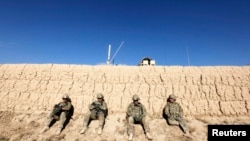
Some 10,000 U.S. Army personnel are initially expected to remain in Afghanistan through 2015. (file photo)

Washington commits only to keeping Kabul informed "if requested" of the progress of U.S. criminal proceedings against soldiers accused of crimes and to making efforts so that representatives of Afghanistan can attend or observe the proceedings in U.S. military courts.

However, the BSA does give Afghanistan jurisdiction over "United States contractors and United States contractor employees."

If Kabul had not agreed to immunity for U.S. soldiers, Washington would almost certainly have refused to sign the BSA. Iraq's refusal to give U.S. soldiers immunity helped to scuttle plans to leave a U.S. military-training presence in that country beyond 2011.

Will America Defend Afghanistan Against Third Countries?

The BSA is not a defense pact which would commit the United States to defending Afghanistan if it were attacked by another state. But the text does say Washington "shall regard with grave concern any external aggression or threat of external aggression."

It also says that in the case of external aggression, Washington and Kabul would work together to develop "an appropriate response," including considering political, military, and economic measures.

Will the United States Maintain Military Bases In Afghanistan?

The BSA authorizes U.S. forces to maintain existing facilities and undertake new constructions so long as they are agreed upon by both sides.

That clause in the BSA is likely to be closely read by Iran, which accuses Washington of seeking to create a permanent presence in the region under the guise of fighting terrorism. Iran's state-run Press TV said in a commentary on its website on September 30 that "Germany and Japan provide excellent examples of how the number of American bases mushroomed in these countries under the pretext of fighting the Cold War."

The United States has repeatedly said it does not seek permanent bases in Afghanistan, despite claims by Karzai in May last year that Washington wanted nine bases and that he would not accept it.

"We seek no permanent bases," then-White House Press Secretary Jay Carney told reporters the day after Karzai's remarks. "Any continued presence of U.S. forces in Afghanistan beyond 2014 would be subject to an agreement between the Afghanistan government and the U.S. government, and would only be at the request of the Afghanistan government."

More News

Hunger, Poverty Overshadow Ramadan In Afghanistan

A woman and boy beg for alms outside a mosque during Ramadan in Kabul. (file photo)

Ramadan is usually a time of compassion, charity, and celebration.

But the Islamic holy month has been overshadowed in Afghanistan, the world's largest humanitarian crisis, by rising hunger, poverty, and joblessness.

As some in the Muslim world break their fast with nightly feasts, millions of Afghans are desperately trying to stave off starvation in a country where many survive on only bread and water.

"We have nothing to eat during iftar," said Maria, a mother of three who lives in Kabul, referring to the nightly, fast-breaking meal served after sundown throughout the month of Ramadan.

Maria, whose husband is a drug addict, is the sole breadwinner of the family. But the Taliban, which seized power in 2021, has barred most women from working outside their homes.

"We won't be able to celebrate Eid either," she said, referring to Eid al-Fitar, the festival that marks the end of Ramadan, which began on March 11 this year.

Abdul Qadir is one of the more than 500,000 Afghan refugees and migrants expelled from neighboring Pakistan since October. Unable to feed his family, he said he cannot observe Ramadan this year.

"It's impossible to fast when you have nothing to eat [in the evening]," said Qadir, who lives in the eastern province of Laghman. "The economy is absolutely zero. There's no work."

Multiple Crises

Ramadan has coincided with a devastating humanitarian and economic crisis in Afghanistan.

Around 24 million people -- out of a population of around 40 million -- will need life-saving humanitarian support this year, the United Nations said on March 10.

The World Food Program said around 4 million Afghans are acutely malnourished, including over 3 million children under the age of 5.

In a report issued on March 10, the World Bank said Afghanistan was experiencing deflation amid weak economic activity. It also reported a significant decline in Afghanistan's exports and depreciation of the national currency.

Afghan women sit after receiving food aid distributed by a charity foundation during the Muslim holy fasting month of Ramadan in Kandahar. (file photo)

The Taliban's takeover of Afghanistan in 2021 triggered an economic collapse and worsened a major humanitarian crisis. Western donors abruptly cut off assistance and the Taliban government was hit by international sanctions.

Aid groups have continued their humanitarian operations, although major cuts in international funding have restricted their activities.

The Taliban government, which remains unrecognized and under sanctions by the international community, appears unable to address the crises.

Natural disasters like earthquakes and droughts as well as the influx of over 1 million Afghan refugees from neighboring countries recently have further aggravated the already dire humanitarian situation in the war-torn country.

'I Have Nothing'

Many Afghans are scaling back or even skipping Ramadan altogether this year due to their increasing financial restraints. "Like everyone I know, we suffer enormous economic pressures," said Mursal, a civil servant under the previous Western-backed Afghan government who is now unemployed.

"I can't cope with the expectations and demands of Ramadan," added Mursal, who lives with her family in Kabul.

Women in burqas buy dry fruit on a street in the northern Faryab Province.

Nida Ahmadi, a female teacher in the northern province of Parwan, says she took out a loan in order to be able to fully observe Ramadan.

"But even that is not enough," said Ahmadi, whose monthly salary of around $200 is not enough for her family of seven.

"When I go to the market, I wonder what to buy with the little money I have," she said.

Written by Abubakar Siddique based on reporting by Faiza Ibrahimi and Sana Kakar of RFE/RL's Radio Azadi

Tajikistan Going All In On Hydropower, Doubters Be Damned

Tajik President Emomali Rahmon attends the construction-launching ceremony of the Roghun hydroelectric project some 100 kilometrers from the capital, Dushanbe, in October 2016.

ALMATY, Kazakhstan -- When it comes to energy bets, Tajikistan is all-in on hydropower.

Having spent much of the last decade and several billion dollars building the Roghun "megadam," the project is clearly too big to fail from the point of view of Tajikistan's leadership.

But amid spiraling costs and long-standing questions about the environmental and human impacts, its critics contend that Roghun is also too big to be sustainable.

Tajikistan is not alone in eying Roghun's potential 3,600 megawatts of installed capacity.

While millions of Tajiks continue to live without power or have it for just a few hours per day, especially in the colder months, Roghun is an important piece of the energy-security puzzle in Tajikistan's electricity-strapped neighborhood, with Uzbekistan, Afghanistan, and Pakistan all potential customers.

So there is a lot at stake.

And that is without considering whether large-scale hydropower is a wise direction for a region where climate change is set to continue the erosion of river-feeding glaciers.

But while some of Tajikistan's Central Asian neighbors are already diverting resources to smaller solar and wind projects to plug their deficits, megadams new and old are still the order of the day for Dushanbe.

Supply Outrunning Demand

On March 9, a delegation from the board of executive directors at the World Bank Group wrapped up a regional tour of Central Asia that included talks in Tajikistan with Roghun's ultimate champion, President Emomali Rahmon, as well as a trip to the dam's partly operational hydropower plant (HPP).

The group's press release gave little in terms of the details of the talks, but they included "a particular focus on climate change within the prism of the water-energy nexus."

The visit came on the back of both negative and positive developments for Tajikistan's power sector.

The negative was a massive and as-yet-unexplained power outage that plunged the vast majority of the country, including the capital, Dushanbe, into darkness for several hours on March 1.

Local media outlet Asia-Plus cited a source that attributed the outage to an "accident" at the Norak HPP that currently supplies around half of Tajikistan's power.

Another outlet, Dushanbe TV, cited a source claiming a "technical accident on the main republican high-voltage lines."

State power company Barki Tojik did not provide RFE/RL's Tajik Service with a comment.

Just days later, on March 4, Deputy Energy and Water Minister Sorbon Kholmuhammadzoda was dismissed. A government decree said he would assume a new post, although it is unclear what that will be.

More encouraging was news issued by the World Bank last month, and confirmed by the Taliban last week, that the all-important Afghan leg of CASA-1000 -- a four-country regional power project in which Tajikistan is expected to play the role of top provider -- is back on track.

A map shows the CASA-1000 route during the inauguration ceremony in 2016.

CASA-1000 had been de facto suspended since the Taliban's return to power in Afghanistan in 2021, but the World Bank announced it would move forward with financing pylons and other infrastructure in the Afghan section "in a ring-fenced manner" to ensure distance from the radical government that is yet to gain international recognition.

When CASA-1000 eventually becomes reality, Tajikistan should transmit 70 percent of an approximately 1.3 gigawatts of electricity to the power-starved Afghan and Pakistani grids, with Kyrgyzstan due to receive the remainder.

But the power-transportation infrastructure is of little use if Tajikistan doesn't have the spare energy.

With colder-than-usual temperatures recently hitting Central Asia in the final lap of winter, Tajikistan's annual but now worsening power shortages have had some tragic consequences.

In recent weeks, RFE/RL's Tajik Service has reported multiple carbon-monoxide deaths, including of children, as rural families load up their stoves to get through the freezing nights.

Tajik Family Dies Trying To Keep Warm Amid Chronic Power Cuts
please wait

No media source currently available

0:00 0:01:49 0:00

And if reports of the Dushanbe blackout being connected to an accident at the Soviet-era Norak HPP are true, that means progress at Roghun -- where only two of six 600-megawatt units are currently online -- cannot come fast enough.

Bulldozing On

In December, Rahmon said he expected the third unit of Roghun to come online in 2025.

His personal attachment to the project is clear. In 2016, when construction began, he clambered into a bulldozer to move earth around the site in a grandiose ground-laying ceremony. Some political subordinates of the long-serving leader have even called for the HPP to take his name.

At the time of its ground-laying, the government's estimate for the total cost was just under $4 billion. Following a long construction delay during the coronavirus pandemic, the most recent government estimate put the project's total cost at $6 billion.

The Italian-based company Webuild (formerly Salini Impregilo) is the project's principal contractor. But there is no clear path to financing the final stages of a facility that Dushanbe wants to be the tallest of its kind in the world at 335 meters.

Is the world's tallest dam what Tajikistan really needs?

Norak, which is 300 meters high, once held this honor but was displaced from the top more than a decade ago by China's Jinping-I dam, which has a height of 305 meters.

Roghun has thus far been financed with a combination of state budget funds and borrowed money. The former have been disproportionately large for Central Asia's poorest country, reportedly outweighing all other infrastructural spending.

The latter has included a $500 million, 7.1 percent-yield eurobond issued in 2017, the success of which Reuters hailed as "the latest indication of the undiminished thirst for high-yield debt, even from frontier markets -- so-called because of their poverty and rock-bottom credit scores."

Tajikistan is clearly hoping that international institutions will pick up the rest of the tab.

In a release this month, a group of 17 environment- and government-focused nonprofit organizations -- including the Prague-headquartered watchdog CEE Bankwatch Network -- called on the World Bank, the Asian Infrastructure Investment Bank, and the European Investment Bank to "reconsider" an apparent collective-funding pledge of up to $600 million to support Roghun, branding the project's current Environmental and Social Impact Assessment unfit for its purpose.

The coalition had in February referred to Roghun as "a sad reminder of the Soviet ideology of exerting total control over nature," while pointing out that at least 46,000 people would have to be displaced for a dam that it said might not reach full operational capacity until 2040.

"The development of the [Roghun] HPP project on the Vakhsh River is of great concern due to its enormous associated social and environmental risks, not only to Tajikistan but to the region as a whole," the organizations wrote.

One important former Roghun critic has in recent years become a cautious supporter.

That is partly because Tajikistan's downstream neighbor Uzbekistan -- a water-stressed country of around 35 million people -- has prioritized better regional relations under President Shavkat Mirziyoev than did his late, hard-line predecessor, Islam Karimov.

But it is also because Uzbekistan is increasingly unsure which it needs more -- water or electricity -- with deliveries from Tajikistan potentially easing one of those problems.

Back to basics in Tajikistan

Tajikistan, for its part, has begun talking up other "green technologies" to plug its deficits.

But in comparison to the region's renewable pacesetters, Uzbekistan and Kazakhstan -- which are also mulling nuclear power -- this appears to currently be little more than an idea.

At the Effective Energy In Tajikistan conference in Dushanbe in October, Tajik officials said solar and wind energy could contribute up to 70 megawatts to Tajikistan's energy mix by 2030.

But then-Deputy Energy and Water Minister Kholmuhammadzoda was clear what the government's priority was. "In the next seven years, energy [production] capacity in Tajikistan will increase by an additional 4,000 megawatts of electricity due to the commissioning of the Roghun hydroelectric power station and the reconstruction of other hydroelectric power stations, such as Norak, Sarband and Kairakkum," he said.

So it's hydro or bust. Or perhaps, "hydro and bust."

With reporting by RFE/RL's Tajik Service

'I Can't Tell': Sexual Abuse At Taliban-Run Madrasahs Fuels Fear, Dropouts

Young boys study at a madrasah in Afghanistan.

Male students who enrolled in Taliban-run religious schools say that sexual and physical abuse has led some to end their pursuit of an education in Afghanistan.

The students, all of whom were aged 10 to 17 and spoke to RFE/RL's Radio Azadi on condition of anonymity out of fears of repercussion, described numerous instances in which they and fellow classmates were pressured to engage in sexual acts with teachers and subjected to corporal punishments.

The reported cases took place in western and southwestern Afghanistan at Taliban-run madrasahs, part of the network of religious schools that the extremist group has expanded significantly as part of its drive to foster religious education more in keeping with its hard-line Islamist views.

One 16-year-old student, a resident of Farah Province, described being propositioned by a teacher at the madrasah he attends.

"One day at school a Taliban member who teaches there made an inappropriate offer, but I did not accept it," the boy told Radio Azadi, using inexplicit language to describe sexual abuse, a culturally taboo topic in Afghanistan. "When the lessons were over, he bothered me again."

The boy said he reported the incidents to a "qari," a person who has memorized the Koran and serves as a religious authority at the school, to no avail.

"I told the qari that the teacher was doing bad things to me, and the qari told him not to do these things, that he was a teacher," the boy said. "The teacher admitted doing it, but it had no effect. He has continued to do bad things and made sexual requests to numerous students at the school."

A Taliban-controlled madrasah in Afghanistan

Another student in southwestern Afghanistan, a 17-year-old in the 10th grade, gave a similar account of his experience during his six months studying at a Taliban-run madrasah.

"A Taliban member who teaches at the school proposed having a relationship with me and said some other things that I did not accept," the boy said.

After being refused, the teacher swore and issued threats, the boy said, adding that his fellow students have faced similar treatment.

"He also harassed several of my classmates, and one of them left the school," the boy said. "He told me I should not go to school anymore because the same teacher is harassing me."

The boy said the experience has left him "damaged" and unsure of whom he can confide in. "I can't tell my family," he said.

The Taliban has come under widespread criticism for the severe restrictions it has placed on the daily lives of the Afghans since seizing power in August 2021. In its pursuit to impose its extreme interpretation of Islam, the Taliban has restored many of the draconian rules it was infamous for during its first stint in power from 1996 to 2001.

The ban on the education of girls past the sixth grade, and the erasure of women's role in society stand out among the measures the Taliban has taken. But other steps -- including prohibitions on music and idolatry through art, and pressure against students and teachers -- have affected all walks of life regardless of sex.

Since the Taliban returned to power, many educators have left the country, while female teachers have been left at home without work due to restrictions on women's freedom of movement and their ability to teach males.

Meanwhile, the Taliban has steadily worked to replace secular state schools and informal madrasahs with a system of religious schooling. The system does allow for girl students, including those of university age, but critics say it falls far short of the standards of modern education for girls and boys alike and often promotes extremism.

According to a report on Afghanistan issued by the United Nations in February, the Taliban has established 6,836 madrasahs for males and 380 for females and was expected to finalize a standardized religious curriculum in time for the new school year beginning this month.

Afghan boys read the Koran at a madrasah in Kabul.

The recruitment of madrasah teachers is also in full swing, according to the report, following a decree by the Taliban’s spiritual leader Mullah Haibatullah Akhundzada to have 100,000 new madrasah teachers in place.

In December, Human Rights Watch gave a stinging assessment of the state of education in general, saying that in addition to the obstacles to the education of girls and women, the Taliban had "also inflicted deep harm on boys' education" in Afghanistan.

"Many boys were previously taught by women teachers; the Taliban has prohibited women from teaching boys, depriving women teachers of their jobs and often leaving boys with unqualified replacement male teachers or sometimes no teachers at all," HRW said. "Parents and students said that corporal punishment, which has long been a problem at Afghan schools, has become increasingly common. The curriculum in many schools appears to be under revision to remove important school subjects and promote discrimination."

The rights watchdog said the circumstances had "led many boys to leave school altogether" and "left boys struggling with mental health problems such as anxiety and depression."

Shortly after the Taliban regained power, the United Nations highlighted the dire situation for children in Afghanistan, including exposure to sexual violence and increased risk of students dropping out of school.

A madrasah in Kandahar

Difficulties in ensuring the protection of children are exacerbated, according to the UN, by the Taliban's refusal to consider people below the age of 18 to be children, as is the international standard, instead using the onset of puberty as the basis for adulthood.

Younger madrasah students in western and southwestern Afghanistan below or at the age of puberty said they were not spared physical abuse and sexual harassment from teachers.

One young man who spoke to Radio Azadi said he recently learned that his young brother was being subjected to sexual abuse at a madrasah in western Afghanistan.

The young man said his brother was being assigned extracurricular "homework by a teacher, or to put it bluntly, he was being asked for sex, [the teacher] fondled his hands and feet and kissed him."

As a result, the young man said he told his brother not to go to school anymore.

Fear of sexual harassment and sexual and physical abuse were cited as a common factor leading boys in western and southwestern Afghanistan to give up their studies.

"Some teachers harass our students and make immoral requests," said one 14-year-old boy who also described common methods of corporal punishment at his madrasah. "They strike our faces or beat our hands and feet under the pretext of disciplining us for not learning our lessons properly."

Afghan boys peek out from inside a madrasah in Kandahar.

The boy said many students were studying hard in fear of being taken to a special room for punishment, and that "some even drop out of school."

Another student, aged 10, said his teacher separated him and other students from their class to beat the soles of their feet.

Afterward, he told Radio Azadi, he stopped going to class because he was afraid. And upon hearing about the incidents, his and his classmates' parents "did not allow us to go to school."

The Taliban authorities did not respond to requests for comment on the allegations of abuse at madrasahs it has established. And efforts to speak to individuals aware of the situations at madrasahs in other areas of Afghanistan were met by refusals to comment due to fear of reprisals.

A women's rights activist who asked that her name not be published told Radio Azadi that families have no avenue to lodge complaints about the abuse their children encounter at Taliban-run madrasahs because they, too, would face threats.

The activist said that not only had she been made aware of sexual harassment against both girls and boys at Taliban-run madrasahs, but the curriculum also serves to "increase the level of extremism in the country."

Reducing the risks of both threats, she said, would require greater oversight by the Taliban authorities and ideally, she said, a reduction in the number of madrasahs.

Najib Amini, a civil society activist in western Afghanistan, said that for now, the onus falls on families to be aware.

"Children are subjected to sexual abuse in madrasahs established under the Taliban regime," Amini said. "Families have an important and essential role in this regard. If they do not want their children to be abused in schools, if they want their children to get a basic education...then they should not send their children to madrasahs under the control of the Taliban."

Written by Michael Scollon based on reporting by RFE/RL’s Radio Azadi

Afghan Women, Lives Upended, Demand Taliban End Bans And Restrictions

Afghan women held small demonstrations on March 8 to demand their rights and for authorities to release imprisoned Afghan women activists.

Afghan women on International Women's Day demanded the country's hard-line Islamist Taliban rulers end bans and restrictions that have turned their lives upside down since the militants seized power in August 2021 as international troops withdrew.

Despite a Taliban-mandated ban on protests, Afghan women held small demonstrations on March 8 to demand their rights and for authorities to release imprisoned Afghan women activists.

They also called on the government to reopen schools and universities to females after cutting off their education after grade seven.

"The international community should defend the rights of Afghan women and help them gain the right to work, education, and equality," an exiled women's rights activist who requested anonymity told RFE/RL's Radio Azadi.

The Taliban seized power promising more moderate policies than when it ruled the country some two decades earlier. But its leaders have since doubled down on the recreation of a totalitarian clerical regime, especially with regard to women, who have effectively been denied any public role in society.

Afghan Exiles Say Taliban Tightening Restrictions On Women
please wait

No media source currently available

0:00 0:03:39 0:00

Afghan women have been banned from working in many sectors of the economy. Women-owned businesses face myriad restrictions. Women are also banned from recreation and leisure activities such as visiting public parks and public baths.

Women also are dealing with severe restrictions on mobility and how they can appear in public. In most instances, they are required to be accompanied by a male chaperone. A Taliban decree requires women to wear the niqab, the head-to-toe veil in which only their eyes are visible.

"The Taliban's restrictions have upended our lives," a university student in Kabul who requested anonymity told Radio Azadi. "My hopes of serving my community and our country have been dashed."

In the capital, Kabul, right campaigner Kavia Siddiqi said the Taliban-led government has systematically deprived Afghan women of rights and freedoms.

"Afghan women live in a prison because they are deprived of all their rights," she said.

The Taliban has treated the anger surrounding its decisions with the same type of oppression. Its government has detained and tortured hundreds of women activists, some of whom remain in custody.

"The fight for women's rights in Afghanistan is a global fight and a battle for women's rights everywhere," said Alison Davidian, special representative for UN Women in Afghanistan.

Richard Bennett, the UN special rapporteur on human rights in Afghanistan, told Radio Azadi that Taliban discrimination against Afghan women could amount to "gender apartheid" if codified in international law.

He said that under the concept of "gender persecution," the treatment of women in Afghanistan could be prosecuted as crimes against humanity under the 1998 Rome Statue of the International Criminal Court.

"It is already possible to criminally prosecute for the crime of gender persecution," he said.

Afghan Exiles Say Taliban Tightening Restrictions On Women

Afghan Exiles Say Taliban Tightening Restrictions On Women
please wait

No media source currently available

0:00 0:03:39 0:00

Two exiled Afghan women have told RFE/RL that the Taliban appears to be further tightening restrictions on women and girls in Afghanistan. Speaking ahead of International Women's Day, activists Nargis Sadat and Fawzia Wahdat said that more women were being imprisoned amid a fresh clampdown on female activists. The Taliban has barred women and girls from secondary schools, universities, and many jobs since retaking control of the country in 2021.

The Azadi Briefing: Taliban Appears Split Over Women's Education Ban   

Afghan women protest in Kabul to demand that the Taliban administration allow the reopening of girls schools and ensure ample employment opportunities for women. (file photo)

Welcome to The Azadi Briefing, an RFE/RL newsletter that unpacks the key issues in Afghanistan. To subscribe, click here.

I'm Abubakar Siddique, senior correspondent at RFE/RL's Radio Azadi. Here's what I've been tracking and what I'm keeping an eye on in the days ahead.

The Key Issue

Abdul Salam Zaeef, a former senior Taliban official, has criticized the extremist group’s severe restrictions on female education.

“Those who oppose modern education or invent arguments to undermine its importance, they are either completely ignorant or oppose Muslims under the garb of Islam,” he wrote on X, formerly Twitter, on March 5.

The Kabul-based Zaeef is one of the founders of the Taliban and a former deputy minister and ambassador during the group’s first stint in power from 1996 to 2001.

Since seizing power in 2021, the Taliban has banned girls above the sixth grade from going to school and women from attending university, in moves that provoked international condemnation.

Zaeef, a dissenting voice for years, is the second prominent Taliban figure who has recently criticized the group's restrictions on female education.

The Taliban’s deputy foreign minister, Sher Mohammad Abbas Stanikzai, called on the government to rescind the ban on women’s education.

"Learning should be open to all because education is obligatory for both men and women,” he said. “No country can progress without education.”

Why It’s Important: Zaeef and Stanikzai’s comments highlight the rifts within the Taliban over the issue of female education.

The Taliban’s spiritual leader, Mullah Haibatullah Akhundzada, has come under growing fire from figures inside the group over his extremist policies, including the severe restrictions on women’s rights.

In his attempt to create what he sees as a "pure" Islamic system, Akhundzada has alienated many Afghans and isolated the Taliban's unrecognized government internationally.

What's Next: It is unclear if Akhundzada, who has the ultimate say on all important matters under the Taliban’s theocratic system, will moderate the group’s policies.

Without reversing its repressive policies and creating an inclusive government, the Taliban appears unlikely to gain international recognition.

What To Keep An Eye On

Afghan laborers and traders say they face increasing visa restrictions in the Gulf states.

During the past four decades, the oil-rich states in the Persian Gulf have provided jobs to hundreds of thousands of poor, uneducated Afghans.

"I want to go there, but the Gulf Arab nations are now reluctant to grant us visas," Naqibullah, a resident of southeastern Khost Province, told RFE/RL’s Radio Azadi.

“There is no business here, but it is tough to obtain a visa for the United Arab Emirates,” said Asmatullah Zadran, a trader in Khost.

According to a January report by the Afghanistan Analysts Network, an independent research organization, none of the Gulf countries, except Oman, currently grant work visas to Afghans.

Why It's Important: The increasing visa restrictions on Afghans are likely to affect tens of thousands of families who have relied on remittances from family members working in the Gulf.

Afghanistan is already reeling from an economic crisis and mass unemployment since the Taliban takeover.

The drop in remittances from the Gulf are likely to further aggravate the economic situation in Afghanistan, where millions of people are on the verge of starvation.

That's all from me for now. Don't forget to send me any questions, comments, or tips that you have.

Abubakar Siddique

If you enjoyed this briefing and don't want to miss the next edition, subscribe here. It will be sent to your inbox every Friday. You can always reach us at azadi.english@rferl.org

Afghan Woman Award Winner Determined To Struggle For Rights Under Taliban

U.S. first lady Jill Biden (left) and Secretary of State Antony Blinken (right) present an International Women of Courage award to Benafsha Yaqoobi during an awards ceremony on March 4 at the White House in Washington.

Afghan lawyer Benafsha Yaqoobi has been chosen as one of the winners of the U.S. State Department's 2024 International Women of Courage Award.

Yaqoobi, who is visually impaired, has advocated for human and women's rights from exile since Taliban militants seized power and forced her to flee Afghanistan in August 2021.

"I am happy to have this prize because it gives me another platform to raise my voice for the world's most marginalized community," she told RFE/RL's Radio Azadi while alluding to the plight of Afghan women under Taliban rule.

While just about every part of Afghan society has seen an erosion of fundamental freedoms and rights under the militants, women and girls have been the main targets of mounting Taliban bans and restrictions.

Hard-line Taliban leaders have used their interpretation of Islamic Shari'a law to justify banning teenage Afghan girls and women from education, work in most sectors, and draconian restrictions on their mobility and how they can appear in public.

The Taliban has banned women from recreation by outlawing their visits to parks and public baths.

Women's rights activists who have spoken out, have ended up in jail.

"Every day after the Taliban takeover in August 2021, we are witnessing new restrictions being imposed on Afghan women," Yaqoobi said.

"No one in the world today can beat the oppression that the women suffer in Afghanistan," she added.

The rights campaigner served as a commissioner for the Afghanistan Independent Human Rights Commission before the Taliban's return to power.

Yaqoobi advocated disability rights by hosting a daily television show. She is still engaged in advocating for the rights of Afghan girls with disabilities.

"The Taliban cannot rule Afghanistan without the consent of the Afghan people because they are the real owners of that land," she said, adding that all Afghans deserve to live in a broad-based and inclusive country.

She called on the Taliban government to immediately release all women rights campaigners who are languishing in its prisons because they spoke out for their rights.

"I am optimistic that Afghan women will get their rights back one day," she said. "We are effective and successful and will one day reach our goals."

Since 2007 the International Women of Courage Award honors activists and practitioners from around the world for demonstrating "exceptional courage, strength, and leadership in order to bring about positive change to their communities."

So far, the State Department has recognized more than 190 women in 90 countries with the award.

For 2024, winners came from 12 countries, ranging from Europe to Asia to Africa, the Caribbean Sea and South America.

Special Visa Program For U.S.-Affiliated Afghans Faces Demise

A demonstration in Kabul in 2021 that urged U.S. visas for Afghans who worked as U.S. interpreters

A program that resettles in the United States Afghans who worked with the U.S. government could grind to a halt later this year, stranding thousands at risk of Taliban retribution following the 2021 U.S. troop pullout from Afghanistan. The congressionally authorized limit of 38,500 Special Immigration Visas (SIVs), which offer a path to U.S. citizenship, is expected to be reached around August, and it looks unlikely that the divided U.S. Congress will approve a U.S. administration request for 20,000 more. State Department spokesman Matthew Miller told a briefing that the U.S. administration has "urged Congress to raise the cap."

Extreme Weather After Mild Winter Kills Dozens In Afghanistan And Pakistan

An Afghan man pushes a wheelbarrow following heavy snowfall in Ghazni Province early last month.

Heavy snowfall and rains have killed at least 80 people in Afghanistan and Pakistan as extreme weather conditions wreak havoc in both countries.

Deluges have flooded communities and forced residents to flee in recent days, while blizzards and landslides in mountainous areas have closed major highways.

The current spell of wet weather follows a long, dry winter marked by unusually low precipitation.

On March 5, Pakistan's newly elected prime minister, Shehbaz Sharif, visited the southern coastal city of Gwadar, which was flooded after torrential rains began on February 28.

"Hundreds of houses were inundated with floodwater, which forced thousands to flee the city," said Aurangzeb Badini, a local administration official.

Badini added that the floods had killed five people and washed away or damaged more than 3,200 houses in Gwadar and the nearby towns of Jiwani and Pasni.

During his visit, Sharif distributed cash grants, tents, and food aid to Gwadar residents affected by the floods.

Some 1000 kilometers away in the mountainous northwestern Khyber Pakhtunkhwa Province, rain and snowfall killed at least 40 people and injured 62 more, according to the provincial rescue service.

"Most of the people were killed or injured because of collapsing houses," Bilal Faizi, a spokesman for the rescue service, told RFE/RL's Radio Mashaal.

In neighboring Afghanistan, recent heavy snowfalls have led to the loss of 39 lives in different provinces, while scores more have been injured.

"The recent snow and rain have completely or partially destroyed 637 houses and killed over 14,000 livestock," said Janan Sayeq, a spokesman for the Taliban-led Disaster Management Ministry.

On March 4, Taliban rescue workers opened the high-altitude Salang tunnel, which connects northern Afghanistan to the capital, Kabul.

The two neighboring countries are some of the most vulnerable to climate change. They frequently face earthquakes, droughts, floods, landslides and other natural disasters.

Taliban Returns Its 'Eye For An Eye' Justice To Afghanistan

A Taliban fighter and onlookers attend the execution of three men in Ghazni Province in April 2015.

With the recent execution of three convicted murderers in separate incidents, the Taliban has sent a very public message that its infamous "eye for an eye" approach to justice has been restored in Afghanistan.

"Qisas," or retributive Islamic punishments that can include killings at the hands of victims' families, were a trademark of the Taliban's first stint in power in Afghanistan from 1996 to 2001.

After a nearly 20-year reprieve under new governance, the hard-line Islamist group has vowed since its takeover in 2021 to revive the practice in its push to reimpose its strict interpretation of Islamic law.

The public shootings of the three men in the past two weeks show the Taliban was issuing promises, not threats.

In a throwback to the executions carried out in stadiums under the previous Taliban regime, all three were executed by heirs of their victims in front of spectators.

On February 22, Syed Jamaluddin and Gul Khan were shot dead inside a soccer stadium in the southeastern province of Ghazni. "One was shot eight times while the other received six bullets," an eyewitness who requested anonymity told RFE/RL's Radio Azadi.

Days later, on February 26, an unidentified man shot Nazar Mohammad inside a sports stadium in the northern province of Jawzjan. The shooter was avenging the death of his brother, Khal Mohammad, two years ago.

Such "eye for an eye" forms of justice, which include qisas as well as corporal "hudood" punishments such as amputations for lesser crimes, are carried out for crimes and offenses considered to violate God's boundaries.

Shirin Khan (left) fires a shot from a Kalashnikov assault rifle to kill Dur Mohammad (on the ground) in the eastern Afghan town of Khost on February 9, 1996. It is one of the early qisas punishments carried out during the Taliban's first stint in power between 1996 and 2001.

The recent executions are not the first since the Taliban returned to power.

In December 2022, just a month after Taliban leader Mullah Haibatullah Akhundzada ordered the return of Islamic punishments, a convicted murderer was shot dead by his victim's father in front of hundreds of onlookers in the western Farah Province.

Last June, a man convicted of killing five people was executed in the eastern Laghman Province, according to the Taliban, which did not say how the sentence was carried out.

Since Akhundzada's order, the Taliban has also flogged, stoned, or amputated the body parts of hundreds of people for crimes such as theft and adultery.

The executions and punishments have been condemned by Afghans and abroad, and experts have questioned their validity under Islamic law and say they are mainly intended to incite fear.

Islamic Shari'a law can only be implemented as part of an overarching governing framework under a legitimate government accountable to the people, according to Afghan Islamic scholars.

"Judges who rule on such punishments must be famous for their fairness and in-depth knowledge," said professor Fazluminullah Mumtaz, an expert in Islamic jurisprudence. He added that judges "are obliged to have a thorough understanding of the jurisprudential and Shari'a aspects of the sentence and its execution."

That is not the case under the Taliban, which has gutted the Afghan judiciary and whose government is not recognized by any country.

The hard-line Islamist group has scrapped or suspended all laws implemented by the previous government, which constitutionally allowed for Islamic law while also adhering to international legal and rights norms.

And since taking over in 2021, the Taliban has fired thousands of judges, public prosecutors, and lawyers and replaced them with loyalists, most of whom are clerics.

"The Taliban government does not even have relative legitimacy and it operates in a legal vacuum," Subhanullah Misbah, an Afghan legal expert, told Radio Azadi.

The stadium in Farah where the Taliban held its first public execution (in 2022) after taking over the country in August 2021.

The Taliban has effectively recreated its "Islamic emirate" of the 1990s, under which such punishments became a hallmark of its brutal take on Islamic law.

The group's insistence on pursuing its vision of Shari'a is widely seen as one of the reasons the Taliban has strongly resisted demands by Afghans and the international community that it allow the establishment of an inclusive government.

Its refusal to bend, despite initial promises to adhere to international law, has given the Taliban a monopoly on power but has also increased its isolation globally and fomented domestic political and economic crises.

All this, Misbah says, means the Taliban has failed to gain the qualifications required to determine the course of Islamic law. "No one in Afghanistan will oppose the implementation of Shari'a, but the Taliban first must meet the prerequisites for implementing such laws," he said. "Implementing capital punishments now will only spread fear in society."

Under the previous government, capital punishment was allowed in compliance with international law, and death sentences -- mostly by hanging -- were carried out in prisons.

But the return of public executions have alarmed the United Nations and global rights watchdogs. "Public executions are a form of cruel, inhuman, or degrading treatment, or punishment," said Jeremy Laurence, a spokesman for the UN Office for the High Commissioner on Human Rights.

In a February 28 statement, he pointed out that such execution was arbitrary and "contrary to the right to life protected under the International Covenant on Civil and Political Rights, to which Afghanistan is a state party."

Amnesty International has called an immediate halt to such executions. "Carrying out executions in public adds to the inherent cruelty of the death penalty," said Livia Saccardi, Amnesty International's deputy director for South Asia. "And can only have a dehumanizing effect on the victim and a brutalizing effect on those who witness the executions."

Some rights campaigners oppose the death penalty globally and frequently oppose its implementation, including in Muslim countries where it is rooted in or inspired by Shari'a. Sunni Saudi Arabia and Shi'ite Iran are among the world's leading executioners. All executions, including qisas, in these countries are justified according to their interpretation of Islamic law.

Graeme Smith, a senior Afghanistan analyst at the International Crisis Group, says that the Taliban's approach to justice did gain some legitimacy among Afghans, particularly in rural areas in the south and east of the country, when the group was fighting against the pro-Western government from 2002 to 2021.

Smith says this was because some Afghans -- frustrated by the rampant corruption in the Kabul-run court system -- preferred to take their cases before the insurgents. "Human rights organizations will rightly condemn these executions," he said. "However, it's worth remembering the recent history in Afghanistan, where many executions happened secretly."

After a communist coup in April 1978 toppled a republican government, Afghanistan witnessed large numbers of extrajudicial killings under communist, Islamist, and pro-Western governments.

"Many aspects of that violent legacy are still to be uncovered as journalists and other investigators gain access to former battlefields," Smith said.

The Azadi Briefing: Afghan Poet Languishes In Taliban Captivity

Pashtun poets such as Ezatullah Zawab were relatively immune to Taliban oppression, but it's showing a willingness to mute even traditional avenues for airing grievances and criticism.

Welcome to The Azadi Briefing, an RFE/RL newsletter that unpacks the key issues in Afghanistan. To subscribe, click here.

I'm Abubakar Siddique, senior correspondent at RFE/RL's Radio Azadi. Here's what I've been tracking and what I'm keeping an eye on in the days ahead.

The Key Issue

A prominent ethnic Pashtun poet has spent a month in Taliban captivity in what his family and rights activists see as another example of the hard-line Islamist group's sustained assault on freedom of expression.

Ezatullah Zawab's family members say they are completely in the dark about his situation a month after he was arrested under unclear circumstances. But Zawab's supporters have an idea why he is behind bars.

"We think that it is a conspiracy to silence my father through character assassination," Zawab's son, Nusrat Arman, told RFE/RL's Radio Azadi.

Arman has rejected official claims that Zawab was arrested for carrying alcohol, which is strictly prohibited by the Taliban.

Zawab's supporters say the real reason is that the Taliban did not like Zawab's literary magazine, Meena ("Love" in Pashto), because it published prose and poetry that could be seen as critical of life under Taliban rule. Zawab is known for penning satirical verse with political undertones.

"The current political system in Afghanistan is dictatorial," Zarifa Ghafari, a rights campaigner, told Radio Azadi. "The Taliban silences anyone who raises a voice against it."

Why It's Important: Zawab's arrest shows the Taliban is underscoring its lack of tolerance for dissent in any form.

Pashtun poets such as Zawab were relatively immune to Taliban oppression because of their popularity and distance from known political factions. Some of them even dared to criticize the Taliban government for its abuses and mistakes publicly.

But as the Taliban strengthens its stranglehold on power, it is showing a willingness to mute even traditional avenues for airing grievances and criticism like poetry.

Since its return to power in August 2021, the Taliban has imposed all-encompassing censorship. It has detained and tortured journalists, writers, and activists, prompting hundreds in those fields to flee the country.

Despite early promises to tolerate a free press, the Afghan media has significantly declined under the Taliban. Hundreds of media outlets have been shut down and journalists not working for the Taliban are grappling with mounting restrictions.

To deny Afghans access to credible information, the Taliban has banned some international broadcasters. Its government has also denied visas to foreign correspondents to keep the country under wraps.

What's Next: The Taliban is doubling down on creating a media environment that only amplifies its views and promotes its interests.

Some Taliban officials had already declared all forms of photography un-Islamic amid speculation that women will be completely banned from working in or appearing on electronic media.

As the Taliban continues to replace journalism with propaganda, waning international interest in Afghanistan and diminishing access to the country makes accurate reporting on Taliban-ruled Afghanistan increasingly difficult.

What To Keep An Eye On

An international nongovernmental organization, the Danish Refugee Council (DRC), has issued a fresh warning about the impact of climate change in Afghanistan.

"Afghanistan is the 12th-most-vulnerable country in the world to the impacts of climate change," the DRC said in a report issued on February 27.

The report says climate change "continues to worsen the frequency and severity of climate-related disasters such as droughts, floods, and landslides."

The DRC warned that a deepening water crisis and climate change present unique challenges to some 40 million Afghans, 80 percent of whom depend on natural resources for their livelihoods.

"Next year, we will not be able to look after our livestock, so we are selling them now," Faeza, a peasant in the western Ghor Province, told Radio Azadi. "Without water, grass, and vegetable feed, it will be difficult to keep them alive."

Why It's Important: Afghanistan remains one of the most vulnerable countries to climate change, and its ability to adapt and difficulties in attracting international aid under the unrecognized Taliban government stand as major obstacles to dealing with the situation.

In one rare bit of good news following years of drought, an ongoing spell of rain and snowfall is expected to prevent drought in parts of the country this summer. However, the country remains the third-greatest at risk from human and natural disasters in the world.

That's all from me for now. Don't forget to send me any questions, comments, or tips that you have. You can always reach us at azadi.english@rferl.org

Until next time,

Abubakar Siddique

If you enjoyed this briefing and don't want to miss the next edition, subscribe here. It will be sent to your inbox every Friday. You can always reach us at azadi.english@rferl.org

Killing Of Street Sweeper Puts Spotlight On Iranian Leader's 'Fire At Will' Approach

The recent killing of a young street sweeper in Iran has raised fears that the country's clerical regime has given many pro-establishment Iranians the green light to confront any perceived threat to the Islamic republic or violations of its rules. (file photo)

Iranians are blaming the killing of a young Afghan street sweeper in Tehran on the authorities' adoption of a "fire at will" approach that allows staunch supporters to take the protection of the Islamic Revolution into their own hands.

The street sweeper, identified as Elias Mohammadi, was thrown off a bridge to his death in the early hours of February 9.

A man arrested in connection with the attack, whose name has not been revealed, told Iranian media that he acted in the belief that Mohammadi was seeking to "insult" flags raised in the Iranian capital to mark the revolution's 45th anniversary on February 11.

The apparent act of revolutionary fervor, coming years after Iranian Supreme Leader Ayatollah Ali Khamenei gave supporters free rein to protect the Islamic republic's core values, led to suggestions that the approach has left even ordinary municipal workers at risk.

"Street sweeping is probably the least safe job in Tehran," the reformist Etemad newspaper wrote on February 27.

On social media, observers highlighted how supporters of Iran's clerical establishment feel emboldened to carry out acts of vigilantism in defense of the state.

Moein Khazaeli, an Iranian human rights lawyer based in Sweden, wrote that Mohammadi's death was "the direct result of...the promotion of the culture and ideology of 'fire at will.'"

Khamenei first endorsed the approach in June 2017, when he described supporters as "officers of the soft war" who were free to act independently to put the Islamic republic's teachings into practice at their own discretion.

Iranian Supreme Leader Ali Khamenei (file photo)

"Everyone must work independently; as they say on the battlefield, 'fire at will,'" he said in an address to university students in Tehran.

His remark was widely taken as giving pro-establishment Iranians the green light to confront any perceived threat to the Islamic republic or violations of its rules.

With criticism of the clerical establishment at the heart of various mass demonstrations in recent years -- including over contentious elections, Iran's draconian hijab law, and the suppression of human rights and political opposition -- the ingredients for vigilante justice abound.

As authorities have increasingly enforced the requirement that women wear a hijab, or head scarf, numerous cases of ordinary citizens taking it upon themselves to warn, and in some cases attack, women who do not cover their hair have been documented.

"The heinous killing of the Afghan street cleaner, like all those murdered by the executioners of Khamenei, was very upsetting," wrote Gohar Eshqi, an Iranian activist and mother of Sattar Beheshti, a political prisoner who died in custody in 2012.

One user on X lamented Mohammadi's death and said he had fallen victim to "one of the regime's fire-at-will nightcrawlers." Another demanded that the authorities "bridle the fire-at-will crowd" and bring justice to Mohammadi.

Rising Anti-Afghan Sentiment

Mohammadi's killing also comes amid rising anti-Afghan sentiment in Iran. This has been promoted in recent weeks on social media by mostly anonymous accounts under a Persian hashtag that calls the "expulsion of Afghans" a "national demand."

The authorities say around 5 million undocumented Afghan citizens live in Iran "illegally" and have vowed to deport them. More than 400,000 Afghan migrants have been expelled since November 2023.

Afghan migrants have also been banned from living in, traveling to, and working in 16 of Iran's 31 provinces.

Iran enhanced restrictions particularly after a man identified as an Afghan citizen attacked a Shi'ite shrine in Shiraz, Fars Province, in August 2023, killing 13 people. The attack was claimed by the extremist Islamic State group.


Following the incident, Iran imposed a ban on "foreign nationals" living in the vicinity of the shrine. In the directive, however, the Persian term used for foreign nationals -- "atba'" -- is generally understood to be a euphemism for Afghans.

In recent months, Afghan migrants in Iran have complained to RFE/RL's Radio Azadi about rising harassment.

Iranian authorities say that despite hosting millions of Afghan refugees, the country is receiving little financial support from international groups.

Taliban Holds Another Public Execution In Afghanistan

A Taliban fighter and onlookers witness the execution of three men in Afghanistan's Ghazni Province in 2015.

A spokesman for the Taliban government said a man was publicly executed on February 26 at a stadium in Shibirghan, in Afghanistan's northern Jawzjan Province, the fifth public execution since the radical group returned to power in August 2021. Zabihullah Mujahid said the Taliban's Supreme Court had sentenced the man to death for murder. The man was shot five times with a rifle by the victim's brother, according to an anonymous witness. Last week, two people were publicly executed for murder in the southern city of Ghazni. The UN and rights groups have criticized the practice, calling for its abolition. To read the original story by RFE/RL's Radio Azadi, click here.

Polio Inoculation Campaign Kicks Off In 21 Afghan Provinces

Afghan health workers administer polio vaccination drops to a child during an inoculation campaign in Jalalabad. (file photo)

An extensive polio vaccination campaign started on February 26 in 21 of Afghanistan's 34 provinces, the country's Health Ministry said. The Taliban-controlled ministry's spokesman, Sharaf Zaman, said the four-day-long campaign aims to inoculate 7.6 million children under the age of five. Zaman asked local religious leaders to cooperate with the inoculation teams. Some parents in the northwest refuse to allow their children to be vaccinated against polio, an infectious disease that can cause paralysis and lead to death. Pakistan and Afghanistan are the only countries in the world where polio has not been completely eradicated. To read the original story by RFE/RL's Radio Azadi, click here.

Taliban Releases 84-Year-Old Austrian Man Detained In Afghanistan Last Year

Austrian Herbert Fritz had been held in a Kabul prison since being arrested last year. (file photo)

An Austrian man, 84, who had been arrested in Afghanistan has been released by the Taliban, the Austrian government said on February 25. The Austrian Foreign Ministry said Herbert Fritz arrived in Doha, Qatar, from Afghanistan. A spokeswoman said the man had been held in a Kabul prison. An Austrian newspaper last year reported that an Austrian man had been arrested in Afghanistan and that he was a far-right extremist and co-founder of a minor far-right party that was banned in 1988. It said he was arrested after a far-right magazine published an article he wrote titled Vacation With The Taliban in which he gave a positive view of life under Taliban rule.

Afghan Girls Banned From Contacting Media In Eastern Province

The Taliban police in Afghanistan’s eastern Khost Province has banned local radio and television channels from accepting phone calls from girls, citing immorality. (file photo)

The Afghanistan Journalists Center (AFJC) has reported that Taliban police authorities in the eastern Khost Province have banned girls from contacting local radio and television channels and warned local media outlets not to accept phone calls from girls.

Regional security head Abdul Rashid Omari cited the potential for spreading immorality as the reason for giving the order in a letter he sent to the Taliban's provincial Information and Culture department.

In the letter, published by the media watchdog AFJC's website on February 25, Omari alleged that some private media outlets were spreading corruption by way of "illegitimate contacts" with girls through their social and educational programs.

The letter alleged that such contacts led to "inappropriate behavior" that was in violation of the hard-line Taliban's strict interpretation of Islamic law.

It said that local media, some of which allegedly lacked the required permission to broadcast educational content, had been warned they could be summoned and prosecuted for violating the order.

Representatives of two media outlets in the province confirmed to RFE/RL's Radio Azadi that they had received warnings but declined to reveal their identities or to have the names of their outlets published out of fear of retribution by the Taliban.

Taliban officials in Khost Province did not respond to requests by Radio Azadi for comment.

Educational and social programs have emerged as a crucial outlet following the Taliban's banishment of education for girls past sixth grade.

AFJC communications head Samia Walizadeh told Radio Azadi that the order was in clear violation of media laws and the right for citizens to have free access to information and said the nongovernmental watchdog was demanding the order be rescinded so that "freedom of expression can be saved."

One woman from Khost Province who spoke to Radio Azadi on condition that her voice be altered for her protection said prohibiting girls from contacting the media shows that "women are slowly being removed from society as a whole."

According to the AFJC, which operates independently across Afghanistan under the country's mass media law, 15 private radio stations and three private television outlets are broadcasting in Khost Province, along with National Radio and Television under the control of the Taliban.

In August, women's voices were banned from being broadcast by media in the southern Helmand Province. That order warned that media outlets would face punishment and possibly be shut down if any women's voices were broadcast on air, including advertisements.

The Taliban has used its interpretation of Shari'a law to justify its consistent degradation of women's rights, including barring women from public spaces and education, and jailing women's rights activists who dare protest.

Despite promises to allow press freedom after returning to power, the Taliban has also shut down independent radio stations, television studios, and newspapers. Some media outlets have closed after losing funding.

The Taliban-led government has banned some international broadcasters while some foreign correspondents have been denied visas.

Families Demand Release Of 39 Afghans Detained In Turkey

Turkey hosts one of the largest refugee communities worldwide, with some 3.6 million Syrians and more than 300,000 people from other countries, the majority of whom are Afghan. (file photo)

The families of 39 Afghan citizens detained in Turkey after they reportedly tried to reach Europe on a migrant route have called for the release and the safe return of their relatives.

The Afghan migrants were hiding inside a truck carrying boxes of tissue when they were arrested in the Çilimli district of the northwestern Duzce Province, Turkey's state-run news agency reported on February 22.

All 39 Afghans were taken to the Immigration Department, and the truck driver was also arrested on charges of human trafficking, Anadolu reported.

Their relatives said they were attempting to reach Europe via Turkey to seek better opportunities.

The father of one of the Afghans detained in Turkey told Radio Azadi that he told his son he didn't have money for the journey, but he left anyway and reached Turkey after staying in Iran for a month.

The man, who identified himself as Sediqullah, a resident of Nangarhar, said he now has sent his 18-year-old son money so he can return to Afghanistan.

His son is among a wave of migrants who are fleeing Taliban persecution and a country that is reeling from one of the world’s largest humanitarian crises.

Some Afghans who have been detained by the Turkish police in the past claim that they were tortured by the security forces during their detention.

“They electrocuted, tortured, and brutalized the Afghans,” said 23-year-old Rahman Heydari, an Afghan who was recently deported from Turkey.

Earlier this month, Abdul Rahman Rashid, the Taliban's deputy minister of refugees, said some 1,600 Afghans currently languish in Turkish prisons. He said that Ankara has released more than 600 Afghans, who returned to their country.

Last year the number of Afghans deported by Turkey was in the thousands. In November alone the number was 4,000. The number of Afghans expelled by Turkey was even higher in 2022 when Ankara deported 50,000 back to their country.

According to the UN refugee agency, the UNHCR, Turkey hosts one of the largest refugee communities worldwide, with some 3.6 million Syrians and more than 300,000 people from other countries, the majority of whom are Afghan.

In a 2022 report, global rights watchdog Human Rights Watch criticized Ankara for routinely pushing tens of thousands of Afghans -- many of whom are undocumented -- back to its border with Iran or deporting them directly to Afghanistan “with little or no examination of their claims for international protection.”

Neighboring Iran and Pakistan forced more than 1 million Afghans to return to their country in the past year.

The Azadi Briefing: Public Executions On The Rise Under Taliban Rule 

The Taliban held two public executions last week and it is likely to hold more as it seeks to create a "pure" Islamic system in Afghanistan. (file photo)

Welcome to The Azadi Briefing, an RFE/RL newsletter that unpacks the key issues in Afghanistan. To subscribe, click here.

I'm Abubakar Siddique, senior correspondent at RFE/RL's Radio Azadi. Here's what I've been tracking and what I'm keeping an eye on in the days ahead.

The Key Issue

The Taliban held the public execution of two men accused of murder in southeastern Afghanistan on February 22.

The two men -- Syed Jamaluddin and Gul Khan -- were killed by gunfire by the relatives of the victims in a soccer stadium in Ghazni Province.

The Taliban said the men were executed according to the Islamic concept of qisas, or retributive justice, under which a convicted murderer can be publicly killed at the request of the murder victim’s relatives.

Several thousand people witnessed the executions in Ghazni, but were banned from recording the incident.

“One was shot eight times while the other received six bullets,” an eyewitness who requested anonymity told RFE/RL’s Radio Azadi.

Why It’s Important: The killings were the third and fourth known executions to have been carried out by the Taliban since it seized power in 2021. Three people have been executed in the last seven months, suggesting an uptick.

The Taliban’s use of corporal and capital punishments and retributive justice underscores its commitment to imposing strict Islamic Shari'a law.

In November 2022, the Taliban’s spiritual leader, Mullah Haibatullah Akhundzada, ordered the use of qisas and hudood punishments, which allow "eye-for-an-eye" retribution and corporal punishments for offenses considered to be in violation of the boundaries set by God.

Since then, hundreds across Afghanistan have been publicly flogged or had body parts amputated for crimes such as theft and adultery.

These punishments have provoked strong criticism from human rights watchdogs and Afghans. Meanwhile, Islamic scholars have questioned whether the Taliban has met the stringent conditions required by Islamic law in implementing such harsh punishments.

Livia Saccardi, Amnesty International’s deputy director for South Asia, said in a statement on February 23 that the executions were “a gross affront to human dignity as well as a violation of international laws.”

What's Next: Despite international criticism, the Taliban appears set to continue to impose capital punishments and retributive justice.

With the Taliban bent on creating a “pure” Islamic system in Afghanistan, the group is likely to increase its use of harsh Islamic punishments.

Under the Taliban’s first regime in the 1990s, public executions were common. The group gained international notoriety for using sports stadiums to carry out the killings.

What To Keep An Eye On

The International Organization for Migration (IOM) has described the humanitarian situation in Afghanistan as one of the world’s “most challenging” crises.

The organization said this week that the political upheaval following the Taliban takeover has plunged the country of around 40 million people into turmoil.

“Afghanistan is facing an unprecedented humanitarian crisis,” IOM said. “Two-thirds of the population require humanitarian assistance.”

The IOM said the humanitarian crisis has been exacerbated by the deadly earthquakes that devastated western Afghanistan last year and the deportation of around 1 million Afghan refugees from neighboring Pakistan and Iran in recent months.

"It's raining, it's winter, we don't have shelter even as we are sick,” Abdul Qadir, an Afghan refugee who recently returned from Pakistan told Radio Azadi. “We can’t buy medicine for our children. There's no work.”

Why It's Important: The humanitarian crisis in Afghanistan, already the world’s largest, is likely to worsen as international aid recedes.

Aid agencies operating in Afghanistan have urgently called for more international funding amid fears of a widespread famine. Millions of Afghans are on the verge of starvation.

The Taliban government, which remains unrecognized and has been hit by sanctions from the international community, appears unable to address the humanitarian needs of Afghans.

That's all from me for now. Don't forget to send me any questions, comments, or tips that you have. You can always reach us at azadi.english@rferl.org

Until next time,

Abubakar Siddique

If you enjoyed this briefing and don't want to miss the next edition, subscribe here. It will be sent to your inbox every Friday. You can always reach us at azadi.english@rferl.org

Taliban Publicly Executes Two People For Murder

A Taliban fighter and onlookers witness the execution of three men in Ghazni Province in 2015.

Taliban officials say two people were publicly executed on February 22 for murder at a soccer stadium in the southeastern Afghan city of Ghazni. The Taliban’s Supreme Court said in a statement that the execution of the two, whose names were withheld, was ordered by three courts and the Taliban's supreme leader, Mullah Haibatullah Akhundzada. Witnesses were ordered not to record the executions. The first confirmed public execution after the Taliban's return to power in August 2021 was carried out in December 2022 in Farah Province. In June 2023, the Taliban publicly executed a person for murdering five people in Laghman Province. To read the original story by RFE/RL's Radio Azadi, click here.

With Sights On Taliban, UN Experts Call For Declaring Gender Apartheid A Crime Against Humanity

Afghan women wait to receive food from foreign aid in Kandahar. Since seizing power in August 2021, the Taliban has reinstated one of the most rigid gender discrimination policies in the world.

United Nations experts on discrimination against women and girls have called on the international community to formally recognize "gender apartheid" as a crime against humanity.

Emphasizing the grave situation of women and girls under the Taliban rule in Afghanistan, the five-member panel of experts from Mexico, the United States, China, Serbia, and Uganda said the step is long overdue.

"The Taliban's rule makes codifying gender apartheid in international law particularly urgent," a UN press statement said.

"It would allow the international community to better identify and address the regime’s attacks on Afghan women and girls," the statement added.

Since seizing power in August 2021 as international troops left the country, the Taliban has reinstated one of the most rigid gender discrimination policies in the world.

Its government has banned women and teenage girls from education and employment in most sectors. The Taliban's growing restrictions against women are aimed at controlling their appearance and their public interactions.

Afghan women are also banned from leisure activities and visiting bathhouses. Women are barred from or discouraged from running or visiting beauty salons and restaurants.

“State laws, policies, and practices that relegate women to conditions of extreme inequality and oppression, with the intent of effectively extinguishing their human rights, reflect the very core of apartheid systems,” the UN statement said.

The UN experts recommended including gender apartheid as a crime against humanity under Article 2 of the draft articles on the prevention and punishment of crimes against humanity. The UN General Assembly’s Sixth Committee is currently considering the draft legislation.

"Women are detained and tortured under various pretexts," a woman resident of the capital, Kabul, told RFE/RL's Radio Azadi. “I hope that gender apartheid will be recognized in Afghanistan."

Another woman in he capital told Radio Azadi that gender discrimination needs to end soon.

"Don't perpetuate this crisis,” she said.

For more than a year, Afghan women's rights activists have been campaigning to declare the Taliban's treatment of Afghan women and girls as gender apartheid.

Taliban's Boycott Of Key UN Meeting A Blow To Hopes Of Increased Engagement

The foreign minister of Afghanistan's Taliban-led government, Amir Khan Muttaqi. The Taliban’s refusal to attend a UN conference is a blow to the hopes of the international community to improve dialogue with the extremist group. (file photo)

The Taliban boycotted a United Nations-sponsored conference on Afghanistan, the first time the extremist group was invited to participate in a major international event since it seized power in 2021.

The group's refusal to attend the February 18-19 conference in Qatar is seen as a blow to the hopes of the international community to improve dialogue with the Taliban government, which remains unrecognized and is under sanctions.

The two-day event brought together representatives of member states, special envoys to Afghanistan, and Afghan civil society members, including women.

The conference came amid a standoff between the Taliban and the international community. Since regaining power, the hard-line Islamists have monopolized power, committed gross human rights abuses, and severely curtailed the freedoms of Afghan women.

The international community has called on the Taliban to reverse its repressive policies and create an inclusive government, which the extremist group has refused.

"One of our main objectives is to overcome this deadlock," UN Secretary-General Antonio Guterres said on February 19, adding that "the concerns of the international community” and “the concerns of the de facto authorities of Afghanistan” both need to be taken into account.

While the world body has left the door open for the Taliban to participate in future UN-sponsored meetings, observers said it is unclear if the Taliban and the international community can increase engagement and bridge their differences.

'Unacceptable'

The Taliban set conditions for its participation in the Doha conference, including that it be the sole representative of Afghanistan at the meeting. The UN chief said the group’s demands were “unacceptable” and amounted to recognizing the Taliban as the country’s legitimate government.

The Taliban has also opposed the appointment of a UN special envoy to Afghanistan, one of the key issues discussed at the Doha meeting. One of the envoy’s main tasks would be to promote intra-Afghan dialogue.

The Taliban’s Foreign Ministry, in a statement issued ahead of the meeting, accused the international community of "unilateral impositions, accusations, and pressurization."

"One of our main objectives is to overcome this deadlock," UN Secretary-General Antonio Guterres said on February 19, adding that "the concerns of the international community” and “the concerns of the de facto authorities of Afghanistan” both need to be taken into account.

Javid Ahmad, a senior fellow at the Atlantic Council think tank in Washington, said the group wants to engage with the international community on “Taliban-owned terms without having to entertain negotiations that could challenge their grip on power.”

Ahmad said the Taliban was keen to avoid being “pigeonholed by the engagement community into unwanted conference outcomes without prior discussions, which would undermine their authority as rulers.”

That, experts said, would explain the Taliban’s opposition to the appointment of a UN special envoy for Afghanistan, an international interlocutor who would be tasked with promoting dialogue between the extremist group and exiled opposition political figures.

Since seizing power, the Taliban has sidelined many ethnic and political groups as well as women. The Taliban's theocratic government appears to have little support among Afghans.

“Problems will persist as long as these issues are not addressed,” Ali Ahmed Jalali, a distinguished professor at the National Defense University in Washington, told RFE/RL’s Radio Azadi. “The appointment of the UN special envoy will mean that the Taliban government is downgraded from a government to a group.”

'Categorical Answer'

Most of the international community’s dialogue with the Taliban has been through its ministers in Kabul and its diplomats in Qatar, where the group maintains a political office.

But experts said the Taliban’s spiritual leader, Mullah Haibatullah Akhundzada, and his key confidants, all of whom are senior clerics, have the real decision-making authority in the group.

The Taliban sees itself as only answerable to Allah and not the people of Afghanistan and even less to the international community."
-- Anders Fange, Swedish aid worker

The reclusive Akhundzada, a hard-line cleric who rarely leaves the southern Afghan city of Kandahar, has the ultimate say on all important matters under the Taliban’s clerical system.

“The Taliban diplomats will keep the door open,” said Anders Fange, a Swedish aid worker who worked for the UN in Afghanistan. “But the people down in Kandahar will give you a more categorical answer.”

Fange said international pressure on the Taliban is unlikely to work given the fundamentalist views of its leadership.

“The Taliban sees itself as only answerable to Allah and not the people of Afghanistan and even less to the international community,” he added.

International Divisions

One of the key aims of the Doha conference was to reach a consensus among member states on how to deal with the Taliban. But that has been complicated by Afghanistan’s neighbors, as well as Russia and China, who have forged ties with the Taliban.

At the Taliban's request, the Russian delegation that participated in the Doha meeting refused to meet the Afghan civil society representatives.

China’s special envoy to Afghanistan, who was in Doha, meanwhile called on Washington to unfreeze some $7 billion in Afghan central bank reserves held in the United States, a move that Beijing has said will allow the Taliban to address the devastating humanitarian and economic crises in Afghanistan.

If the West does not engage with the Taliban, it risks “being entirely without influence" in Afghanistan, said Fange.

Landslide In Afghanistan Kills At Least 5, Leaves 22 Trapped, Missing

An avalanche has killed at least five people and left 22 more trapped or missing amid heavy rainfall in a mountainous region of an eastern Afghan province, locals and a Taliban official said on February 19. The landslide in the Nurgram district of Nuristan Province destroyed as many as six homes, according to Gohar Rahman, a deputy district governor for Afghanistan's Taliban-led government. Afghanistan has been hit by heavy rainfall following an extended drought that worsened the humanitarian crisis in a country already hard-hit by decades of war. To read the original story by Radio Azadi, click here.

Updated

At Afghanistan Meeting, UN's Guterres Pledges Work To Appoint Envoy

UN Secretary-General Antonio Guterres held closed-door sessions with the representatives of several nations and organizations on the first day in Doha. (file photo)

UN Secretary-General Antonio Guterres on February 19 told a press conference at a two-day UN-sponsored meeting of more than two dozen nations but not including Taliban representatives in the Qatari capital to discuss the "evolving situation" in Afghanistan that he is starting consultations toward appointing a UN envoy to coordinate engagement between Kabul and the international community.

The Doha gathering is also aimed at discussing possible international engagement since the Taliban took control of Afghanistan in mid-2021.

Guterres held closed-door sessions with the representatives of several nations and organizations on the meeting's first day.

Mahbouba Seraj, a civil-society and women's rights representative who is in Doha along with a number of other Afghan participants not affiliated with the Taliban-led government, told Radio Azadi that priority topics on day two would include the plight of women and girls under the Taliban.

She expressed hope that hers and other women's voices will "finally be heard, that this issue will be followed up on, and indeed someone" will take up the cause of Afghan women, who are routinely discriminated against and isolated under the hard-line fundamentalist Taliban.

Girls above the sixth grade have been barred from attending school, universities are closed to women, and work in the nongovernmental sector and among most government bodies has been banned for women, in addition to other restrictions.

The Taliban leadership declined the invitation from the UN Department of Political Affairs and Peacebuilding (DPPA) to attend the gathering.

Guterres said the Taliban set unacceptable conditions for attending the meeting, including the barring of Afghan civil society members and de facto recognition of the Taliban as Afghanistan’s legitimate rulers.

“I received a letter with a set of conditions to be present in this meeting that were not acceptable,” Guterres told a news conference. “These conditions denied us the right to talk to other representatives of Afghan society and demanded a treatment that, to a large extent, would be similar to recognition.”

Russia also said via its embassy in Afghanistan that it wouldn't send a delegation to the Qatari meeting.

Moscow said it was acting "at the request of the Afghan authorities" and would not join "so-called Afghan civil activists, whose selection, by the way, was conducted nontransparently behind Kabul's back."

Organizers said participants from 25 nations and groups would include those from "Afghanistan, the wider region, and beyond.”

“Other regional organizations working actively on Afghanistan such as the Organization of Islamic Cooperation, the European Union, and the Shanghai Cooperation Organization” were also expected to be there.

The Taliban-led government remains overwhelmingly unrecognized internationally since taking over following the withdrawal in mid-2021 of the U.S.-led international coalition that spent two decades in Afghanistan after the events of 9/11.

The Taliban’s Foreign Ministry on February 17 said that due to the nonacceptance of its demands, it did not consider participation in the Doha meeting to be fruitful, expressing anger over the planned appearance of non-Taliban Afghan representatives at the sessions. The Taliban has long had a representative office in Qatar.

The DPPA said the current session would “take place in the context of Security Council resolution 2721 (2023), which encourages member states to consider increasing international engagement in the country, with the objective of a ‘clear end state of an Afghanistan at peace with itself and its neighbors, fully reintegrated into the international community, and meeting international obligations.’”

The gathering is the second such meeting organized by the UN in the past year following a session in May 2023.

With reporting by AP

Afghan Province Orders Officials Not To Photograph Living Things

Afghan nomads carry firewood on donkeys in Kandahar Province.

Authorities in the Afghan province of Kandahar, the birthplace of the Taliban, ordered officials on February 18 not to take pictures or videos of "living things." In a letter addressed to civilian and military officials, the provincial department of the interior directed them "to refrain from taking pictures of living things in your formal and informal gatherings, because it causes more harm than good." It said text or audio content on officials' activities was allowed. Images of humans and animals are generally avoided in Islamic art, extending for some Muslims to an aversion to any images of living things.

Former Envoy Gives Pessimistic Assessment Of Taliban As Crucial UN Meeting Opens

"A lot will depend on whether the Taliban attend the meeting in Doha," Nicholas Kay said. (file photo)

A former British diplomat and NATO representative in Afghanistan says he is not optimistic about the situation in the war-torn country as its Taliban leaders continue to restrict rights and freedoms, especially for women.

In an interview with RFE/RL's Radio Azadi, Nicholas Kay, NATO's senior civilian representative in Afghanistan between 2018 and 2020, said he saw little potential for change in Afghanistan in the near future with the Taliban holding a tight grip on society.

"I think it's tough days ahead for Afghans, unfortunately," he said ahead of a major UN meeting on Afghanistan that began in Doha on February 18. "I wish I could be more optimistic."

Since the Taliban's return to power in August 2021, the extremist Islamist group has banned education and work for women in most sectors. Afghans have lost most fundamental rights and many face Taliban retribution and oppression.

The country's aid-dependent economy has shrunk dramatically as natural disasters, climate change, and forced returns of Afghan refugees from neighboring countries have worsened the world's largest humanitarian crisis.

Kay says that reforming or diluting the Taliban's hard-line policies will be "a long, hard process," because the group is committed to its ideology and way of governing.

"I don't see any immediate openings in terms of granting more human rights, civil and political rights to Afghans," he said.

Kay, however, said he didn't expect the international community to abandon the country, with continued aid likely to flow to alleviate the suffering of Afghans.

"It is nobody's interest to see the Afghan state collapse and its institutions collapse," he said. "So, a degree of cooperation and support will continue."

International diplomacy concerning Afghanistan is intensifying.

The United Nations has invited the Taliban to the two-day international conference on Afghanistan that began in the Qatari capital on February 18.

Hosted by UN Secretary-General Antonio Guterres, special envoys of member states and regional organizations will discuss international engagement with the Taliban and the potential appointment of a UN special envoy tasked with promoting reconciliation among Afghans.

Kay said that if the meeting achieves consensus over appointing a UN special envoy, it will be "good progress."

However, the Taliban government is staunchly opposed to the appointment of a high-profile UN envoy.

It argues that the UN presence under Roza Otunbaeva, the UN secretary-general's special representative for Afghanistan, who heads the United Nations Assistance Mission in Afghanistan (UNAMA), is enough.

"A lot will depend on whether the Taliban attend the meeting in Doha," Kay said.

The Taliban claims that its internationally unrecognized government has restored peace by establishing a central authority, and thus there's no need for an inclusive government.

Meanwhile, Kay said he saw the Taliban as being "an awful long way" from accepting that its government is not inclusive and that its treatment of girls and women "is a crime against humanity" and "a form of gender apartheid."

"As long as that persists, then I fail to see that there will be a normalization of relations between the international community and the Taliban."

Written by Abubakar Siddique based on reporting by Mustafa Sarwar

Load more

RFE/RL has been declared an "undesirable organization" by the Russian government.

If you are in Russia or the Russia-controlled parts of Ukraine and hold a Russian passport or are a stateless person residing permanently in Russia or the Russia-controlled parts of Ukraine, please note that you could face fines or imprisonment for sharing, liking, commenting on, or saving our content, or for contacting us.

To find out more, click here.

XS
SM
MD
LG