




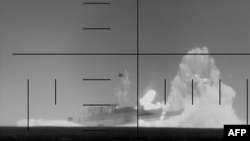
Defense Secretary Pete Hegseth confirmed a US submarine sank an Iranian warship off the coast of Sri Lanka as military officials said Iran is firing fewer missiles at targets around the Gulf region due to its decimated capabilities to wage war.
Speaking at a briefing on March 4, Hegseth called the attack -- which left at least 87 seamen dead with dozens of others injured or missing -- "quiet death." Sri Lankan authorities said 32 Iranian sailors were rescued.
"An American submarine sunk an Iranian warship that thought it was safe in international waters. Instead, it was sunk by a torpedo," Hegseth said.


Hegseth said the United States has the resources to continue the campaign, which started on February 28 in tandem with strikes by Israel, indefinitely if needed, saying Washington would take "all the time we need" to secure victory.
In response, Iran has launched missile and drone barrages at states around the Persian Gulf that have fanned fears the war could spread throughout the region.
Highlighting those fears, a ballistic missile launched from Iran headed toward Turkish airspace before being intercepted by NATO air defense systems.
The military alliance, to which Turkey is a member, condemned the incident, saying it "stands firmly with all Allies."

At the same briefing as Hegseth, General Dan Caine, chairman of the Joint Chiefs of Staff, said Iran was launching some 86 percent fewer ballistic missiles than it did on February 28, the first day of the conflict. Drone launches were down almost as much, he added.
"We have sufficient precision munitions for the task at hand, both on the offense and defense," Caine said.
Hegseth echoed those comments, adding that coalition forces expect to gain complete control of Iranian airspace within about a week, which would allow expanded bombing operations across the country.

EU foreign policy chief Kaja Kallas says she doubts Iran's capacity to sustain its pace of attacks on countries across the Middle East given its decimated military following the 12-day war last year with Israel and the current US-Israeli campaign.
She told RFE/RL in an interview in Warsaw on March 4 that "Iranian capacities are not endless, especially if also the big friends are not supporting them."
"Americans have also said that their target is the missile launchers and missile factories, then their capacity to cause harm is also and maybe more limited than they want to show. So this is always also a fight for narratives," Kallas said.

