




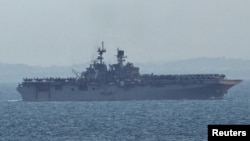
Thousands more US Marines arrived in the Middle East, as Washington continued laying the groundwork for a possible land invasion of Iran. The deployment has deepened fears of a widening war, though US officials said no decisions have been made whether to invade.
With the US war against Iran now in its second month, Iran's parliamentary speaker -- seen as a possible contender to lead the country after US-Israeli air strikes killed most of the top leadership -- accused the United States of "secretly" planning a ground attack despite talking about peace.
In a statement released on March 29, Mohammad Baqer Qalibaf called a 15-point peace proposal plan put forward by the United States last week as tantamount to surrender.
"We are certain we can punish America and make it regret ever considering an attack on Iran," he said.


The war, which started on February 28 when Israel and United States began attacking Iranian sites, was on the verge of widening dramatically after Houthi rebels fired a second salvo of missiles within 24 hours against Israel.
Israel intensified its attacks on Iran, targeting a naval research facility and striking sites in Tehran late on March 28.
Iran launched at least six salvos of ballistic missiles at Israeli sites on March 29, most of which were intercepted, Israeli officials said. Saudi Arabia also reported 10 drones, likely Iranian, had been intercepted early on March 29.
More than 3,500 US troops arrived in the region, US Central Command said March 28, including 2,500 Marines. The new troops come in addition to around 50,000 US military personnel who are already in the Gulf region, deployed at US bases.
The Washington Post, citing unnamed US officials, reported that the Pentagon was preparing plans for weeks of ground operations in Iran. The White House did not deny the report, but downplayed it, suggesting that such preparations would be routine contingency planning.
US Secretary of State Marco Rubio said last week that the deployments, which include units from the 82nd Airborne Division, were meant "to give the president maximum optionality and maximum opportunity to adjust the contingencies, should they emerge."
The involvement of the Houthis-- a Iran-backed Yemeni-based group that has been designated a terrorist organization by Washington-- risks widening the war further, as Iran retaliates against Gulf Arab states, and even farther away places, such as Cyprus and Diego Garcia in the Indian Ocean, where Britain has military assets.
Houthi spokesman Yahya Saree said the group fired "a barrage of cruise missiles and drones targeting several vital and military sites" in Israel. The attack "coincided with the military operations being carried out by" Iran and Hezbollah in Lebanon, he said in a statement.
Israel's military confirmed an incoming missile was fired from Yemen but said it was intercepted before it reached territory near the southern city of Eilat.
In a televised address a day earlier, Saree said "our fingers are on the trigger for direct military intervention” if attacks on Iran continue or if any new combatants join the war.
The Houthis, who have been armed, supplied, and funded by Iran for years, avoided joining the fight, but the missile launch raised fears of a possible disruption to the Bab al-Mandab Strait off Yemen, through which roughly 10 percent of the world's seaborne oil passes, to and from the Suez Canal.
Choking off the strait would be another major blow to global oil tanker traffic, following Iran's efforts to effectively shut down the Strait of Hormuz, which has sent global energy prices soaring.
Tehran said ships from “nonhostile” nations would be allowed to pass through the Strait of Hormuz.
Iran also threatened to target the American universities and colleges who have campuses scattered around the Gulf region.
'A Multifront War'
Israel's military said it hit Iran's Marine Industries Organization facility, which it said developed "a wide range of naval weaponry, including surface and sub-surface vessels, [and] manned and unmanned equipment."
Israeli military spokesman Brigadier General Effie Defrin asserted that Iran’s weapons production capabilities would be largely destroyed "within a few days."
“We are preparing for a multifront war," Defrin said, when asked about a widening of the war.

Israel has launched its own air and ground campaign in Lebanon against Hezbollah, a US-designated terror organization that has been backed by Iran for decades.
Iranian President Masud Pezeshkian threatened further retaliation against countries in the region should Iranian infrastructure or economic centers be targeted.
"If you want development and security, don't let our enemies run the war from your lands," he said.
Responding to the Washington Post story, White House spokeswoman Karoline Leavitt said: "It's the job of the Pentagon to make preparations in order to give the commander-in-chief maximum optionality. It does not mean the president has made a decision."
Pakistan Gets Hormuz OK
Pakistani Foreign Minister Ishaq Dar said Iran had agreed to allow an additional 20 Pakistani-flagged ships to pass through the Strait of Hormuz, with two vessels permitted to transit daily.

The Pakistani government has been acting as a mediator between Iran and the United States and has conveyed the US peace plan to Tehran. It is hosting a meeting of foreign ministers of Saudi Arabia, Turkey, and Egypt on March 29–30.
After the first day, Pakistani Foreign Minister Ishaq Dar said Islamabad is preparing to host talks to end the conflict in the coming days between Washington and Tehran.
"Pakistan will be honored to host and facilitate meaningful talks between the two sides in coming days, for a comprehensive and lasting settlement of the ongoing conflict," he said, although it wasn't clear if the United States and Iran had agreed to attend such a meeting.
Pakistan shares a 900-kilometer-long border with Iran and has a large Shi'ite Muslim minority. Iran's population is overwhelmingly Shi'ite.
Islamabad is also an ally of the United States -- although the relationship is often strained over issues such as the fight against terrorism -- and has close ties to the Gulf Arab states.
The Bangkok Post reported that Tehran has also agreed to allow Thai oil tankers through the strait. There was no immediate confirmation of the report.

The Strait of Hormuz accounts for around one-fifth of global oil shipments. Its effective closure has become a central issue of the conflict, driving up global energy prices and spooking nations with no involvement in the fighting.
Tehran has suggested that ships from "nonhostile" nations would have clear passage through the Strait of Hormuz. However, uncertainty has made it difficult to secure insurance, effectively preventing ships from using the waterway.

