





Hungarian Prime Minister Viktor Orban traveled to the TurkStream gas pipeline on the Hungarian-Serbian border on April 6, inspecting infrastructure that his government says was the target of a foiled sabotage attempt -- six days before parliamentary elections that polls suggest he may lose.
"Yesterday they wanted to blow up the gas pipeline," Orban wrote on Facebook before departing for the border. "We are checking whether everything is in order on the Hungarian side."
Serbian authorities said they discovered two backpacks containing about 4 kilograms of plastic explosives -- along with detonator caps, detonating cord, and tools used to assemble an explosive device -- near the village of Velebit in northern Serbia on April 5.
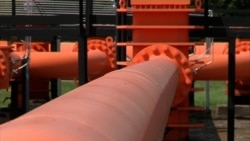

The Higher Public Prosecutor's Office in Subotica said the case had been classified as illegal weapons and explosives trafficking linked to suspected sabotage.
The find has quickly sparked a dispute over responsibility, with the issue spilling into the run-up to Hungary's upcoming elections.
Speaking after an emergency session of Hungary's Defense Council, Orban stopped short of directly naming Ukraine but said Kyiv had "for years been trying to cut Europe off from Russian energy," adding that attacks on the Russian section of TurkStream represented "a mortal danger for Hungary."
Ukraine's Foreign Ministry categorically rejected any involvement.
"This is most likely a Russian false-flag operation, as part of Moscow's strong interference in the Hungarian elections," spokesman Heorhiy Tykhiy wrote on X.
Kremlin spokesman Dmitry Peskov said there was "no reliable evidence" yet on who was responsible but still suggested Ukraine could be involved, citing what he claimed were past attacks on energy infrastructure.
Significant pushback on this, however, came from Serbia's own military intelligence.
Djuro Jovanic, director of the Military Security Agency (VBA), said flatly that "it is not true that Ukrainians tried to organize this sabotage," before adding a caveat that will complicate any definitive attribution.
"Based on the markings on the explosives, it is unmistakably clear that the manufacturer is from the United States," Jovanic said. "Now, will someone suggest that the United States would benefit from this situation at this moment?"
Jovanic said forensic analysis of the collected evidence was already under way and new information would follow.
He also disclosed that the VBA had spent months warning political leadership that an attack on gas infrastructure was possible and had met with "skepticism, disapproval, disagreement."
Jovanic claimed an immigrant with military training was behind the alleged sabotage operation.
Srdjan Cvijic of the Belgrade Center for Security Policy was unconvinced.
"Our authorities do not dare to openly accuse Ukraine, so they invent some supposed migrants instead, conveniently fitting into Orban's anti-migrant rhetoric," he told RFE/RL's Balkan Service.
Cvijic added that the incident reflected "all the core narratives of Russian disinformation being promoted in this part of Europe" and suggested Belgrade's handling of it pointed to "an intention to help a friend -- Orban -- in trouble," while stopping short of a direct accusation of Ukraine to avoid alienating Serbia's European partners.
The incident comes amid a tense energy standoff.
Budapest is already in dispute with Kyiv over the suspension of oil deliveries via the Druzhba pipeline, which Hungary and Slovakia blame on Ukraine, while Kyiv attributes the damage to a Russian drone strike.
Orban has leveraged both disputes to block the formal adoption of a 90-billion-euro ($104 billion) EU loan to Ukraine, which was approved by the other 26 member states in December.
That broader confrontation has defined Orban's campaign framing -- war or peace, Brussels or Budapest -- and his Fidesz party has worked to link opposition leader Peter Magyar to Ukraine and the EU.
Magyar called the pipeline incident a transparent attempt to boost Orban's flagging numbers.
Orban, standing before the cameras at the border, dismissed the charge.
"This event does not affect the elections," he said. "It affects Hungary's energy security. Let us not mix the campaign with governing the state."
The suspect remains unidentified. The election is on April 12.

