




Iran launched attacks across the Middle East on April 3, setting parts of a major Kuwaiti oil refinery ablaze and triggering air defense responses across the Gulf, as the war with the United States and Israel neared the end of its fifth week.
The refinery has been targeted several times since the war began and state-run Kuwait Petroleum Corporation said firefighters were working to put out multiple fires from the strikes. Electricity, water, and renewable energy infrastructure in Kuwait were also hit in the attack.
Tehran continued to keep the pressure on Israel and its other Gulf Arab neighbors. Saudi Arabia said it had destroyed several Iranian drones, air raid sirens sounded in Bahrain, defenses were activated in the United Arab Emirates, and Israel reported incoming missiles.
Authorities in Abu Dhabi in the United Arab Emirates said at least 12 people suffered "minor to moderate" injuries on April 3 from falling debris following the interception of an incoming projectile. Officials said seven Nepali nationals and five Indian citizens were injured.
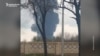
Iran also said that is shot down a US F-35 fighter jet. Multiple Iranian state media outlets, including Press TV, published the images along with a statement from the Islamic Revolutionary Guard Corps (IRGC) as evidence of a downed US jet in central Iran. The United States has not commented and RFE/RL has not been able to independently confirm the claim.
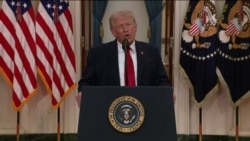
The latest wave of Iranian attacks follows comments from US President Donald Trump late on April 2 where he signaled further escalation, saying Washington had “not even started” its campaign against Iran and warning that more strikes on infrastructure were imminent, even as diplomatic efforts to contain the war showed little progress.
“The US hasn’t even started destroying what’s left in Iran,” he wrote in a series of social media posts, adding that targets could include bridges and power plants. “Iran’s leadership knows what has to be done, and has to be done, FAST!”
He also shared video of a US strike on a newly built bridge linking Tehran and the nearby city of Karaj. Iranian state media said the attack killed eight people and wounded 95. Iranian media said a separate drone strike hit a Red Crescent warehouse in the southern province of Bushehr, destroying two containers. The port city is a key maritime hub and home to Iran’s only nuclear power plant.
Iran also reported that the Pasteur Institute, a medical research center, suffered heavy damage in an attack. That report also could not be verified, although the Iranian government released a photo purporting to show the damage.

Iranian Foreign Minister Abbas Araqchi condemned the strike, saying attacks on civilian infrastructure “will not compel Iranians to surrender.”
Israeli Prime Minister Benjamin Netanyahu said Israeli strikes have destroyed about 70 percent of Iran's steel production capacity, significantly hitting Tehran's ability to manufacture weapons.
"Together with our American friends, we continue to crush the terror regime in Iran. We are eliminating commanders, bombing bridges, bombing infrastructures," Netanyahu said in a video statement.
Britain To Deploy Systems To Kuwait Amid Attacks
The latest exchange of attacks underscores how the war, which began with coordinated US-Israeli strikes on Iran in late February, is expanding across the region, disrupting global energy flows and raising pressure on world powers to secure shipping through the Strait of Hormuz, a critical artery for oil and gas supplies.
British Prime Minister Keir Starmer's office announced on April 3 that the country will deploy its Rapid Sentry air defense system to Kuwait to help protect British and Kuwaiti interests in the Gulf.
The Rapid Sentry is a ground-based short-range air defense system aimed at countering drone threats.
Iran has continued to target energy infrastructure across the Gulf while maintaining pressure on shipping routes through the strategic Strait of Hormuz, through which roughly one-fifth of global oil and gas supplies pass in peacetime.
In a social media post on April 3, Trump said: "With a little more time, we can easily open the Hormuz Strait, take the oil, and make a fortune. It would be a 'gusher' for the world???"
Oil markets have reacted sharply and sent prices climbing. Shipping through the strait, once a stable corridor for global trade, has been increasingly disrupted.
Trump has said it is not the responsibility of the United States to reopen the waterway, urging countries that rely on the route to take action themselves.

