




France Summons Iranian Diplomat Over Detention Of Embassy Staff
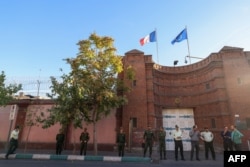
France's Foreign Ministry summoned Iran's charge d'affaires on July 21 after two French Embassy staff members were detained by Iranian security services in Tehran, with one allegedly physically assaulted.
"France expects the Iranian authorities to shed full light on this incident, to bring those responsible to justice, and to guarantee the security of our premises and personnel, in accordance with their international obligations," the ministry said.
Foreign Minister Jean-Noel Barrot said on July 20 that "two agents of the French Embassy in Iran were the target of an extremely serious act of intimidation by the Iranian security services, in blatant violation of the diplomatic immunities from which they benefit."
Barrot said the two staff members were "detained without reason for several hours" and "questioned," while "one of them was physically assaulted," before they were able to return to the French Embassy.
"This extremely serious and unacceptable violation of the integrity of our agents cannot remain without consequences," Barrot said, adding that he had conveyed the message to his Iranian counterpart, Abbas Araqchi.
We are now closing the live blog for the day. We'll be back at 9:00 a.m. Central European time to cover the latest events across the Middle East.
Trump Warned Xi Against Supporting Iran, US Ambassador Says
WASHINGTON -- US President Donald Trump directly warned Chinese President Xi Jinping against providing assistance to Iran during their talks in Washington, according to the US ambassador to China, offering new details about an issue that had loomed over Xi's visit.
Ambassador David Perdue, who attended the bilateral meetings, told CNBC that Trump made clear that any Chinese assistance to Tehran -- including intelligence, components, or military equipment -- was "totally unacceptable."
“There’s been indirect support we think, but there’s no direct evidence. We’re very concerned about this indirect work and we’ve made that very clear,” Perdue said.
In a separate interview with Fox News, Perdue said Beijing had given Washington assurances that it was not providing such assistance.
“We've seen movement...on that already. That's what the commitment is. They assured us yesterday they're not doing that,” he said.
The comments come after US lawmakers and national-security experts had urged Trump to confront Xi over allegations that Chinese entities have helped Iran through satellite intelligence, weapons components, and purchases of sanctioned Iranian oil.
Beijing has denied providing Tehran with military or intelligence support.
Xi instead publicly called for Washington and Tehran to return to negotiations aimed at ending the war and reopening the Strait of Hormuz.
Iran Says It Gave US 'Concrete' Plan To Reopen Strait Of Hormuz
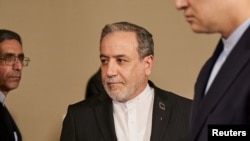
Tehran has given Washington a "concrete" plan to reopen the key Strait of Hormuz, Iranian Foreign Minister Abbas Araqchi said on September 25.
"If the necessary conditions are met, the strait can be reopened, a normal maritime passage restored within seven days. The choice now rests with the United States," he told reporters at the United Nations.
"The actions that the United States should take are not new," Araqchi added. He did not specify the steps Washington would have to take but said they were similar to those outlined in a memorandum of understanding the two countries had signed in Islamabad earlier this year.
The effective closure of the Strait of Hormuz has long been a central issue in the war between the United States and Iran and a major obstacle to a negotiated settlement aimed at ending the broader conflict in the Middle East.
Since the early days of the war, Tehran has restricted access to the waterway in response to US and Israeli attacks on Iran, disrupting global oil markets and sending prices soaring. In the following months, it also sought to impose a toll on vessels passing through the strait.
The United States, in turn, imposed a naval blockade on Iran in mid-April and reinstated it in July, diverting ships and preventing them from reaching Iranian ports.
Yemen’s President Calls On Yemenis To Mobilize Amid Houthi Attacks
Rashid al-Alimi, the Riyadh-based president of Yemen’s Saudi-backed, internationally recognized government, called on Yemenis on September 25 to mobilize and join the armed forces.
Al-Alimi also offered a future general amnesty to Iran-backed Houthi fighters and affiliates who leave the group on or after September 26.
Yemen descended into civil war in 2014 when the Houthis seized the capital, Sanaa, ousting the internationally recognized, Saudi-backed government. A 2022 truce had largely held until recently.
In July, a spate of attacks began after the Houthis welcomed an Iranian plane to Sanaa.
Earlier this month, Houthi rebels seized nearly all of Yemen’s Red Sea coastline, giving the militant group control of the Bab al-Mandab Strait, a key chokepoint for global trade. They have also intensified attacks on energy facilities in Saudi Arabia, the world’s biggest oil exporter.
With reporting by Reuters.
Iraqi Airports Suspend Iranian Flights As US Targets Tehran’s Aviation Sector
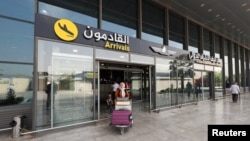
Iraqi airports have suspended flights operated by Iranian airlines after the United States targeted Tehran’s aviation sector. At least five other countries have imposed similar restrictions.
All flights to and from Iran have been suspended at airports in Baghdad, Najaf, Erbil, and Sulaimaniya, according to Iraqi state media and sources cited by Reuters on September 25.
Two days earlier, Washington had announced that it would impose sanctions on any company doing business with Iranian airlines, aiming to ground Tehran's entire civilian fleet worldwide.
The announcement was followed by flight suspensions in Oman, Azerbaijan, Georgia, Turkmenistan, and the United Arab Emirates, the Middle East’s biggest travel hub.
With reporting by Reuters.
At Asian Games, Hadiani Becomes Iran's First Woman To Compete In Gymnastics Since 1979
Twenty-year-old gymnast Hengameh Hadiani has become the first Iranian woman to compete in gymnastics at the Asian Games since Iran’s 1979 Islamic Revolution.
For 47 years, Iran’s hard-line authorities had refused to issue competition licenses to female gymnasts because of the country’s dress code restrictions.
On September 22, she placed 13th in artistic gymnastics at the Asian Games in Nagoya, Japan, with Iranian state-affiliated media celebrating her achievement as a “historic performance.”
The shift in tone echoes a pattern in state media coverage of women’s participation in other sports and activities. Reports celebrating such breakthroughs often overlook the official arguments used for decades to justify the restrictions.
About three years ago, for example, Mahin Farhadizadeh, a former Iranian deputy sports minister, said that standard gymnastics violated the Islamic republic’s “cultural standards,” adding that rhythmic gymnastics had “no athletic or medal value whatsoever.”
Iran has already won 24 medals in Nagoya, including six golds, 11 silver, and seven bronze.
With reporting by IranWire and Asianet News
Bosnian Arms Probe Leads To Iran-Linked Criminal Network, Sources Tell RFE/RL

Firearms allegedly diverted into illegal channels by a police officer near Sarajevo may have reached Iran-linked criminal networks across Europe, sources familiar with a Bosnian weapons-trafficking investigation told RFE/RL's Balkan Service.
The Bosnian State Investigation and Protection Agency (SIPA), working with Europol, carried out searches this week at several locations across the country, detaining a police officer in the town of Ilijas. While under SIPA supervision, the officer obtained a gun and committed suicide.
He was suspected of misusing firearms permits issued to residents of the town and the surrounding area to purchase pistols from at least two Bosnian companies -- Bratunac and Doboj -- and rerouted them into illegal channels.
Information obtained by RFE/RL suggests that dozens of firearms were acquired by the criminal groupings through this path in 2024 and 2025.
To read the full report, click here.
Pezeshkian Offers To Dilute Uranium, Calls For Return To June MOU
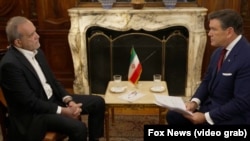
Iranian President Masud Pezeshkian said Tehran is willing to dilute its stockpile of uranium enriched to 60 percent and allow international verification of its nuclear program, while calling for Washington to return to a June memorandum of understanding (MOU).
In an interview with Fox News's Bret Baier that aired on September 24, Pezeshkian rejected the possibility of Iran seeking a nuclear weapon, saying, "Not at all. Not at all." He cited a religious decree by the late Supreme Leader Ayatollah Ali Khamenei against nuclear weapons and said Iran was ready to "dilute" its enriched uranium and "submit ourselves to verification."
Pezeshkian also said Tehran remained willing to move forward with the United States on the basis of the June MOU, which established a framework for ending hostilities and negotiating a broader agreement. The agreement provided for negotiations over a period of up to 60 days.
Speaking separately to NBC News on September 24, Pezeshkian said Tehran did not want negotiations to extend until the US midterm elections. "We wish Americans to return to the MOU before the midterms," he said.
Fellow Protesters Call For Ali Zarei's Life To Be Spared
Nine Iranians who suffered eye injuries during the 2022 Women, Life, Freedom protest movement have called for international and domestic action to prevent the execution of fellow protester Ali Zarei Doozdarrehsi.
Zarei, who is being held at Ghezel Hesar Prison near Karaj, was transferred to solitary confinement on September 21, prompting concerns that his execution could be imminent. The Iran Human Rights group and HRANA reported the transfer, while Iran Human Rights said Zarei had previously sent a voice message from prison stating that his death sentence had been upheld.

Zarei was injured in one eye during the 2022 protests and later lived in Germany. He returned to Iran this year and was arrested by Intelligence Ministry agents on April 28. Branch 23 of the Tehran Revolutionary Court subsequently sentenced him to death on the charge of "corruption on Earth." HRANA said the verdict was formally communicated to him on August 23.
The nine protesters who recorded messages supporting Zarei are Ghazal Ranjkesh, Erfan Ramizipour, Mersedeh Shahinkar, Majid Movafegh, Hossein Noori-Nikoo, Hamidreza Heydari, Salar Vatan-Shenas, Parsa Ghobadi and Ali Delpasand. Their appeal was published by Reza Pahlavi's communications account on X.
The protesters also appealed to international organizations, including the UN, to intervene on Zarei's behalf.
Bessent Says Up To 90 Percent Of Iran's Foreign Flights Suspended
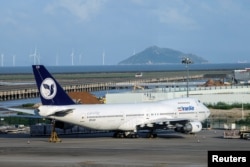
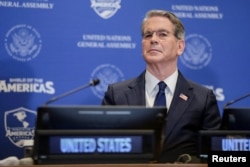
US Treasury Secretary Scott Bessent said Washington had placed Iran under unprecedented economic pressure, telling Fox News that "we have put the Iranian government under pressure in a way that they have never seen before." He also said that more than 80 or 90 percent of Iran's foreign flights had probably been suspended, adding: "I don't know how Iran's representatives at the United Nations are going to get back home."
The comments followed a US sanctions campaign targeting Iran's aviation sector. On September 8, the Treasury Department sanctioned 36 targets and said the measures covered Iran's remaining airlines and aviation-related networks. Bessent subsequently said foreign airports and companies providing fuel, landing services, or tickets to sanctioned Iranian airlines could risk exclusion from the US dollar system.
The campaign is part of Operation Economic Outcast, launched by Treasury on August 24 to intensify financial and secondary sanctions against Iran and its international enablers.
Bessent described the Iranian leadership as "cornered animals" and said the world had "never seen anything like this." He outlined three possible outcomes: the regime turning on itself, an uprising in Iran, or Tehran agreeing to a deal and adhering to it. He said the US-Iran Islamabad Memorandum of Understanding, signed in June, had subsequently broken down after renewed fighting and attacks on shipping.
Iranian officials have threatened countries cooperating with the US restrictions. Supreme National Security Council Secretary Mohsen Rezaei warned: "If you side with America, we will not just watch you…. Your airports will have no flights."
China has meanwhile opposed the US airline sanctions, calling unilateral measures without UN authorization "illegal."