



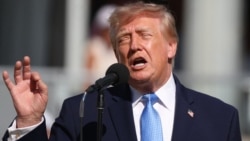

US Fires On, 'Disables' Vessel Seeking to Evade Blockade Of Iranian Ports
US Central Command (CENTCOM) said its forces struck a tanker early on July 25 attempting to reach an Iranian port in violation of the US blockade of the country's ports.
Spokesman Captain Tim Hawkins said the tanker was struck after attempting to evade the blockade multiple times.
"We disabled the tanker after the crew attempted to run the blockade at least four times prior," Hawkins told AFP.
"The crew was repeatedly warned, didn’t comply, and US forces on scene disabled the ship after firing into its engine room," he said. "The ship is no longer transiting to Iran.”
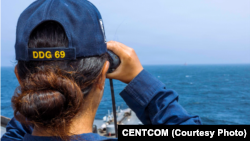
CENTCOM did not immediately disclose the specific type of tanker, the location, or its country of origin.
US forces earlier this month resumed the blockade of Iranian ports earlier this month, preventing ships from entering or leaving the country's ports and coastal areas.
A similar naval blockade was initially imposed in mid-April before it was lifted in mid-June as part of an interim framework agreement with Tehran.
The number of oil tankers passing through the Strait of Hormuz on July 23 reached the lowest level in nearly seven weeks, according to data from oil tanker traffic monitoring companies.
Only one giant oil tanker, called the New Giant and carrying 2 million barrels of Iraqi crude oil, left the Strait of Hormuz and headed for China on July 23.
On July 21 and 22, three and eight oil tankers passed through the Strait of Hormuz, respectively.
Before the US-Iran war began, up to 150 vessels passed through the strait per day.
With reporting by dpa and AFP
Trump Sees More Talks In Coming Week After Rejecting Iran's Hormuz Proposal
US President Donald Trump said he expects negotiations with Tehran to resume in the upcoming week, despite having rejected a proposal put forward by Iran days earlier.
"They want to make a deal, but it is not the deal that I want to make," Trump said in a phone interview with Axios on September 27 without providing specifics.
"It is what we would have maybe agreed to a year ago," he added.
Trump on September 25 rejected a proposal made hours earlier by Tehran to reopen the important Strait of Hormuz, saying that Iran made the offer because "they are losing so badly."
"They overplayed their hand," Trump told Axios.
Axios, citing sources familiar with the talks, said indirect talks could resume as early as September 28 through Qatari mediators.

US envoys Steve Witkoff and Jared Kushner met last week with Iranian Foreign Minister Abbas Araqchi on the sidelines of the UN General Assembly in New York, although no breakthroughs were reported.
According to The Wall Street Journal, Trump is considering resuming air strikes on Iran following the November 3 midterm elections amid growing public opposition to the war, which has sent fuel prices surging in the US and around the globe.
Iran on September 27 said its demands for reopening the Strait of Hormuz had not changed – including the release of frozen Iranian assets, the lifting of sanctions on Iranian oil, and an end to the US naval blockade.
"Our conditions are clear, and any move toward reopening the Strait of Hormuz is contingent upon these conditions being fulfilled. We will not back down from them," Araqchi said, according to state broadcaster IRIB.
We are now closing the live blog for the day. We'll be back at 9:30 a.m. Central European time to cover the latest events across the Middle East.
Middle East Oil Exports Rise, But Still Down From Prewar
Data showed that crude oil exports from key Middle East producers have recovered in September to 12.8 million barrels a day -- the highest level since the beginning of the US-Israeli war with Iran at the end of February.
Figures released on September 28 by commodity analytics firm Kpler showed that Saudi Arabia and the United Arab Emirates led the rise in exports.
Exports from the region -- including those from Saudi Arabia, the UAE, Iraq, Oman, Qatar, Kuwait, and Iran -- although experiencing a rebound, are still some 6 million bpd down from 18.8 million bpd in February, according to Kpler.
With reporting by Reuters
Five Men Arrested Near UK Air Base Used By US Forces In Iran War
British police have arrested several men on suspicion of explosives offenses near an air base used by US forces, prompting the evacuation of residents from nearby homes.
Police declared a major incident on September 27 near RAF Fairford in Gloucestershire, western England, and said army bomb-disposal experts were examining several vehicles.
RAF Fairford is used by the US Air Force and has been used for US military operations against Iran.
Several properties in the nearby village of Whelford were evacuated, and residents were taken to a local leisure center, police said.
Armed police were seen blocking access to the main gate of the base, according to Reuters.
In March, Britain granted the United States permission to use RAF Fairford and another British base for what the government described as specific and limited defensive action against Iranian missile facilities. The permission was later extended to missile sites and capabilities threatening shipping in the Strait of Hormuz.
Iran's Islamic Revolutionary Guards Corps warned in July that any base used for strikes against Iran would be considered a legitimate target, according to Reuters.
There was no immediate indication that the arrests were connected to Iran or to any foreign government.
The US Air Force said it remained vigilant and would take appropriate measures to protect US personnel, civilians, contractors, and their families, according to Reuters.
British authorities have also warned in recent months about the threat of hostile activity and possible sabotage by state actors, including Russia. The British government has said it does not comment on specific intelligence or security threats.
Gloucestershire police said it believed the incident was contained.
UPDATE: Counter-terrorism police said five men remain in custody and have been arrested on suspicion of preparing a terrorist act.
US President Donald Trump described the arrests as "fantastic" and called the prevention of the act "an amazing job," adding that the suspects had been planning to cause "big damage."
Deputy Assistant Commissioner Vicki Evans said police were in the "early stages of an investigation" and were working with Gloucestershire Police and other partners to gather evidence.
A 400-meter cordon remains in place around the vehicles while the Army's Explosive Ordnance Disposal unit examines them, Evans said. Some 85 households have been evacuated.
The BBC reported that a wheeled robot was operating next to three parked white vans as the bomb-disposal team examined the vehicles in Whelford.
US Treasury Chief Hails Success Of New Economic Measures On Iran
US Treasury chief Scott Bessent said he had deployed representatives around the globe to pressure countries to economically isolate Iran, citing new restrictions that have targeted the Islamic republic's airline and banking sectors.
"At my direction, teams were dispatched across the globe to engage with countries and demand action against the Iranian regime," he wrote on X. "These efforts are delivering results."
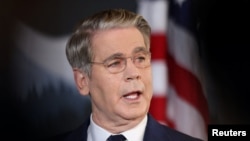
Bessent said the United Arab Emirates has stopped all flights by Iranian airlines and that Turkey and Oman have halted incoming flights from Mahan Air.
The UAE's emirate of Dubai is a major destination for Iranian carriers, with multiple flights each day, and a large Iranian community.
A Wall Street Journal article shared by Bessent said Treasury's assistant secretary for terrorist financing traveled across the Middle East and Europe over two weeks to press the plan to impose what Bessent called "economic D-Day" on Iran.
Discussions were held with more than 50 countries, the Journal reported.
With reporting by AFP
Saudis Call On Global Community To Help Ensure Free Sea Traffic In Region
Saudi Arabia called on UN members to join efforts to defend freedom of navigation in vital Middle East waterways, calling the current situation a threat to global energy security.
"The international community has been absent from assuming its responsibilities in confronting all that threatens international peace and security," Foreign Minister Faisal bin Farhan told the UN General Assembly on September 26.
Iran has disrupted shipping through the Strait of Hormuz, and its Houthi allies in Yemen have done similar actions in the Bab al-Mandab Strait. Both are crucial routes for transit of oil and gas exports.
"The kingdom stresses the importance of guaranteeing the protection of freedom of navigation in all international waterways, foremost among them the Strait of Hormuz, the Bab al-Mandab Strait, the Red Sea, the Gulf of Aden," he said.
He also demanded "the return of conditions in the Strait of Hormuz to what they were before February 28, without imposing any fees or taxes.”
Tehran has insisted it has the right to charge transit charges or similar fees to allow sea traffic to flow through the Strait of Hormuz, while the global community insists that the passage is an international waterway and not under the control of any one nation.
With reporting by AFP
Iraq In Talks With US Over Exemption From Sanctions On Iranian Airlines
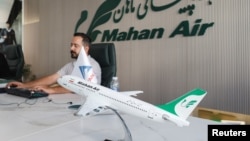
The Iraqi government said on September 26 that it was in talks with Washington to secure an exemption from US sanctions on Iranian airlines that have grounded Tehran's civilian fleet in several countries where they operate.
"The Iraqi government is holding direct talks with the American side to exempt certain Iraqi airports from these measures," the Iraqi prime minister's media office said, adding that the move would allow flights to resume "for humanitarian reasons, including medical treatment, education, religious visits."
Earlier in the week, after a number of countries, including the Middle East's biggest travel hub, the United Arab Emirates, restricted flights to and from Iran, Iraq suspended such flights at the country's airports in Baghdad, Najaf, Erbil, and Sulaimaniya.
Iran's ambassador to Iraq Mohammad Kazem Al-Sadegh said in an interview with the Iranian news agency ISNA that Tehran was in contact with the Baghdad to find a way to restore the flights, adding that there are "roughly 25 daily flights from Iran to Najaf and about 15 flights to Baghdad."
Iraqi airlines stopped flying to Iran when the conflict in the Middle East began earlier this year.
With reporting by AFP.
Trump Rejects Iran's Plan To Reopen Strait Of Hormuz
US President Donald Trump said on September 26 that he was "rejecting" Iran's seven-day plan to reopen the key Strait of Hormuz as unacceptable.
"I'm rejecting their deal. They want to make a deal where they open the strait immediately because they're losing so badly," Trump told reporters outside the White House. "I like making a deal, too, but that deal would not be acceptable."
A day earlier, Iranian Foreign Minister Abbas Araqchi said Tehran had given Washington a "concrete" plan to reopen the strait, requiring steps similar to those outlined in a memorandum the two countries signed in Islamabad earlier this year.
The effective closure of the Strait of Hormuz has been a major obstacle to a negotiated settlement aimed at ending the war between the United States and Iran.
In response to US and Israeli attacks, Tehran restricted access to the strait at the start of the war, disrupting global oil markets and sending prices soaring. Washington, in turn, imposed a naval blockade on Iran, diverting ships and preventing them from reaching the country's ports.
Trump said the United States had "total control" over the Strait of Hormuz. He said that "massive amounts of oil" were moving through the waterway, with 29 ships crossing the chokepoint over the past day.
"They outsmarted themselves," the US president added, saying Washington had cut off one of Tehran's main sources of income with its naval blockade. "They don't have any money now, because they wanted to close the strait, and we closed it on them."
UPDATE: Iranian Foreign Minister Abbas Araqchi said on September 27 that Tehran had seen the reported remarks by Trump to its proposal but had not yet received an official response through mediators.
Araqchi said Iran was waiting for the mediators to convey the definitive US position and would make a decision based on it.
The foreign minister said that only diplomacy can end the conflict.
"Our conditions are clear, and any move toward reopening the Strait of Hormuz is contingent on these conditions being met," he said. "Only a negotiated solution can get them out of this deadlock."
Trump Warned Xi Against Supporting Iran, US Ambassador Says
WASHINGTON -- US President Donald Trump directly warned Chinese President Xi Jinping against providing assistance to Iran during their talks in Washington, according to the US ambassador to China, offering new details about an issue that had loomed over Xi's visit.
Ambassador David Perdue, who attended the bilateral meetings, told CNBC that Trump made clear that any Chinese assistance to Tehran -- including intelligence, components, or military equipment -- was "totally unacceptable."
“There’s been indirect support we think, but there’s no direct evidence. We’re very concerned about this indirect work and we’ve made that very clear,” Perdue said.
In a separate interview with Fox News, Perdue said Beijing had given Washington assurances that it was not providing such assistance.
“We've seen movement...on that already. That's what the commitment is. They assured us yesterday they're not doing that,” he said.
The comments come after US lawmakers and national-security experts had urged Trump to confront Xi over allegations that Chinese entities have helped Iran through satellite intelligence, weapons components, and purchases of sanctioned Iranian oil.
Beijing has denied providing Tehran with military or intelligence support.
Xi instead publicly called for Washington and Tehran to return to negotiations aimed at ending the war and reopening the Strait of Hormuz.
Iran Says It Gave US 'Concrete' Plan To Reopen Strait Of Hormuz
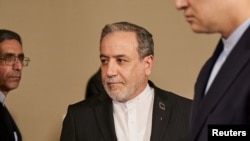
Tehran has given Washington a "concrete" plan to reopen the key Strait of Hormuz, Iranian Foreign Minister Abbas Araqchi said on September 25.
"If the necessary conditions are met, the strait can be reopened, a normal maritime passage restored within seven days. The choice now rests with the United States," he told reporters at the United Nations.
"The actions that the United States should take are not new," Araqchi added. He did not specify the steps Washington would have to take but said they were similar to those outlined in a memorandum of understanding the two countries had signed in Islamabad earlier this year.
The effective closure of the Strait of Hormuz has long been a central issue in the war between the United States and Iran and a major obstacle to a negotiated settlement aimed at ending the broader conflict in the Middle East.
Since the early days of the war, Tehran has restricted access to the waterway in response to US and Israeli attacks on Iran, disrupting global oil markets and sending prices soaring. In the following months, it also sought to impose a toll on vessels passing through the strait.
The United States, in turn, imposed a naval blockade on Iran in mid-April and reinstated it in July, diverting ships and preventing them from reaching Iranian ports.