




Somali Pirates Seize Iran-Linked Tanker
An oil tanker under US sanctions for allegedly transporting Iranian petroleum products has been seized off Yemen and diverted toward Somalia, the latest sign of a resurgence in Somali piracy.
Six armed individuals boarded the Eritrea-flagged Sibu 1 on August 20, according to the shipping-security monitor United Kingdom Maritime Trade Operations (UKMTO).
Washington sanctioned the tanker in December, saying it belonged to a so-called shadow fleet used to circumvent restrictions on Iranian petroleum exports.
The Sibu 1 is at least the 13th vessel attacked this year off Somalia or in the Gulf of Aden, according to International Maritime Bureau data and UKMTO reports, up from five attacks in all of 2025.
Somali piracy, which caused hundreds of attacks between 2008 and 2014 before being largely suppressed by an international naval response, has revived as security resources are stretched elsewhere.
Experts say higher oil prices and the diversion of naval assets toward to counter from Iran and Yemen's Houthi rebels may have created fresh opportunities for pirates.
With reporting by Reuters
Report: US Blockade Squeezes Iranian Oil Supplies To China
Offers of Iranian crude to Chinese buyers have fallen and prices have risen sharply as a US blockade restricts Tehran’s oil exports, according to traders and ship-tracking data, Reuters reports.
Trade sources said less Iranian oil was being offered for delivery in September and October as supplies already aboard tankers were sold off. Iranian crude, which is normally sold at a discount because of US sanctions, was in some cases being offered at a premium to international benchmark prices.
The amount of Iranian crude being stored aboard tankers outside the US blockade zone has fallen to about 80 million barrels from 105 million barrels before the blockade was reinstated on July 13, according to Kpler, a maritime data and ship-tracking firm.
The squeeze is hitting China’s independent refiners, known as teapots, which are major buyers of sanctioned Iranian oil. Some have begun seeking alternatives, including Brazilian and Iraqi crude.
“Given the thin Iranian availability amid the U.S. blockade, Chinese teapots are now looking beyond Russia and Iran,” Energy Aspects analyst Sun Jianan told Reuters.
China’s Iranian crude imports fell to 534,000 barrels per day (bpd) so far in August, according to Kpler, compared with an average of 1.4 million bpd last year.
The supply squeeze comes as Washington prepares further economic pressure on Tehran. US Treasury Secretary Scott Bessent on August 20 threatened Iran with “the toughest sanctions in history,” with details expected on August 24.
China buys more than 80 percent of Iran’s shipped oil, according to Kpler. Beijing has criticized unilateral sanctions and says sanctions will not resolve the conflict.
Based on reporting by Reuters
Qalibaf Says 'We Cannot Survive' If People Go Hungry
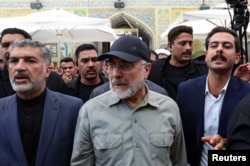
In an implicit warning about Iran's economic conditions, the country's parliament speaker, Mohammad Baqer Qalibaf, has said “no matter how much military power we have, if the people are hungry and we do not have financial activity, economic growth, and domestic production, we cannot survive.”
Speaking in Iraq on August 21 to a group described by Iranian media as Iranian and Iraqi businesspeople, Qalibaf called the US government's new measures to impose severe economic sanctions on Iran “unjust” and said: “We must plan to overcome them so that we can prevail.”
Qalibaf, a hard-line former Revolutionary Guards commander who headed Iran’s negotiating team in talks with the United States, called for Iran and Iraq to use their national currencies in bilateral trade, saying: “We can strike a blow against the American currency.”
His visit to Iraq comes as Washington intensifies economic pressure on Tehran and negotiations aimed at ending the conflict remain stalled.
US Treasury Secretary Scott Bessent told the US network CNBC on August 20 that Washington's plan to intensify economic sanctions on Iran was going to “collapse” the Islamic republic.
"It is a one-two punch. We have the blockade [on Iranian ports], and we are going to have the toughest sanctions in history," he said.
Details of the sanctions are expected to be announced on August 24.
This blog entry has been updated to cover Qalibaf's comments on economic conditions in Iran.
Just 7 Commodity Ships Transit Hormuz, According To Shipping Tracker
Shipping through the Strait of Hormuz remained at low levels on August 20, with just seven commodity vessels transiting the key energy route, according to data from the ship-tracking firm Kpler.
The total, comprising four vessels entering the strait and three leaving, was half the previous day's tally. No very large crude carriers or liquefied natural gas (LNG) tankers made the crossing, although one very large gas carrier transporting propane and butane exited via the Iranian-designated route on the northern side of the strait.
Shipping through Hormuz has remained far below prewar levels amid repeated attacks on commercial vessels and Iran's efforts to control traffic through the waterway.
Tehran says the strait remains closed to normal shipping but has allowed some vessels to use routes it has designated, while Washington rejects Iran's claim of control and says it remains open.
Traffic also slowed through the Bab el-Mandeb Strait between Yemen and the Horn of Africa, with 23 commodity vessels crossing the narrow body of water, down from 34 on each of the previous two days. Two Suezmax crude tankers -- large vessels typically capable of carrying about 1 million barrels of crude -- were among those exiting, bound for Vietnam and India.
Kpler's figures do not include vessels operating with their transponders switched off.
With reporting by Reuters
Iran-Backed Houthis Claim Drone Hits On Saudi Airport, Oil Facility
Iranian-backed Houthi rebels based in Yemen claimed they launched successful drone attacks on airport and an oil facility in the Najran region of Saudi Arabia, near the Yemeni border, on August 20.
The group "successfully carried out two military operations using drones: the first targeted a sensitive Saudi enemy site at Najran Airport, while the second targeted the Aramco facility in Najran," Houthi military spokesman Yahya Saree said on Telegram.
There was no confirmation from Saudi authorities or Aramco, the state-owned oil giant.
The statement came not long after Iran's Islamic Revolutionary Guards Corps (IRGC) asserted that Saudi Arabia would be "unable to contain" the Houthis, a US-designated terrorist organization.
Yemen descended into civil war in 2014 when the Houthis seized the capital, Sanaa, ousting the internationally recognized, Saudi-backed government. A 2022 truce had mostly held until recently.
In July, a spate of attacks began after the Houthis welcomed an Iranian plane in Sanaa. They later announced a maritime blockade of Saudi Arabia and launched attacks targeting Saudi ships, airports, and oil facilities.
USS George Washington Arrives In Arabian Sea Near Strait Of Hormuz
The US military's Central Command (CENTCOM) says that the aircraft carrier USS George Washington has arrived in the Arabian Sea.
The Arabian Sea connects in the north to the Gulf of Oman and then to the Strait of Hormuz.
CENTCOM posted a photograph on X on August 20 of the carrier’s crew on deck in the Arabian Sea and said the George Washington Carrier Strike Group had entered the command’s area of responsibility the previous day and would operate in the region as part of its scheduled deployment.
The Wall Street Journal, CNN, and NBC News reported that the USS George Washington was being sent to the Middle East to relieve the USS Abraham Lincoln. CNN cited a US official as saying the rotation had been planned in advance.
The move comes amid reports of food and supply shortages, plumbing problems, declining morale, and mental-health concerns aboard the Lincoln after months at sea.
Defense Secretary Pete Hegseth said reports of difficult conditions aboard the ship had been “completely misrepresented” and that the military was doing everything possible to support the crew.
The Abraham Lincoln left San Diego in November 2025 and has spent more than eight months deployed, including more than 200 consecutive days without a substantial port call. US carrier deployments typically last about six to nine months, although they can be extended during wartime.
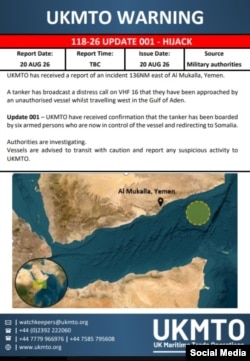
Armed Men Seize Tanker Off Yemen, Shipping Monitor Says
A tanker traveling through the Gulf of Aden was seized by six armed people and diverted toward Somalia, according to the shipping security monitor United Kingdom Maritime Trade Operations (UKMTO).
The vessel had been heading west when it reported being approached by an unauthorized craft about 136 nautical miles east of Mukalla, Yemen, UKMTO said on August 20.
The armed group subsequently boarded the tanker and took control of it.
UKMTO gave no further details and the safety of the crew remains unclear.
Iran Hangs Man Accused Of Involvement In Killing Officers In January Protests
- By Kian Sharifi
Iranian authorities have executed another defendant in connection with the deadly unrest in Isfahan in January, marking the fifth execution linked to a single high-profile case arising from widespread protests against the Islamic republic's leadership.
The Iranian judiciary announced on August 20 that Qaem Hosseini, who went by the alias "Arian," was executed in the early hours of the morning.
Authorities identified Hosseini as a foreign national. Earlier reports noted that his cousin and co-defendant, Gol-Mohammad Mohammadi, was an Afghan citizen.
Hosseini was convicted of “corruption on earth,” the most serious offense under Iran’s Islamic jurisprudence; moharebeh (waging war against God); acting against national security; and destruction of public property.
State prosecutors alleged that Hosseini played an active role during the January 8 unrest at Isfahan's Alikhani Square, where four special forces officers were killed.
Hosseini's execution brings the total number of people put to death in the Alikhani Square case to five. At least eight other defendants in the same case currently face potential execution.
Since the start of the war with the United States and Israel on February 28, Iran has witnessed a surge in executions of people human rights groups consider political prisoners -- from demonstrators to alleged members of banned groups and those convicted of spying.
According to the Office of the UN High Commissioner for Human Rights (OHCHR), Iranian authorities executed at least 56 people on security-related and political charges between March 19 and August 5. This total includes at least 27 protesters convicted over their involvement in antiestablishment unrest.
According to Amnesty International, Iran conducts the second most executions of any country in the world behind China.
Bessent Says 'Toughest Sanctions In History' Will 'Collapse' Iranian Regime
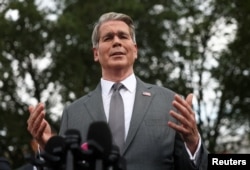
Treasury Secretary Scott Bessent said the United States will impose "the toughest sanctions in history" on Tehran and suggested plans to turn up the economic pressure mean major US military attacks on Iran are unlikely to resume soon.
"It is a one-two punch. We have the blockade [on Iranian ports], and we are going to have the toughest sanctions in history," Bessent told US network CNBC on August 20. "It is going to work in Iran and we are going to collapse this regime."
Bessent's comments came a day after President Donald Trump threatened Iran with “Economic Warfare and Isolation on a tremendous scale” and warned that any country providing support to Iran will face severe economic fallout.
In addition to pressure on Tehran, "ANY country that allows its financial institutions, businesses, airports, or government entities to provide any type of lifeline to Iran will itself face TREMENDOUS Economic Consequences," Trump wrote on his Truth Social platform late on August 19.
"This is going to be the greatest coordinated economic isolation in the history of the world," Bessent said. "And we are going to [allies] and saying you are either with us or against us."
Neither Trump nor Bessent offered much detail.
Bessent told CNBC he would hold a press conference on August 20 "to talk about exactly what we're going to do."
As oil prices rose on August 20, Bessent said he believed oil markets were "misinterpreting what this economic pressure means. If we are doing the maximum economic pressure, then that means that likely there will not be a large-scale kinetic restart."
"Kinetic" in this context refers to military action.
Trump's warnings came in a social media post in which he said Tehran had failed to agree to a deal with United States.
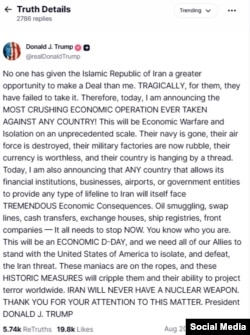
That post came hours after Trump said that negotiations with Iran could possibly resume "at some point" but expressed satisfaction with the current state of affairs, saying, “Right now, I think the situation is so good."
A 60-day negotiating period established under a US-Iran memorandum of understanding (MOU) signed in June expired earlier this week. The MOU was intended to establish a framework for ending the conflict, preventing Iran from obtaining a nuclear weapon, and restoring freedom of navigation through the Strait of Hormuz.
The United States says Iran violated the June understanding by attacking neutral commercial vessels in the strait in July, prompting renewed US military action. The US-Israeli war with Iran began on February 28.
This blog entry has been updated to include Scott Bessent's comments. With reporting by AFP and Reuters.
Iran's Qalibaf Meets With Iraqi Prime Minister
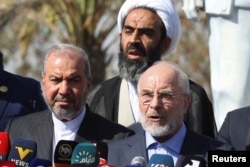
Mohammad Baqer Qalibaf, speaker of the Iranian parliament, held talks with Iraqi Prime Minister Ali Faleh Al-Zaidi on August 19, the first day of his visit to Iraq.
Qalibaf described the purpose of his visit as "to strengthen the new order in the region and accelerate the strengthening of cooperation between all countries in the region without foreign interference."
However, efforts to disarm Iranian-backed Iraqi armed groups have become a prominent issue in relations between Baghdad and Washington in recent months.
The Iraqi government, under pressure from the United States, has given these groups until September 30 to hand over their weapons. This date coincides with the end of the US-led international coalition mission against Islamic State.