



Iran: Strait Of Hormuz Won't Open Until Our Conditions Are Met
An Iranian official said that Tehran will not allow the Strait of Hormuz to open until the United States takes meaningful steps toward fulfilling Iran's conditions.
Mohsen Rezaei, secretary of Iran's Supreme National Security Council, made the comments during a meeting with Qatari Prime Minister Mohammed bin Abdulrahman Al-Thani in Tehran on August 27.
Rezaei warned that if the United States tries to "commit evil" against Iran, Tehran will target Washington's military and economic interests.
He also cited Iran's "distrust in America," saying the country repeatedly betrayed Tehran in diplomacy and negotiations.
Al Thani, who traveled to Tehran with the aim of mediating between Iran and the United States, also met with Mohammad Baqer Qalibaf, speaker of the Parliament and Iran's chief negotiator.
White House: No Talks Under Way As US Seeks To 'Destroy' Iran Economy
Washington and Tehran are not currently in talks to end the war, White House Press Secretary Karoline Leavitt said on August 27, as the United States focuses on efforts to "destroy" Iran's economy.
Leavitt added, though, that all options remain "on the table" in the drive to prevent Iran from becoming a nuclear power.
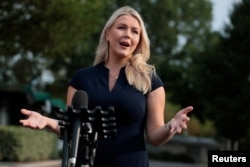
"What President [Donald] Trump's No. 1 goal has been and will always be is to ensure that Iran can never obtain a nuclear weapon. Period," Leavitt said in an interview with Fox News.
"We've had Operation Epic Fury to destroy their military. Now we have Operation Economic Outcast to destroy their economy."
She said that "no negotiations are happening right now, and this will continue until the president feels that maybe they come to the table in a meaningful way. We have not seen that yet."
Trump "of course" retains all options on the table, she said, adding that the naval blockade on Iranian ports remains in effect.
Trump and US Treasury Secretary Scott Bessent have declared what they labeled an "economic D-Day" against Iran and warned countries to cut financial ties with Tehran or face secondary sanctions, although few details were released.
Meanwhile, Qatari Prime Minister Mohammed bin Abdulrahman Al Thani visited Tehran on August 27 for a meeting with his Iranian counterpart, Abbas Araqchi, the Iranian Foreign Ministry said, although details were not immediately disclosed.
Qatar, along with Pakistan, has acted as a mediator for talks between Washington and Tehran. Qatar has also been a target of Iranian missile and drone attacks that have hit US Gulf Arab states since the start of the war.
Iran Says It Will Block UN Watchdog's Access To Bombed Nuclear Sites
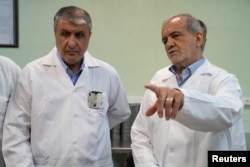
Iran will not allow inspectors from the UN’s atomic watchdog to visit nuclear facilities damaged in military attacks until new inspection procedures are established, the head of the country's Atomic Energy Organization (AEOI) said.
Iran has denied the International Atomic Energy Agency (IAEA) access to nuclear sites damaged in US and Israeli strikes in June 2025, though inspectors have been allowed to visit some unaffected facilities.
AEOI chief Mohammad Eslami told the IRNA state news agency on August 26 that the IAEA could not inspect the damaged facilities until rules and protocols governing access to them had been drafted, approved, and formally issued.
As a party to the Nuclear Non-Proliferation Treaty, Iran is required under a safeguards agreement with the IAEA to allow the agency to verify the country’s declared nuclear material.
Eslami said the attacked facilities “are all registered with the agency and had been continuously inspected by the agency,” adding that the IAEA's failure to protest against or condemn the strikes called its competence and independence into question.
IAEA Director General Rafael Grossi has said nuclear facilities should never be attacked and has repeatedly warned of the risks that military strikes pose to nuclear safety, security, and safeguards.
Before the US and Israeli strikes on Iranian nuclear facilities in June 2025, the IAEA estimated that Iran had about 440 kilograms of uranium enriched to 60 percent. The agency has since been unable to verify the status and whereabouts of that material.
Uranium enriched to 60 percent is a short technical step from the roughly 90 percent purity considered weapons grade. Iran claims its nuclear program is peaceful, while the United States and Israel have long accused Tehran of pursuing an atomic weapons capability.
Iran Mulls Fuel Price Increase As Gasoline Shortage Deepens
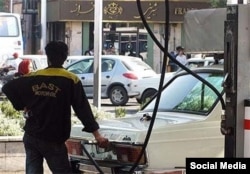
Iran is unable to import gasoline to cover a growing domestic supply shortfall because of the US naval blockade, Iranian Vice President Mohammad Jafar Qaempanah said, as authorities consider changes to heavily subsidized fuel prices.
Qaempanah said changes to gasoline and diesel pricing were necessary but that the scale and timing had not been decided.
“The distribution of gasoline is not equitable and continuing on this path is impossible,” Qaempanah was quoted as saying by the IRNA state news agency. “Moreover, gasoline production is insufficient, and because of the US naval blockade, we cannot import gasoline.”
Reports of fuel-station closures and long lines have emerged in Iran in recent days as concerns over shortages mount.
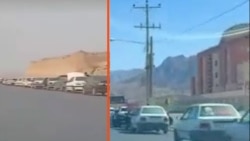

Iran, a major crude oil producer, has for decades heavily subsidized gasoline, leaving pump prices among the world's lowest and encouraging high domestic consumption. Demand now exceeds domestic production, forcing Tehran to rely on imports and withdrawals from reserves to cover the shortfall.
Iran currently produces about 115 million liters of gasoline a day against consumption of roughly 129 million liters, leaving a daily deficit of about 14 million liters, according to recent official estimates.
Import options have also narrowed as Russia has restricted gasoline exports amid its own supply constraints due to Ukrainian attacks on its refineries.
Shipping Monitor Says Tanker Hit In Strait Of Hormuz On August 25
An unknown projectile struck a tanker in the Strait of Hormuz, causing a fire, the United Kingdom Maritime Trade Operations (UKMTO) agency reported early on August 27.
The agency said the incident occurred on August 25 near Khasab, Oman.
According to the UKMTO, the fire was later extinguished, all crew members were safe and accounted for, and no environmental impact was reported.
The news comes amid negotiations between Iran and Oman over new arrangements for maritime traffic through the strategic waterway.
According to a senior Iranian source, the countries are still working on the details of a potential agreement. Iran's Islamic Revolutionary Guards Corps (IRGC) claimed on August 26 that Tehran and Muscat had reached agreements on their respective shares of revenues from the strait.
The safe passage of ships through the Strait of Hormuz, which once accounted for one-fifth of global oil trade, has become one of the central issues in the Middle East since the start of the war between the United States and Iran.
The matter has also been a major obstacle to a negotiated settlement of the conflict, with Tehran and Washington remaining far apart over the terms of control of the strait.
With reporting by Reuters.
Qatari PM Heading To Tehran To Discuss Hormuz, De-Escalation
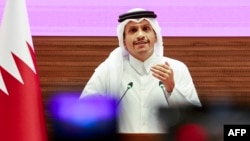
Qatari Prime Minister and Foreign Minister Sheikh Muhammad bin Abdulrahman Al Thani will travel to Tehran on August 27 for talks with Iranian officials "to discuss ways to de-escalate tensions and create appropriate conditions for dialogue," Qatar's Foreign Ministry spokesman said.
Majed Al-Ansari said in an X post on August 26 that the talks would also "address freedom of navigation in the Strait of Hormuz" and the need to restore shipping in the crucial waterway to the way it was before February 28, when the United States and Israel launched attacks on Iran.
Qatar has been involved in efforts to mediate between Tehran and Washington and has repeatedly called for a diplomatic solution to the conflict.
Ansari said on August 25 that Doha had maintained contacts with regional parties aimed at encouraging a return to US-Iran negotiations and called for freedom of navigation through Hormuz to be restored in accordance with international law.
Trump Says He Thinks Mojtaba Khamenei Is Alive
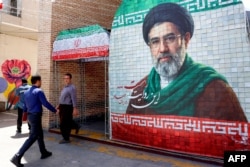
US President Donald Trump says he thinks the man named Iran’s supreme leader in March, Ayatollah Mojtaba Khamenei, is alive.
"I don't think he's dead,” Trump said in an interview with US radio host Glenn Beck that aired on August 26.
Mojtaba Khamenei has not been seen in public since before the announcement that he was replacing his father, Supreme Leader Ayatollah Ali Khamenei, who was killed on February 28, the first day of the US-Israeli war with Iran.
Mojtaba Khamenei was reportedly injured in the same air strike.
“He was very seriously wounded. The left side of his body, the arm, the leg, the whole thing,” Trump said. “He was very seriously wounded. But I don't think he's dead."
IRGC Claims Iran, Oman Reach Agreement On Sharing Hormuz Revenues
Iran's Islamic Revolutionary Guards Corps (IRGC) said on August 26 that Iran and Oman had reached agreements on their respective shares of revenues from the Strait of Hormuz as they work on new arrangements for maritime traffic through the strategic waterway.
"During negotiations with Oman, some agreements were made regarding each country's share of the waters of the Strait and Iran's and Oman's shares of its revenues," IRGC spokesman Hossein Mohebi said, according to Iranian media.
Mohebi did not provide details on how revenues would be generated or divided. Oman has not yet commented on the IRGC's claims.
His comments came a day after the two countries' foreign ministers discussed a temporary shipping corridor and mine-clearing operations aimed at restoring safe passage through Hormuz.
With reporting by AFP
Netanyahu Says Diplomatic Agreement Cannot Be Reached With Iran
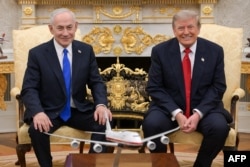
Israeli Prime Minister Benjamin Netanyahu welcomed the new US economic pressure campaign on Iran and expressed doubts about the possibility of a diplomatic agreement with Tehran.
In a speech on Augugust 25, Netanyahu referred to his July 28 meeting with US President Donald Trump, saying they had discussed three options for dealing with Iran: an agreement, military action, and "tightening the siege" on Tehran.
Netanyahu said he told Trump: "I doubt that you can make a deal with that bunch over there, with those savages. I'm telling you: You can't make a deal."
Netanyahu then praised expanded US sanctions against Iran, saying the president had "reaffirmed that decision with something very, very, very powerful." He said the measures amounted to tightening the siege not directly on Iran but on those helping what he called "that terrible dictatorship."
Pezeshkian Reiterates Need To End War With US
Iranian President Masud Pezeshkian reiterated his previous position on the need to end the war with the United States, saying, "War is not always the solution. A knot that can be untied with the hands should not be untied with the teeth."
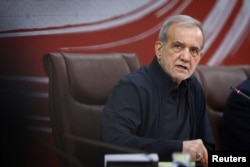
At a public ceremony on August 26, Pezeshkian once again called Iran "victorious in the field," adding that this path can be crossed with "measurement and thought."
After the 40-day war, Iran and the United States signed a memorandum of understanding to stop the war and negotiate an end to the conflict, but this memorandum collapsed due to tensions in the Strait of Hormuz, and negotiations between the two sides have been at least publicly stalled since then.
In his remarks today, Pezeshkian cited the command of Ali ibn Abi Talib, the first imam of the Shi'a, to Malik Ashtar in defense of peace, saying: "Do not reject the peace that the enemy proposes and that God is pleased with, because peace brings comfort to the armies and security to the people and the market."
He also emphasized that accepting peace does not mean trusting the other side, and said that even after an agreement, one must be vigilant about the possibility of surprise from the enemy.