



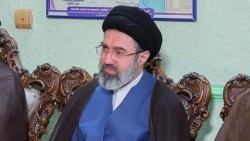

Iranian Official Calls Any Country Cooperating With US An 'Enemy'
Mohsen Rezaei, the secretary of Iran's Supreme National Security Council, said the Iranian government views any country that cooperates with the United States in creating further economic restrictions against Iran is considered an "enemy" and threatened that in such a case, these countries will be targeted for attack.
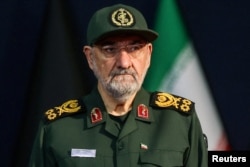
In a television interview broadcast on August 21, Rezaei also threatened that if the new US plan against Iran to impose further sanctions is implemented, Tehran will not allow "a single drop of oil to leave not only the Strait of Hormuz but the entire Persian Gulf."
These statements are the latest response from Tehran officials to the sanctions, the details of which the US government is set to announce on August 24 and which US Treasury Secretary Scott Bessent has already called "the toughest sanctions in history" against Iran.
"We are telling all surrounding countries not to engage in an economic war against Iran, and whoever does, we consider that country an enemy. First, we will negotiate so that they do not do this, and if they continue, we will target that country," said Rezaei.
Qatari PM Heading To Tehran To Discuss Hormuz, De-Escalation
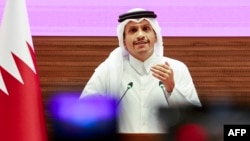
Qatari Prime Minister and Foreign Minister Sheikh Muhammad bin Abdulrahman Al Thani will travel to Tehran on August 27 for talks with Iranian officials "to discuss ways to de-escalate tensions and create appropriate conditions for dialogue," Qatar's Foreign Ministry spokesman said.
Majed Al-Ansari said in an X post on August 26 that the talks would also "address freedom of navigation in the Strait of Hormuz" and the need to restore shipping in the crucial waterway to the way it was before February 28, when the United States and Israel launched attacks on Iran.
Qatar has been involved in efforts to mediate between Tehran and Washington and has repeatedly called for a diplomatic solution to the conflict.
Ansari said on August 25 that Doha had maintained contacts with regional parties aimed at encouraging a return to US-Iran negotiations and called for freedom of navigation through Hormuz to be restored in accordance with international law.
Trump Says He Thinks Mojtaba Khamenei Is Alive
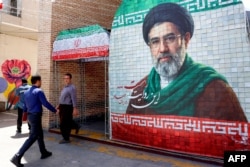
US President Donald Trump says he thinks the man named Iran’s supreme leader in March, Ayatollah Mojtaba Khamenei, is alive.
"I don't think he's dead,” Trump said in an interview with US radio host Glenn Beck that aired on August 26.
Mojtaba Khamenei has not been seen in public since before the announcement that he was replacing his father, Supreme Leader Ayatollah Ali Khamenei, who was killed on February 28, the first day of the US-Israeli war with Iran.
Mojtaba Khamenei was reportedly injured in the same air strike.
“He was very seriously wounded. The left side of his body, the arm, the leg, the whole thing,” Trump said. “He was very seriously wounded. But I don't think he's dead."
IRGC Claims Iran, Oman Reach Agreement On Sharing Hormuz Revenues
Iran's Islamic Revolutionary Guards Corps (IRGC) said on August 26 that Iran and Oman had reached agreements on their respective shares of revenues from the Strait of Hormuz as they work on new arrangements for maritime traffic through the strategic waterway.
"During negotiations with Oman, some agreements were made regarding each country's share of the waters of the Strait and Iran's and Oman's shares of its revenues," IRGC spokesman Hossein Mohebi said, according to Iranian media.
Mohebi did not provide details on how revenues would be generated or divided. Oman has not yet commented on the IRGC's claims.
His comments came a day after the two countries' foreign ministers discussed a temporary shipping corridor and mine-clearing operations aimed at restoring safe passage through Hormuz.
With reporting by AFP
Netanyahu Says Diplomatic Agreement Cannot Be Reached With Iran
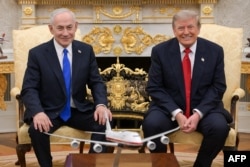
Israeli Prime Minister Benjamin Netanyahu welcomed the new US economic pressure campaign on Iran and expressed doubts about the possibility of a diplomatic agreement with Tehran.
In a speech on Augugust 25, Netanyahu referred to his July 28 meeting with US President Donald Trump, saying they had discussed three options for dealing with Iran: an agreement, military action, and "tightening the siege" on Tehran.
Netanyahu said he told Trump: "I doubt that you can make a deal with that bunch over there, with those savages. I'm telling you: You can't make a deal."
Netanyahu then praised expanded US sanctions against Iran, saying the president had "reaffirmed that decision with something very, very, very powerful." He said the measures amounted to tightening the siege not directly on Iran but on those helping what he called "that terrible dictatorship."
Pezeshkian Reiterates Need To End War With US
Iranian President Masud Pezeshkian reiterated his previous position on the need to end the war with the United States, saying, "War is not always the solution. A knot that can be untied with the hands should not be untied with the teeth."
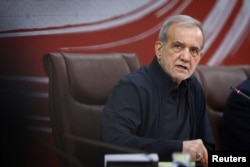
At a public ceremony on August 26, Pezeshkian once again called Iran "victorious in the field," adding that this path can be crossed with "measurement and thought."
After the 40-day war, Iran and the United States signed a memorandum of understanding to stop the war and negotiate an end to the conflict, but this memorandum collapsed due to tensions in the Strait of Hormuz, and negotiations between the two sides have been at least publicly stalled since then.
In his remarks today, Pezeshkian cited the command of Ali ibn Abi Talib, the first imam of the Shi'a, to Malik Ashtar in defense of peace, saying: "Do not reject the peace that the enemy proposes and that God is pleased with, because peace brings comfort to the armies and security to the people and the market."
He also emphasized that accepting peace does not mean trusting the other side, and said that even after an agreement, one must be vigilant about the possibility of surprise from the enemy.
11 Sanctioned Iranian Oil Tankers 'Stranded' Near Sri Lankan Coast
Sri Lanka is monitoring a fleet of 11 Iranian oil tankers under US sanctions near the island's southern coast, the country's foreign minister, Vijitha Herath, said on August 26.
Herath said the tankers have not entered Sri Lanka's territorial waters and are in international waters, where, under the principle of freedom of navigation, they have the right to remain.
According to media reports, the tankers are stranded because of the US blockade and are unable to return to their home port.
An unnamed Sri Lankan military official told AFP that the military had deployed reconnaissance aircraft and patrol boats to monitor the vessels outside the country's territorial waters.
"There is no indication of ship-to-ship oil transfers or the illegal dumping of pollutants, so there is no basis for the Sri Lankan authorities to take action against them," the official said.
In its latest report, US Central Command (CENTCOM) said that since July 14, when the US naval blockade of Iranian ports and shipping was reinstated, it has diverted more than 70 vessels, disabled three vessels, and boarded two vessels.
With reporting by AFP
More Cafes In Tehran Forced To Close
A cafe worker in Tehran has reported that cafes in Tehran's Vanak Park complex in the capital had been closed.
Masud Delpasand, a barista and cafe management instructor, posted a video in which he cited the poor economic conditions in Iran, saying the sealing of the Vanak Park cafes "has deprived at least 200 people of work and income."
After posting the video and protesting the sealing of the cafes, Delpasand posted a story on his Instagram account on September 25, writing that “there was no intention to provoke or protest” and that "any cafe that was sealed must have had a health problem."
The authorities criticized his post, saying saying any page that publishes the video is "hostile" and that it was only created for "exploitation."
Delpasand posted this story even though the video had been deleted from his page.
Along with the release of the video, he wrote: "In these economic circumstances, with the high cost of raw materials, skyrocketing rents, and a thousand obstacles in front of business owners, what is the plan to seal off Vank Park cafes?"
In recent days, a new wave of sealing off cafes and businesses has been launched under the pretext of not complying with the "mandatory hijab" and has drawn criticism.
Iran, Oman Working On New Hormuz Maritime Traffic Settings
"The Strait of Hormuz has no more than two coastal countries, and these two countries are simply the Islamic Republic of Iran and the Sultanate of Oman,” declared Iran’s Deputy Foreign Minister Kazem Gharibabadi to the country’s state media on August 25.
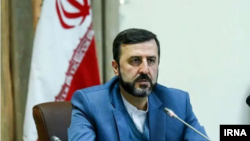
Gharibabadi's interview came hours after foreign ministers of Oman and Iran said in a joint statement that they had discussed a phased framework, including the establishment of a temporary joint shipping corridor and the implementation of a joint project to clear mines from the Strait of Hormuz to resume "safe passage" for ships through the waterway.
Gharibabadi said Iran is still in the state of war and that the Strait of Hormuz is now a matter of Iran's national security and fundamental changes must be made in the entry and exit routes.
According to the official, the working agreement between Oman and Iran is that the new naval traffic route will work like a "round-trip highway" with the entry route to the Persian Gulf through Iranian waters and the exit route through Omani territorial waters and ships passing through Iranian waters on both routes.
The southern route of the Strait of Hormuz is to be closed and the matter will be reported to the International Maritime Organization.
This arrangement is supposed to be temporary, and Tehran and Muscat allow themselves up to 60 days to come up with a permanent agreement.
Gharibabadi reiterated that the entire traffic through Hormuz will remain closed until the United States among other things lifts the economic blockade of Iran and ends the war on all fronts, including Lebanon.
Omani Foreign Minister Badr Al Busaidi discussed the Strait of Hormuz with Iranian Foreign Minister Abbas Araqchi on August 25 in Tehran.
Following the meeting, Araqchi wrote on X that he hoped to soon be able "to announce the establishment of a temporary corridor for the Strait of Hormuz and practical arrangements to restore safe shipping."
Separately, US President Donald Trump announced on Truth Social on August 25 -- citing reports from the US Navy and US Central Command (CENTCOM)-- that "all mines have been removed and/or detonated from within the International Waters of the Strait of Hormuz" and declared the shipping lanes open for maritime traffic. Gharibabadi rejected that as propaganda.
Britain Supports US Actions Against Iran
The United Kingdom supports US efforts to achieve a diplomatic solution on Iran and welcomes moves to step up pressure on Tehran, British Finance Minister John Healey said.
In comments on August 25, Healey said that includes the new sanctions announced a day earlier by US Treasury Secretary Scott Bessent.
Healey also urged Iran to stop its "destabilizing activity" in the Strait of Hormuz and across the Middle East.
Bessent said the United States was launching a campaign to “sever every economic lifeline that sustains this tyrannical regime until Tehran stands alone." He said countries would be given timelines to “shut down” activity that props Iran's regime up.
Bessent On Iran: 'The Pressure Is Working'
US Treasury Secretary Scott Bessent asserted on September 25 that Iran's leadership has acknowledged the effectiveness of US pressure on the Islamic republic.
In a post on X, Bessent wrote: "Iran's leadership is admitting what the world can now see: the pressure is working."
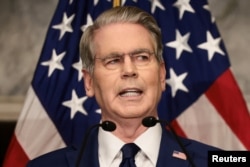
Referring to remarks by Iranian President Masud Pezeshkian on August 21 saying "the war must come to an end at some point," Bessent said Pezeshkian had acknowledged Iran's economic difficulties.
Bessent also cited remarks by Mohammad Baqer Qalibaf, the speaker of Iran's parliament, saying he had been "even more direct."
"No matter how much military power we have, if people are hungry and we do not have financial circulation, economic growth and domestic production, we will not endure," Bessent quoted Qalibaf as saying.
Bessent added: "Under President Trump, Treasury will continue to sever every economic lifeline sustaining this regime until Tehran stands alone."
The comments came a day after the Trump administration launched Operation Economic Outcast, a new campaign aimed at intensifying economic pressure on Iran through sanctions and other measures.
Bessent had previously said the administration's goal was to "collapse this regime" through economic pressure.