




Hundreds Of Ships Still Stranded In Persian Gulf Waters, UN Agency Says
The UN shipping safety organization said some 400 ships remain stranded in the Persian Gulf, with many others in the region still exposed to higher-than-usual risks.
“Six months since the conflict in the Middle East began, the situation in the Strait of Hormuz is unresolved," said Arsenio Dominguez, head of the International Maritime Organization (IMO).
"While some ships and their crews have been able to leave [the Gulf], up to 400 ships carrying around 6,000 seafarers have been unable to depart safely since the conflict began," he added.
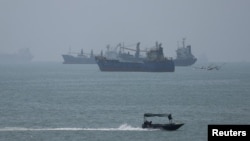
The INO has verified 70 attacks on international ships in the Gulf region, including in and around the Strait of Hormuz, since the start of the US-Israeli war with Iran at the end of February.
It has recorded at least 19 deaths of seafarers during the attacks.
The Strait of Hormuz, through which 20 percent of the world's crude oil and natural gas supplies transited prewar, is a key point of contention in the dispute Washington and Tehran.
It has been effectively closed by Iran, which has been demanding the right to control shipping traffic through the waterway. US officials insist their forces control the crucial passage.
Iran Names UN-Sanctioned Missile Chief As Defense Minister
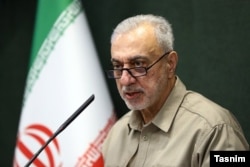
Iran’s parliament on October 18 approved Mehrdad Akhlaqi Ketabchi as the country's new defense minister, according to Iranian state media and international news agencies. He received 237 votes in favor and 15 against, with no abstentions, out of 277 votes cast during an online parliamentary session.
A veteran of Iran's defense industry, Akhlaqi previously headed the country's Aerospace Industries Organization and has held senior positions in its defense sector.
His name appears on the United Nations' sanctions list, which identifies him as the former head of the Shahid Baqeri Industrial Group, an organization designated for its role in Iran’s ballistic missile program. He was added to the UN list in 2007 under measures associated with Security Council Resolution 1737, adopted in 2006.
The United States has also sanctioned him over his missile-related activities.
Addressing lawmakers before the vote, Akhlaqi warned that Iran would respond forcefully to another US-Israeli attack.
Addressing lawmakers before the vote, Akhlaqi warned that Iran would respond forcefully to any further US-Israeli attack, saying the response would be "surprising and extensive." He warned that Washington and its allies would bear the consequences.
Akhlaqi succeeds Aziz Nasirzadeh, who was killed in the initial US-Israeli strikes on Iran on February 28. Majid Ebn al-Reza had served as acting defense minister following Nasirzadeh's death.
Over 10,000 Tehran Medical University Graduates Estimated To Have Emigrated
More than 10,000 graduates of Tehran University of Medical Sciences have emigrated abroad over the years, according to an initial estimate from the university's alumni relations office.
Seyyed Mansur Gatamiri, head of the office, told Iran's ISNA news agency that medicine, dentistry, and pharmacy were among the main fields of study of those who left, with the United States and Western Europe among their leading destinations.
Gatamiri stressed the figure was an estimate, not an official count. The university has more than 150,000 graduates, but its alumni office holds contact information for only around 60,000 to 65,000 of them.
He said emigration had continued in recent years and that some graduates had become less motivated to remain in Iran. Any apparent slowdown in departures, he added, could reflect stricter immigration requirements in destination countries rather than improved prospects at home. Nursing has also become a prominent field of emigration because qualification recognition and employment can be more accessible in some countries.
Vance Says US 'Won Decisively' Against Iran's Nuclear Program
US Vice President JD Vance said the United States had achieved a decisive victory against Iran's nuclear program but must secure guarantees that Tehran will not rebuild its nuclear capabilities.
Speaking at a CBS News town hall hosted by Tony Dokoupil on October 17, Vance defended President Donald Trump's strategy, saying Washington was seeking a long-term, verifiable commitment from Iran not to revive its nuclear program while preventing a global energy crisis.

Asked about the outcome of the war, Vance said "in some ways, we have won decisively, but the Iranians, the enemy gets a vote here." He asserted that the country's nuclear program had been destroyed.
Vance also warned that attacks on commercial shipping and disruptions in the Strait of Hormuz threatened global energy supplies and contributed to higher fuel prices. He argued that withdrawing US forces without addressing these threats could push prices higher still.
Separately, Reuters reported on October 16 that Iran had continued exporting limited quantities of liquefied petroleum gas (LPG) and jet fuel despite a US naval blockade.
Meanwhile, Israeli Defense Minister Israel Katz has threatened attacks on Iranian infrastructure, including energy facilities, warning that further strikes could send the country back to the Stone Age.
Sanctions, War, Isolation: Why Hasn't Iran's Hard-Line Government Collapsed?
Iran's Islamic republic has survived the death of Supreme Leader Ali Khamenei in February, the loss of senior military commanders, war, economic crisis, and widespread public discontent. So why is the system still standing?
Vahid Pourostad of RFE/RL Radio Farda's Iran Tomorrow program explains that its survival rests less on popular support than on a still-functioning security apparatus, entrenched networks of power, and a fractured opposition.



US Says Blockade Has Cost Iran $25 Billion in Oil Exports
The US naval blockade of Iran has prevented at least $25 billion in crude oil exports, and Washington has frozen nearly $350 million in Iranian cryptocurrency assets, the commander of US Central Command (CENTCOM) said.
In a video message released on October 16, Admiral Brad Cooper said economic pressure had grown so severe that Tehran-aligned militias were reportedly withholding fighters' salaries to send money back to the Islamic Revolutionary Guards Corps (IRGC), which he said was itself failing to pay its forces.
Cooper said Iran had no seaborne imports or exports apart from US-approved humanitarian aid. He added that around 400 commercial vessels transited the Strait of Hormuz in the past week, with US forces helping regional partners move more than 100 million barrels of crude.
However, Reuters reported on October 17 that Iran has exported some liquefied petroleum gas and jet fuel since July, with at least eight tankers carrying about 4.1 million barrels of Iranian LPG leaving the Gulf of Oman, according to ship-tracking data and satellite imagery.
The shipments are a fraction of Iran's previous energy exports. Data firm Kpler says Iran's crude exports fell to zero in September but US officials have questioned the tracking data, citing possible spoofing of vessel locations and identities.
US Lawmakers Reintroduce Bipartisan Bill To Expand Internet Access In Iran

Two US representatives have reintroduced bipartisan legislation aimed at expanding Iranians' access to the open Internet and secure communications.
Republican Claudia Tenney of New York and Democrat Yassamin Ansari of Arizona announced the Internet Reach and Access Now (IRAN) Act on October 15. The bill has 13 additional cosponsors from both parties and is supported by the Public Affairs Alliance of Iranian Americans (PAAIA).
The legislation follows Iran's near-total Internet blackout that began on February 28 amid US-Israeli military strikes. After 88 days of disruption, international connectivity began to return in late May, although restrictions on online services have persisted.
According to the lawmakers, the revised bill aims to strengthen US efforts against internet censorship and surveillance, improve secure communications, and help Iranians access independent information.
One focus is evaluating emerging technologies, including direct-to-cell satellite communications, which could connect compatible mobile phones to satellites without conventional cellular towers. However, technical and regulatory barriers mean the technology does not guarantee immediate, nationwide Internet access.
The bill also calls for evaluating virtual private networks (VPNs), decentralized and peer-to-peer networks, and other circumvention tools. It seeks expanded cybersecurity training and secure digital resources for journalists, human rights defenders, and civil society activists.
Additionally, the legislation would improve coordination among US government agencies to prevent sanctions and export controls from unintentionally obstructing access to internet technologies. PAAIA says the revised bill received technical assistance from the US State Department and supports preserving satellite communications coverage over Iran.
The IRAN Act was previously introduced in February. Its reintroduction does not mean it has become law or that satellite Internet services will immediately become available to Iranian users. It must still pass through Congress and receive presidential approval.
Iran Denies Role In Houthi Attacks On Saudi Arabia
Iran has rejected Saudi accusations that it was behind recent Houthi attacks on the kingdom and repeated Tehran's offer to mediate between Riyadh and the Yemeni rebel group.
"The Islamic republic of Iran rejects any claim of Iran's role in the operations of the Yemenis," Foreign Ministry spokesman Esmaeil Baqaei said in a statement on October 16.
Baqaei said the Iran-aligned Houthis act "based on their own interests and assessments," adding that such claims were not credible to anyone familiar with Iran's relations with its allies.
His comments came after Rayed Krimly, Saudi Arabia's deputy foreign minister for public diplomacy, said earlier this week that Iran continues "to arm, train, and support the Houthi militia in violation of UN Security Council resolutions" and was encouraging the group to escalate attacks. Krimly also accused the Houthis of refusing to meet in Oman.
Yemen's civil war reignited in July after years of relative calm following a UN-brokered truce in 2022. Saudi Arabia backs Yemen's internationally recognized government against the Houthis, who seized Sanaa in 2014. A Saudi-led coalition intervened militarily in 2015.
Iran Says Supertanker Hit Mine In Strait of Hormuz
Iran's Islamic Revolutionary Guards Corps (IRGC) said on October 17 that a supertanker carrying more than 2 million barrels of crude oil exploded and caught fire after hitting a naval mine in the Strait of Hormuz.
In a statement, the IRGC Navy said the vessel had been trying to pass through the strait "illegally," using a route not approved by Tehran. It said the tanker had switched off all its positioning and radar systems and was attempting the transit "through deception and with the support of the US military."
The IRGC did not name the vessel or give details on its crew or the extent of the damage. Its claims could not be independently verified.
In a separate incident, the British military's United Kingdom Maritime Trade Operations (UKMTO) center said it had received a delayed report of a tanker being struck by an unknown projectile about 68 nautical miles northeast of Al Jubayl, Saudi Arabia. UKMTO said all crew were safe and had been evacuated, with no environmental impact reported.
Iran's Security Challenges Compounded By Rising Domestic Insurgency
Iran's vast and restive southeastern province of Sistan-Baluchistan, located along the border with Afghanistan and Pakistan, has witnessed a deadly flare-up of violence in recent weeks.
Armed groups and Iranian security forces have clashed almost daily across the impoverished province, the site of a decades-long, low-level insurgency.
Separatist groups and Islamist militants in Sistan-Baluchistan, home to Iran's marginalized ethnic Baluch minority, are increasingly coordinating their efforts to challenge the Iranian state, experts say.
The intensifying insurgency has compounded the security threats facing Iran, which remains at war with the United States and Israel and braces for a possible resumption of major US combat operations.
To read the full report, click here.
US Sanctions Cuban State Bank Over Links To Iran, Rubio Says
WASHINGTON -- The United States on October 15 sanctioned Cuban state-owned Banco Internacional de Comercio S.A. (BICSA) for providing services to an Iranian bank under US sanctions, Secretary of State Marco Rubio said, highlighting Washington's efforts to disrupt financial links between countries it views as hostile to US interests.
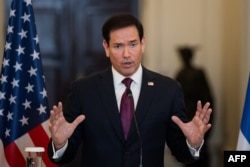
Rubio said BICSA had provided services to Iran's Karafarin Bank since at least 2022. The US Treasury Department sanctioned Karafarin Bank in 2020 under an executive order targeting Iran's financial sector.
The action against BICSA, announced alongside a separate Treasury Department move targeting Iranian financial actors, underscores the Trump administration's push to extend economic pressure beyond Tehran to countries and institutions that help sustain its financial networks.
"The Trump Administration will not tolerate a rogue state hosting hostile foreign military, intelligence and terror operations less than a hundred miles from the American homeland," Rubio said in a statement.
He described Cuba as an outpost for hostile foreign actors, including Iran, and said Washington would continue to identify and dismantle the Cuban government's financial and security ties with Tehran and other countries it considers threats.
Brett Erickson, a sanctions expert at Obsidian Risk Advisors, said the move reflected a broader effort to disrupt cooperation among economies facing US sanctions.
"Sanctioned economies have learned to survive by leaning on one another," Erickson told RFE/RL. "Washington is now attempting to dismantle those relationships, recognizing that economically isolating Iran means targeting not just Tehran, but the countries helping sustain it. Cuba is another front in that expanding campaign."
Erickson said the sanctions were unlikely to inflict significant economic damage on Iran by themselves but carried broader strategic importance as Washington sought to weaken the network of countries and institutions supporting sanctioned economies.
"These sanctions are unlikely to meaningfully damage Iran's economy on their own, but their strategic significance is greater than their immediate economic impact," he said, adding that the Treasury's Department's so-called Operation Economic Outcast was increasingly targeting the wider network sustaining Iran.
Under the measures, BICSA's property and interests in property within the US or under the possession or control of US persons must be blocked and reported to the Treasury Department's Office of Foreign Assets Control. Entities that are 50 percent or more owned by blocked persons are also subject to blocking.