



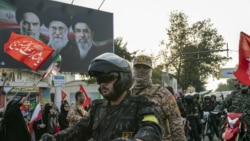

US Strikes Iranian Launchers Near Strait Of Hormuz, Citing Mine-Laying Threat
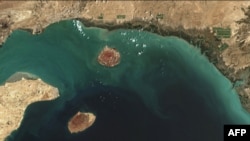
WASHINGTON -- US forces have struck two Iranian missile launchers on Larak Island after Iran’s Islamic Revolutionary Guards Corps (IRGC) was observed preparing to fire rockets carrying sea mines into the strategically vital Strait of Hormuz, a senior US official said on August 30.
The August 30 strike is the first publicly reported US attack on Iranian targets in more than a month and marks a new escalation after a period of relative calm in the conflict.
The US official, speaking on condition of anonymity, told reporters that the launchers were being prepared for an operation that could have threatened commercial shipping through the narrow waterway, a key global energy route.
US Warns It Will Defend Shipping
The strike comes just days after US Central Command (CENTCOM) completed clearing sea mines from international shipping routes in the Strait of Hormuz.
“US forces are monitoring the area closely and remain prepared to protect the free flow of commerce through this essential waterway,” the official said.
President Donald Trump said earlier in the week that Iran had been warned that any vessel or boat attempting to lay new mines in the strait would be “immediately and systematically destroyed.”
Iranian Guards Vow Retaliation
Iran's IRGC said the attack killed and wounded a number of Iranian fighters and civilians. It did not provide a specific casualty toll.
In a statement carried by Iran's state broadcaster, the Guards blamed what they called the “US-Zionist enemy” and vowed that the attack would “result in punishment of the aggressor.”
Larak Island, located near the Strait of Hormuz, has previously been targeted by US forces. A similar strike was reported there in late July.
The latest attack underscores the continuing risk of renewed confrontation around the Strait of Hormuz, through which a significant share of the world's oil and gas supplies passes.
The US says its forces will continue monitoring the waterway and taking action to keep commercial shipping moving safely.
Iraq Closes Border Crossing With Iran
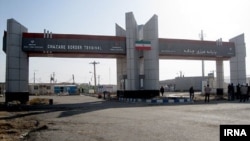
Iraq closed a major border crossing with Iran on October 21, citing security concerns, amid reports that Washington is pressing Baghdad to restrict cross-border trade as part of efforts to increase economic pressure on Tehran.
An Iraqi border official told Reuters that the Al-Sheeb crossing, known as Chazabeh in Iran, had been shut to allow a security review and the installation of equipment to detect smuggled materials.
The crossing will remain closed to passengers and commercial traffic until further notice. Iranian officials confirmed the closure, saying discussions were underway to reopen it and advising travelers and truck drivers to use the nearby Shalamcheh crossing.
Two Iraqi political sources separately told AFP that the United States was pressing Baghdad to close additional crossings with Iran, potentially leaving only two operational.
Iraq and Iran share a border of more than 1,400 kilometers and maintain close economic and political ties.
With reporting by AFP and Reuters
With War In Limbo, Influential Iranian Officials Openly Call For A Nuclear Bomb
- By Kian Sharifi
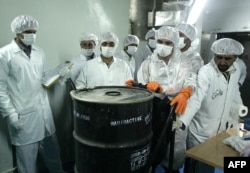
It was once taboo in Iran to publicly speak about developing nuclear weapons. The authorities would often point to former Supreme Leader Ayatollah Ali Khamenei's religious edict barring the development of weapons of mass destruction. Iranian officials have long insisted the country's nuclear program is solely for civilian purposes.
Open calls for a bomb from sitting lawmakers and senior security officials would have been unthinkable a few years ago. But with the war with the United States in limbo, that's no longer the case.
After almost eight months of conflict and with Washington reportedly weighing strikes on Pickaxe Mountain, a deep underground site where US and Israeli officials say Iran has moved thousands of centrifuges, the talk is even growing.
Kamal Kharazi, an adviser to Khamenei who was killed in Israeli strikes earlier this year, said in 2024 that Tehran "might review our nuclear doctrine" if it felt an existential threat. The US-Israeli war against Iran this year seems to be seen by some as that very existential threat.
Read more here
Tanker Struck Near Hormuz Strait, Says Shipping Monitor
A tanker was struck by "an unknown projectile" off the coast of Oman near the Strait of Hormuz on October 21, sparking a fire, British maritime security agency UKMTO said.
The vessel, about 20 kilometers off the town of Bukha, was "now at anchor," with all crew safe and no reported environmental damage.
Also on October 21, the UKMTO reported another tanker being struck the previous day southeast of Al Faw in Iraq, The crew were "reported as safe," and there was no was "no reported damage or environmental impact."
Attacks on shipping in and around the strategic Strait of Hormuz and across the wider Persian Gulf have intensified amid the Middle East war, which began with US-Israeli strikes on Iran in late February.
Tehran has restricted passage through the strait, a vital oil and gas route, while Washington maintains a blockade on Iranian ports.
With reporting by AFP
Lavrov In Tehran Amid Questions Over Whether Moscow Is Helping Iran In War With US
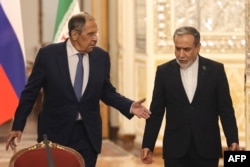
Russian Foreign Minister Sergei Lavrov traveled to Iran on October 19, meeting with President Masud Pezeshkian and Foreign Minister Abbas Araqchi amid questions over what support Moscow is providing Tehran to fight its war with the United States.
Lavrov traveled to the Iranian capital directly from Manama, Bahrain, where he had attended a meeting with Gulf Cooperation Council officials. Gulf states have urged Moscow to use its influence to press Tehran to halt attacks on its neighbors.
Following talks in Tehran with his Russian counterpart, Araqchi said they discussed regional and international issues, including Lebanon, Palestine, Ukraine, and Yemen, as well as expanding economic and nuclear cooperation.
"Never in our history have Iran and Russia worked as closely as now," Araqchi wrote in a post on X on October 20.
To read the full report, click here.
Iran Says It Arrested 39 Over January Protests
Iran's Intelligence Ministry said it had arrested 39 people in Qazvin Province on allegations of involvement in the December/January protests and the destruction of public and private property.
According to the state-run IRNA news agency, the ministry said in a statement on October 19 that the detainees had been organized into eight separate groups and had damaged or set fire to homes, stores, banks, vehicles, and a gas station in Qazvin during the unrest.
The ministry also accused 10 of the detainees of killing security personnel who were attempting to prevent them from setting fire to a gas station on Shahid Babaei Street.
The statement alleged that the detainees had links to the United States and Israel and said authorities had seized firearms, bladed weapons and quantities of alcoholic beverages.
The ministry did not identify the detainees or disclose when they were arrested. The allegations, including the claims about their involvement in killings and foreign links, have not been independently verified.
Rights groups say that thousands of people were killed during the violent government crackdown on the protests.
The announcement is part of a continuing wave of arrests following nationwide protests that began in late December and spread across Iran in January. Iranian authorities have repeatedly accused protesters of violence and acting on behalf of foreign powers, while human rights organizations have raised concerns about the treatment of detainees and the fairness of proceedings against them.
Iran Summons German, Irish Ambassadors
Iran's Foreign Ministry summoned the German and Irish ambassadors to Tehran on October 19 to protest what it described as baseless accusations by Germany and the European Union against the Islamic republic.
Iranian media reported that German Ambassador Axel Dittmann was summoned by Alireza Yousefi, an assistant foreign minister and director general for Western Europe, following what Tehran called the repetition of unfounded accusations by German officials.
Yousefi conveyed Iran's strong protest over what he described as the "ridiculous approach" of some German officials toward Iran, according to Iranian media reports.
Earlier on October 19, Germany summoned Iran's ambassador in Berlin following the conviction of two men over plots targeting prominent Jewish figures in Germany.
The Hamburg Higher Regional Court sentenced the two men on October 15. The Danish national, identified as Ali S., received 8 1/2 years in prison, while the Afghan national, Tawab M., was sentenced to 4 1/2 years.
The court found that the men had gathered information on Josef Schuster, president of the Central Council of Jews in Germany, and Volker Beck, chairman of the German-Israeli Society. According to the court's findings, the principal defendant had been directed by Iran's intelligence service.
"We do not tolerate attacks on Jewish life or on those who defend it, not anywhere, and certainly not in Germany," the German Foreign Ministry said in a post on X. The ministry described the attempted attacks against Schuster and Beck as "malicious" and said they would have legal consequences.
According to Iranian media, Yousefi accused Germany of using security allegations against Iran to divert attention from what Tehran described as Berlin's support for US and Israeli attacks on Iran.
Iran's Foreign Ministry also summoned Irish Ambassador Aidan Cronin to protest the European Union's latest conclusions on the Middle East. Ireland currently holds the rotating presidency of the Council of the European Union.
The European Council adopted its conclusions on October 15–16. EU leaders condemned Iran's attacks against countries in the region and called for freedom of navigation and maritime security in the Strait of Hormuz.
Iranian media reported that Yousefi criticized what he called the EU's irresponsible policies regarding the situation in West Asia and the Strait of Hormuz. He attributed insecurity in the strategic waterway to US and Israeli attacks on Iran, alleging that some European countries had supported those attacks openly or covertly.
Iran Repeats Threat To Target Undersea Fiberoptic Cables
Iran has repeated its threat to target undersea fiberoptic cables running through the Strait of Hormuz if war with the United States resumes.
Hossein Mohebbi, spokesman for the Islamic Revolutionary Guards Corps (IRGC), said Tehran will reveal “new weapons” and “new targets” if there is renewed aggression.
“There are seven big fiberoptic cables under the Persian Gulf and Strait of Hormuz,” Mohebbi said on October 19, without elaborating.
Undersea cables are mostly owned and operated by international tech companies such as Google, Meta, Microsoft, and Amazon. The cables carry SWIFT transactions, cloud traffic, and general Internet data between Asia, Europe, and the Persian Gulf.


If the submarine cables running through Hormuz were severed, the impact on ordinary people across Asia, the Middle East, and Europe would be immediate and wide-ranging.
Streaming services would buffer or fail entirely, while messaging apps would slow or stop working. Online banking and card payments could be disrupted, and cloud-dependent services -- from e-mail to workplace tools -- would degrade.
Iran Names UN-Sanctioned Missile Chief As Defense Minister
Iran’s parliament on October 18 approved Mehrdad Akhlaqi Ketabchi as the country's new defense minister, according to Iranian state media and international news agencies. He received 237 votes in favor and 15 against, with no abstentions, out of 277 votes cast during an online parliamentary session.
A veteran of Iran's defense industry, Akhlaqi previously headed the country's Aerospace Industries Organization and has held senior positions in its defense sector.
His name appears on the United Nations' sanctions list, which identifies him as the former head of the Shahid Baqeri Industrial Group, an organization designated for its role in Iran’s ballistic missile program. He was added to the UN list in 2007 under measures associated with Security Council Resolution 1737, adopted in 2006.
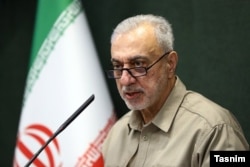
The United States has also sanctioned him over his missile-related activities.
Addressing lawmakers before the vote, Akhlaqi warned that Iran would respond forcefully to another US-Israeli attack.
Addressing lawmakers before the vote, Akhlaqi warned that Iran would respond forcefully to any further US-Israeli attack, saying the response would be "surprising and extensive." He warned that Washington and its allies would bear the consequences.
Akhlaqi succeeds Aziz Nasirzadeh, who was killed in the initial US-Israeli strikes on Iran on February 28. Majid Ebn al-Reza had served as acting defense minister following Nasirzadeh's death.
Over 10,000 Tehran Medical University Graduates Estimated To Have Emigrated
More than 10,000 graduates of Tehran University of Medical Sciences have emigrated abroad over the years, according to an initial estimate from the university's alumni relations office.
Seyyed Mansur Gatamiri, head of the office, told Iran's ISNA news agency that medicine, dentistry, and pharmacy were among the main fields of study of those who left, with the United States and Western Europe among their leading destinations.
Gatamiri stressed the figure was an estimate, not an official count. The university has more than 150,000 graduates, but its alumni office holds contact information for only around 60,000 to 65,000 of them.
He said emigration had continued in recent years and that some graduates had become less motivated to remain in Iran. Any apparent slowdown in departures, he added, could reflect stricter immigration requirements in destination countries rather than improved prospects at home. Nursing has also become a prominent field of emigration because qualification recognition and employment can be more accessible in some countries.
Vance Says US 'Won Decisively' Against Iran's Nuclear Program
US Vice President JD Vance said the United States had achieved a decisive victory against Iran's nuclear program but must secure guarantees that Tehran will not rebuild its nuclear capabilities.
Speaking at a CBS News town hall hosted by Tony Dokoupil on October 17, Vance defended President Donald Trump's strategy, saying Washington was seeking a long-term, verifiable commitment from Iran not to revive its nuclear program while preventing a global energy crisis.

Asked about the outcome of the war, Vance said "in some ways, we have won decisively, but the Iranians, the enemy gets a vote here." He asserted that the country's nuclear program had been destroyed.
Vance also warned that attacks on commercial shipping and disruptions in the Strait of Hormuz threatened global energy supplies and contributed to higher fuel prices. He argued that withdrawing US forces without addressing these threats could push prices higher still.
Separately, Reuters reported on October 16 that Iran had continued exporting limited quantities of liquefied petroleum gas (LPG) and jet fuel despite a US naval blockade.
Meanwhile, Israeli Defense Minister Israel Katz has threatened attacks on Iranian infrastructure, including energy facilities, warning that further strikes could send the country back to the Stone Age.