





We are now closing the live blog for the day. We'll be back at 7:30 a.m. Central European time to cover the latest events across the Middle East.
Trump: Iran War Will End 'Immediately' After US Midterm Elections
- By Frud Bezhan
US President Donald Trump said he believes that the more than six-month war with Iran will end “immediately” after the midterm elections in November.
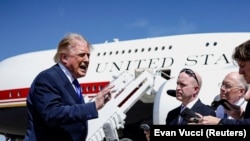
“I think the war will end immediately after the election” because Iran “can't hold out any longer,” Trump told reporters on September 9.
He accused Tehran of being “desperate to try and affect” the elections.
The war with Iran is expected to loom large over the elections. The conflict is unpopular with many Americans, while rising gas prices connected to the war are adding to the economic pressures facing voters.
In his comments to reporters, Trump also said the United States was not looking for a deal to end the Iran war, although he added that negotiations could happen.
In June, Tehran and Washington signed a memorandum of understanding aimed at ending hostilities, but the agreement soon unraveled.
In recent weeks, the sides have been engaged in tit-for-tat strikes that observers say could risk escalating into a return to full-scale conflict.
Revolutionary Guards Say Sunni Cleric Killed In Northwest Iran
Iran's Islamic Revolutionary Guards Corps (IRGC) said a Sunni cleric has been killed in the country’s northwest.
Mohammad Nezhati was “martyred in a brutal terrorist crime committed by Zionist-American separatist groups," the IRGC said in a September 9 statement, according to state media.
It was not clear when Nezhati was killed.
The IRGC said Nezhati was a member of the volunteer Basij paramilitary force, which is estimated to have around 1 million members and is commanded by the Revolutionary Guards.
Opposition Iranian Kurdish groups based in Iraq’s Kurdistan region are active across the border in northwestern Iran. Tehran has long accused the groups of having links to the United States and Israel.
The IRGC said the attack was aimed at “undermining unity between Shi’a and Sunni Muslims” in Iran.
A Shi’a-majority country, Iran has sizeable Sunni communities in the country’s western and southeastern regions.
With reporting by RFE/RL's Radio Farda and AFP
UN Nuclear Watchdog Refers Iran To Security Council
The UN nuclear watchdog's board of governors voted on September 9 to refer Iran to the UN Security Council over breaches of its nuclear non-proliferation obligations, the first such referral in 20 years.
The 35-nation board of the International Atomic Energy Agency (IAEA) adopted the resolution by 23 votes to three, with eight abstentions. Russia, China, and Niger voted against it.
The resolution, submitted by Britain, France, Germany, and the United States, expressed "grave concern" over Iran's continued noncompliance and called on Tehran to cooperate with the IAEA and engage in talks aimed at demonstrating the peaceful nature of its nuclear program.
As a party to the Nuclear Non-Proliferation Treaty, Iran is required under a safeguards agreement with the IAEA to allow the agency to verify the country’s declared nuclear material.
The IAEA has lacked access to key Iranian nuclear facilities since Israeli and US strikes in June 2025, leaving the fate of an estimated 440 kilograms of uranium enriched to 60 percent uncertain.
Uranium enriched to 60 percent is a short technical step from the roughly 90 percent purity considered weapons grade. Iran claims its nuclear program is peaceful, while the United States and Israel have long accused Tehran of pursuing an atomic weapons capability.
Iranian nuclear facilities have also been targeted in the latest US-Israeli war with Iran, further complicating the IAEA's efforts to monitor the country's nuclear program.
Iran's ambassador to the UN in Vienna, Reza Najafi, dismissed the resolution as a "political tool," saying Tehran would cooperate only "to the extent that circumstances and safety permit."
Any punitive action by the Security Council is likely to face opposition from Iran's allies Russia and China, both of which hold veto power.
With reporting by AFP and Reuters
US, Iran Trade Strikes On Shipping As Oil Prices Surge Above $100 A Barrel
- By RFE/RL
Iran said it attacked vessels near the Strait of Hormuz on September 9 after the United States destroyed several Iranian oil tankers overnight, in a sharp escalation in the six-month war.
The tit-for-tat strikes led to a surge in global oil prices, with Brent crude reaching $100 per barrel for the first time since July.
Tehran also said it had fired ballistic missiles at a US base in Jordan. No casualties or damage were reported. The US military said it sank five Iranian oil tankers overnight near Kharg Island, Iran’s main oil export hub, calling it a response to Tehran firing missiles at a US Navy warship over the past two days.
Iran retaliated by firing 20 ballistic missiles toward Jordan, which said it intercepted 18 of them. Jordan said two of the missiles landed in unpopulated areas.
Read more here
Iran Steps Up Work At Pickaxe Mountain, Satellite Images Show
New satellite imagery shows a surge in construction at Iran's deeply buried Pickaxe Mountain complex near the Natanz nuclear facility, but the activity does not appear to indicate that Iran is currently enriching uranium there, according to a new analysis by the Center for Strategic and International Studies (CSIS).
CSIS said its analysis of six years of satellite imagery showed more road activity at Pickaxe Mountain in 2026 than at any previous point in the site's history.
Recent work included hardening tunnel entrances, paving internal roads, reinforcing access areas, and removing excavation spoil, suggesting the project has shifted from excavation toward probable construction inside the underground complex.
The researchers said the imagery could neither confirm nor refute reports that Iran moved centrifuges and centrifuge components into Pickaxe Mountain last year. But continued construction, the lack of increased internal security, and the absence of non-construction vehicles and equipment suggested the facility was "not yet capable of enrichment work," if that is its intended purpose.
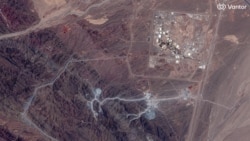

Pickaxe Mountain lies about 2 kilometers south of the Natanz uranium-enrichment facility in Iran's central Isfahan Province and is buried deep inside granite, making it extremely difficult to destroy with conventional weapons.
CSIS said even the heaviest US bunker-buster bombs might not be sufficient to destroy the facility, arguing that military strikes could at best degrade or temporarily disable it.
UKMTO Reports Merchant Vessels Hit In Gulf And Gulf Of Oman
The United Kingdom Maritime Trade Operations (UKMTO) said on September 9 that several merchant vessels in the northern Gulf and Gulf of Oman were hit by disabling fire during military activity in the region overnight.
UKMTO, which is affiliated with the British Navy, said it could not confirm any casualties or environmental impact from the incidents.
Separately, UKMTO reported that a vessel was seen listing while anchored 24 nautical miles northwest of Port Rashid in the United Arab Emirates. The vessel may have taken on water after being struck by an unidentified projectile, the agency said. The incident was reported by a third party.
The reports came a day after US Central Command said its forces destroyed five Iranian crude-oil tankers following attempted missile attacks on a US Navy warship over the previous two days.
Reuters also reported on September 8 that a Panama-flagged tanker carrying 2 million barrels of Iraqi fuel oil was struck by a drone in Iraqi territorial waters.
Two port officials told Reuters that Iraqi rescue boats extinguished a fire aboard the tanker, New Andros, and that there were no reports of casualties.
Tehran Targets US Base In Jordan After Iranian Oil Tankers Sunk
Iran launched fresh missile attacks on Jordan, saying it was targeting a US military base in retaliation for strikes on Iranian oil tankers.
Jordan says it intercepted 18 ballistic missiles, while the US military says it destroyed five Iranian crude carriers after Iran's failed attempted attacks on a US warship.
The latest exchanges mark a sharp escalation in the conflict around the Strait of Hormuz and the Gulf of Oman.

Iranian Currency Hits New Low As US Pressure Intensifies
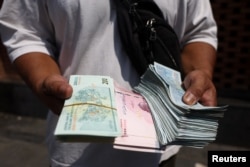
Iran's rial fell to a new low against major foreign currencies on September 8 as the United States intensified military and economic pressure on Tehran.
Currency-market websites reported the dollar trading at up to 2.4 million rials later in the day, while the euro exceeded 2.7 million rials and the British pound reached about 3.1 million rials. The Emami gold coin also reportedly rose to 2.4 billion rials.
The latest depreciation came as US forces said they destroyed five Iranian oil tankers in the Gulf and Gulf of Oman after Iran's Islamic Revolutionary Guards Corps twice targeted a US warship with ballistic missiles.
Washington also announced sweeping new sanctions against Iran's aviation sector on September 8, designating 36 targets and sanctioning all remaining Iranian airlines under its Operation Economic Outcast campaign. Treasury Secretary Scott Bessent warned companies doing business with Iran's airlines that they risk being cut off from the global financial system.
The currency crisis comes amid severe inflation. Iran's Statistical Center reported annual inflation of 89 percent in August, while food and beverage prices rose 127.5 percent year-on-year. Iranian lawmakers warned on August 31 that volatility in currency, gold, and coin markets was increasing economic uncertainty.
Global Oil Prices Rise Above $100 per Barrel
Global oil prices rose above $100 per barrel on September 9, as tensions in the Middle East escalated and Iran and the United States continued to exchange attacks.
Brent crude futures rose 2.2 percent to $100.07 per barrel in early European trading, while US West Texas Intermediate crude futures rose 1.8 percent to $94.73 per barrel, according to Reuters.
Brent's price was its highest since July 24, when it last crossed the $100 mark.
Oil prices have risen sharply in recent days amid escalating regional tensions and concerns about disruptions to oil supplies. On September 8, Iran-backed Houthi forces in Yemen launched attacks on several cities and energy facilities in southern Saudi Arabia, setting oil installations ablaze and temporarily disrupting some operations.
The attacks have raised concerns about further disruption to oil shipments through the Red Sea, while oil flows through the Strait of Hormuz have already been severely curtailed by the US-Iran conflict.