




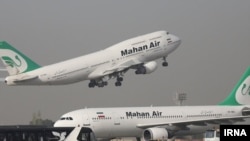
WASHINGTON -- The United States has imposed sanctions on all of Iran's remaining active airlines, sharply escalating pressure on Tehran's aviation sector as part of a broader campaign aimed at cutting the Islamic republic off from international trade and finance.
The US Treasury Department on September 8 sanctioned 36 targets, including 27 Iranian airlines, as well as foreign companies and an individual accused of helping Iran's sanctioned aviation networks procure aircraft, aircraft parts, and other technology.
The action marks the first time Washington has used a new August 24 determination targeting Iran's aviation sector to sanction the country's remaining airlines. Treasury said the sector is used by the Iranian government to move weapons, personnel, and illicit cargo.
"Let this be a warning to anyone doing business with Iran's remaining airlines, all of which we sanctioned today: You are at risk of being cut off from the global financial system," Treasury Secretary Scott Bessent said.
"We will not relent in our campaign to shut down the Iranian regime's financial lifelines, including the aviation sector," State Department spokesman Tommy Pigott said in a statement.
The sanctions come under President Donald Trump's so-called Operation Economic Outcast, announced by Bessent on August 24 as part of a campaign to sever what Washington describes as the Iranian regime's remaining economic lifelines.
Among the airlines designated are Iran Aseman Airlines, Iran Airtour, Kish Airlines, Qeshm Air, Karun Airlines, Sepehran Airlines, Taban Airlines, Varesh Airlines, Zagros Airlines, Chabahar Airlines, Fly Persia, and Saha Airlines, formally known as the Armed Forces Air Transport Service.
Other carriers sanctioned include Air Shiraz, Ava Airlines, Fly Kish, Mehr Airways, Raimon Airways, and Soroush Air.
There was no immediate public response from Iran to the September 8 measures.
Targeting Iran's Aviation Lifelines
The Treasury action goes beyond Iranian carriers, targeting a network of foreign companies that Washington says helped sanctioned Mahan Air acquire aircraft and operate international flights.
Mahan Air has been under US counterterrorism sanctions since 2011. Washington accuses the carrier of providing logistical support to Iran's Islamic Revolutionary Guards Corps (IRGC), including by transporting personnel, weapons, and military equipment.
The Treasury said Mahan Air received at least three Boeing 777 aircraft this summer through a route involving the United Arab Emirates and Oman. The UAE-based ECT Aviation Support and Turkey-based Sky Phoenix were identified as intermediaries in what Washington described as a scheme to transfer US-origin aircraft to Mahan Air.
ECT Aviation Support's owner and chief executive, Egyptian national Mahran Ibrahim Ali Mohamed Mahran, was also sanctioned.
Other foreign companies targeted include Malaysia-based iCargo, Kazakhstan-based Tour Invest, and Turkish firms MES Cargo and S Sistem Logistics. Treasury said the companies provided general sales, cargo, logistics, or other services to Mahan Air.
S Sistem, for example, was accused of coordinating shipments of unmanned aerial vehicle components and industrial equipment destined for Iran. Treasury said iCargo had coordinated shipments of US-origin parts to Iran on Mahan Air's behalf.
Kerri Bitsoff, a former senior official at the US Treasury's Office of Foreign Assets Control, told RFE/RL that the measures could have a broad impact because of the extent to which international aviation relies on US-origin equipment and technology.
"Treasury's action today designated every remaining Iranian airline and pulled the authorizations that let foreign carriers fly US-origin aircraft into Iran," Bitsoff said.
"Nearly every commercial plane in the world is US-origin or flies on US-controlled engines and avionics, so that reaches almost the entire global fleet," she added.

Bitsoff said direct air links had been among Tehran's remaining channels to the outside world and accused the Iranian government of using them to move "gold and hard currency," IRGC personnel and weapons, as well as aircraft parts and dual-use components.
She said the pressure was particularly significant amid what she described as a broader tightening of economic routes around Iran, with maritime routes restricted, European governments backing the pressure campaign, and Persian Gulf countries reducing trade.
"These designations force a choice on every fuel supplier, ground handler, and bank that still touches an Iranian airline," Bitsoff said.
Pressure On Intermediaries
Treasury also suspended three Iran-related aviation authorizations, including permissions concerning overflights and the operation of US-origin or US-controlled commercial aircraft in Iran by non-US airlines.
Requests related to aviation safety will be considered on a case-by-case basis, the department said.
Brett Erickson, a sanctions expert at Obsidian Risk Advisors, described the move as a major escalation of Washington's pressure campaign.
"This is a significant escalation of Operation Economic Outcast," Erickson told RFE/RL. "Washington is pairing a naval blockade with sanctions designed to close off airspace as an alternative economic route and make it harder for Iran to move goods or buffer its economy."
The Treasury said foreign companies and individuals that facilitate transactions involving sanctioned Iranian airlines could face serious consequences, including secondary sanctions that could restrict their access to the US financial system.
US persons are generally prohibited from conducting transactions involving the blocked entities, while foreign financial institutions can face restrictions on their US correspondent or payable-through accounts for certain significant transactions involving sanctioned parties.
Alongside the sanctions, the Treasury's Financial Crimes Enforcement Network, or FinCEN, issued an alert urging financial institutions to watch for Iranian procurement networks seeking aircraft and aircraft parts through front companies and intermediaries in third countries.
The department said Iranian airlines have used companies posing as aviation, technology, or logistics businesses in Europe, the Middle East, Africa, and Asia to acquire Western aircraft, components, and dual-use goods while concealing the ultimate Iranian end-user.
The new measures extend Washington's campaign from individual airlines and support companies to virtually the entire commercial aviation infrastructure serving Iran, increasing the risks for foreign businesses that continue to provide Tehran with aircraft, parts, cargo services, sales representation, or financial support.

