



Stablecoin Giant Tether Says It Helped Freeze $550 Million In Iran-Linked Crypto

Tether, the company behind USDT, the world's largest dollar-backed stablecoin, said on September 28 that it had supported the freezing of nearly $550 million in cryptocurrency linked to Iran this year, including assets associated with the Central Bank of Iran and other Iranian sanctions networks.
In a statement, Tether said it had helped the US government freeze more than $344 million in USDT across two addresses in April, based on information provided by the US Treasury Department's Office of Foreign Assets Control and US law enforcement agencies.
The following day, OFAC added the same addresses to its sanctions listing as digital-currency identifiers for the Central Bank of Iran, Tether said.
In July, Tether said it froze more than $130 million in USDT across four wallets after Treasury added four more TRON addresses to the CBI's sanctions designation. Chainalysis separately reported that $131 million in stablecoins was frozen at those addresses.
Treasury launched its Operation Economic Outcast campaign against Iran in August, identifying digital assets as one of five sectors subject to expanded sanctions.
"Tether has consistently demonstrated that USDT is not a haven for sanctioned actors, terrorist organizations, or criminal networks,” Tether CEO Paolo Ardoino said.
Iran Warns Of Possible Winter Gas Shortages
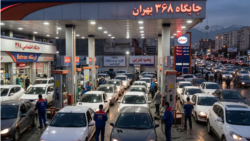
Iranian government spokeswoman Fatemeh Mohajerani warned on September 29 that damage to energy infrastructure during the war could cause gas supply problems in the country's northern provinces this winter.
"We suffered damage due to the attacks on the energy sector," Mohajerani said at her weekly press conference. "230 million cubic meters were lost as a result of the attacks, and we are trying to restore 100 million cubic meters of that."
She said the government was working to prevent shortages but acknowledged that northern provinces could face problems and that governors had been warned.
Earlier, Golestan Deputy Governor Seyed Mehdi Mahiai said that the provinces of Golestan, Mazandaran, and North Khorasan could face gas outages or restrictions lasting 60 to 90 days. The National Iranian Gas Company later rejected that figure as an official forecast.
Golestan officials have conducted gas-cutoff drills at bakeries to test alternative fuels.
An ISPA survey found that 66.1 percent of respondents said they were highly concerned or very highly concerned about energy shortages and rationing.
Iranian Rial Falls As US Dollar Reaches Record High
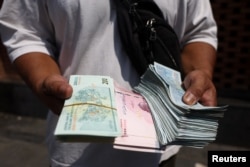
The US dollar reached a new record on Iran's free market on September 29, rising to around 2.5 million rials as the national currency weakened further.
The dollar rose from about 2,495,000 rials to 2,500,200 rials within an hour, according to Iranian market reports. On September 28, it had traded at around 2,437,000 rials, putting the next day's increase at roughly 63,000 rials.
The euro also rose above 2.83 million rials, while the British pound entered the 3.3 million rial range.
Gold and coin prices also increased. The Emami gold coin rose from below 2.48 billion rials on September 28 to nearly 2.52 billion rials on September 29.
The currency's decline came as US President Donald Trump rejected reports that Washington had offered sanctions relief and access to frozen Iranian funds in exchange for concessions on Tehran's nuclear program. "I offered them NOTHING," Trump wrote on Truth Social.
The Wall Street Journal has reported that US officials believe the naval blockade is placing significant pressure on Iran's economy. US and Gulf officials have also said Iran is losing control of the Strait of Hormuz, although those are officials' assessments rather than an independently established measure of control.
Oil Prices Rise For Second Session Amid Supply Concerns
Oil prices rose for a second consecutive session on September 29 as concerns over supply disruptions from the Middle East outweighed signs that crude exports from the region were recovering.
Brent crude futures rose 63 cents, or 0.6 percent, to $105.91 a barrel by 00:02 GMT, while US West Texas Intermediate crude gained 72 cents, or 0.8 percent, to $93.32. Prices later rose further, with Brent reaching $106.77 and WTI $93.94 in early trading.
Preliminary data from Kpler showed crude exports from major Middle Eastern producers reached 12.8 million barrels per day in September, the highest level since February, driven by increased shipments from Saudi Arabia and the United Arab Emirates.
However, much of the recovery has relied on costly workarounds, including ship-to-ship transfers, rather than normal shipping routes. Middle East exports remain below pre-war levels, while uncertainty surrounding the US-Iran conflict and the Strait of Hormuz continues to support prices.
With reporting by Reuters
UK Police Release On Bail 5 Men Held Over Air Base Incident
British police released five men on bail on September 28 after arresting them near RAF Fairford, an airbase in Gloucestershire used by the United States in operations against Iran, as authorities investigated a suspected terrorism plot and whether a foreign state may have been involved.
The men, all British nationals in their 20s and from London, were detained early on September 27 after a member of the public reported suspicious vehicles and masked individuals near the base. Police said they were initially arrested on suspicion of explosives offenses and later on suspicion of preparing an act of terrorism. They remain under investigation and are subject to conditions while inquiries continue.
Counterterrorism police said investigators were pursuing several lines of inquiry, including whether the suspects may have been acting knowingly or unknowingly on behalf of a foreign state. No country has been publicly identified by British police.
US Secretary of State Marco Rubio said the incident appeared to involve "the hands of a foreign actor," without providing further details. President Donald Trump said he was surprised that the suspects had been released on bail and that he would not have taken the same approach.
Prime Minister Andy Burnham chaired an emergency COBRA meeting on September 28 to assess the incident and ensure officials had a full understanding of the investigation.
Iran has denied any involvement in the suspected plot, rejecting claims linking Tehran to the incident as unfounded.
In New Statement, Khamenei Says Iran Will 'Protect' Strait Of Hormuz
As reports emerged about efforts to resume talks between Iran and the United States, Iranian Supreme Leader Ayatollah Mojtaba Khamenei said in a statement released by his office that Iran remained committed to preserving the "blessed Strait of Hormuz."
The statement came amid an ongoing military and diplomatic confrontation between the two countries. The conflict began with US-Israeli strikes on Iran on February 28, after which Iran effectively closed the Strait of Hormuz to shipping.
Khamenei said various sectors of Iranian society were maintaining their positions, including on preserving the strategic waterway.
His remarks came as oil flows through the strait have increased in recent weeks with US military assistance. US President Donald Trump told Axios on September 27 that more than 20 million barrels of oil had passed through the Strait of Hormuz over the weekend. A US defense official told Axios that 22 million barrels had moved through the waterway on the night of September 25-26.
Iranian oil exports, meanwhile, have been sharply curtailed by a US naval blockade imposed in July. Reuters reported that Iranian crude loadings had fallen from about 2 million barrels per day in March to roughly 220,000–255,000 barrels per day in August.
Khamenei, who has not appeared in public since the start of the war, also said the United States would eventually be forced to leave the Middle East after suffering what he described as "painful blows." He said US forces would soon be unable to venture beyond the Arabian Sea.
The Arabian Sea stretches from the Arabian Peninsula eastward toward India and forms a major maritime corridor connecting the region with the waters off Iran and the Strait of Hormuz.
Trump Denies Offering Iran Sanctions Relief, Release Of Frozen Funds
US President Donald Trump denied he had offered sanctions relief and the release of frozen funds in return for nuclear concessions from Tehran after a media publication claimed the president was "willing" to make such moves.
"This is untrue. I offered them NOTHING," Trump wrote on Truth Social, after Axios reported that he was willing to provide the relief in return for nuclear concessions amid fresh indirect talks on September 28.
"Axios’ story, like most others, is a HOAX, used only for purposes of satisfying their Trump Derangement Syndrome. They should withdraw this fake story, IMMEDIATELY!" he wrote.
The Axios story cited unnamed US officials.
CNN, citing an unidentified US official, also reported that Trump was willing to offer sanctions relief and release frozen funds as part of a final deal, on the condition that Tehran provide "concrete progress" on the nuclear issue.
Earlier, Trump told reporters that US officials had spoken on September 28 with mediators seeking to end the US war with Iran and added that the US would win the war "very soon."
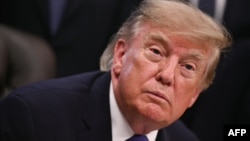
"We're going to win, as far as I'm concerned, it's going to be one way or the other," Trump said. "It's going to go pretty quickly."
Meanwhile, Iranian Foreign Minister Abbas Araqchi said Tehran has presented a proposal to mediators for a "peaceful solution" to the war, but he added that conditions stressed by Iran's supreme leader "must be implemented" for the crucial Strait of Hormuz to be reopened.
According to Iranian state media, Araqchi said he hopes to get a final response through Qatari mediators on September 29.
"If the Americans claim they are seeking an agreement or a peaceful solution, we have presented that solution," Araqchi said, speaking in New York on the sidelines of UN General Assembly activities.
Supreme Leader Mojtaba Khamenei said in a statement released by his office that Iran insists on being a custodian of the strait.
In the statement, Khamenei, who has not been seen in public since being elected to the position in March, declared that Iran will not be forced back to “the era the enemy wants it to be in.”
Netanyahu's Office Acknowledges Rare Secret Trip To UAE
Israeli Prime Minister Benjamin Netanyahu traveled to the United Arab Emirates and met with the president, Netanyahu's office and the UAE said in a rare public acknowledgement at a time of high tensions between Israel and many Gulf Arab nations over the Gaza war.
Abu Dhabi acknowledged the September 27 meeting between Muhammad bin Zayed al Nahyan and Netanyahu, confirming earlier Israeli media reports.
"The two sides discussed bilateral relations between the UAE and Israel and ways to strengthen and develop them," the Emirati statement read.
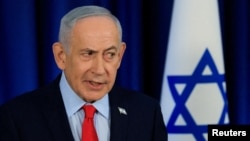
Netanyahu's office said the visit "focused on strengthening relations between the two countries and on regional challenges" amid delicate US-backed diplomacy on the Iran war.
The visit comes amid media reports, denied by Netanyahu, that the Emirati president had warned Netanyahu ahead of Hamas's October 7, 2023, deadly attack on Israel. That attack led to Israeli strikes against Hamas -- a US- and Israeli-designated terror group -- in Gaza.
Israeli media reported that Netanyahu went to the UAE to ask the Emirate leader to deny having given him that warning in 2023.
Netanyahu has acknowledged previous trips to the UAE, with which Israel normalized relations with the 2020 Abraham Accords.
Last week, Mike Huckabee, the US ambassador to Israel, disclosed that Tel Aviv had shared its air defense system with the UAE, sending Iron Dome batteries and specialists to operate them during the US-Israeli war with Iran.
“There’s an extraordinary relationship between the UAE and Israel,” Huckabee said.
The UAE, along with neighboring Saudi Arabia, is a Sunni-Muslim led nation and a bitter regional rival of Shi'ite majority Iran.
With reporting by AFP and The Guardian
Iraqi Airways Flights Between Najaf And Iranian Airports Resume
Iraqi state news agency INA reported on September 28 that Iraqi Airways has resumed flights between the city of Najaf and Iranian airports.
Hours earlier, Reuters cited an American official saying that the US government was set to issue a limited exemption from the Iran sanctions program to allow flights carrying Shi'ite pilgrims between Iran and Iraq.
The Reuters source, said to be involved in negotiations related to the decision, said the US Treasury Department waiver allows Iraqi Airways to operate round-trip flights between Iran and the city of Najaf for one month.
The report said the move is aimed at reducing pressure on the Iraqi government, which is trying to deepen ties with Washington while also maintaining its close ties with Iran.
The Iraqi prime minister's office announced earlier that Baghdad is seeking exemptions from US restrictions on travel between Iran and Iraq for medical, educational, and pilgrimage purposes.
Supreme Leader Releases Statement Reasserting Iran’s Role In The Strait of Hormuz
As reports emerged about efforts to resume talks between Iran and the United States, Iran’s Supreme Leader Mojtaba Khamenei said in a statement released by his office that Iran insists on being a custodian of the Strait of Hormuz.
Shortly after the start of the US-Israeli military campaign against Iran in February this year, Iran’s forces imposed a blockade on the strategic waterway by attacking commercial ships, leaving hundreds of cargo vessels stranded.
In recent weeks, media reports and shipping data show that the amount of oil flowing through the southern route of the Strait of Hormuz has increased with the support of the US military.
At the same time, Iranian oil exports have been greatly reduced due to the US-imposed naval blockade of Iranian ports.
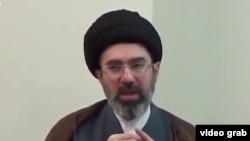
The new Iranian leader, who has not been seen in public since being elected to the position in March, has claimed that the United States will be forced to leave the Middle East after suffering "painful blows."
In the statement attributed to Khamenei and published by Iranian state media on September 28, he declared that Iran will not be forced back to “the era the enemy wants it to be in.”