



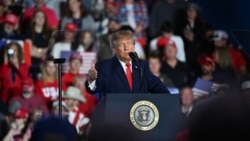

Trump Tells Rally That US May Have To Give Iran 'The Hammer'
US President Donald Trump again threatened to resume air strikes against Iran, saying during a campaign rally that he may have to give Tehran "the hammer" at some point, without being specific.
"And the only reason why I'm not finished with Iran is I want to be nice," he told supporters on November 1 during a rally in Iowa, just ahead of the November 3 midterm elections.
"I want to try and save all those lives if I can...But at some point we're going to have to give them the hammer," he added.
Trump earlier said he had spoken by phone with Israeli Prime Minister Benjamin Netanyahu over the weekend, with Iran being discussed. He was not more specific.
US news outlet Axios, citing US and Israeli sources, reported that Netanyahu pressed Trump to launch strikes on Iran immediately following the November 3 US midterm elections.
Trump was leaning toward allowing current negotiations to play out, the report said.
With reporting by AFP
CENTCOM Rejects Araqchi's Denial Of Attacks On Civilians
The US military's Central Command (CENTCOM) on November 2 rejected a claim by Iranian Foreign Minister Abbas Araqchi that Iran had not targeted civilians in neighboring countries, accusing Tehran of deliberately attacking civilian infrastructure and commercial vessels.
In an interview with Al Jazeera on November 1, Araqchi said Iran's attacks in the region had targeted US military bases and interests, not neighboring countries. He denied Iran had deliberately targeted civilians.
In a post on X, CENTCOM called the minister's claim "false" and said Iran had deliberately attacked civilian infrastructure, residential areas, and other facilities in neighboring Persian Gulf countries.
The command also accused Iran of deliberately targeting civilian mariners at sea, saying the attacks had killed more than 20 people in recent months.
CENTCOM did not identify the vessels involved or provide a breakdown of the reported deaths. The figure was not independently verified.
The statement comes amid ongoing maritime tensions in the Strait of Hormuz, where commercial shipping has faced repeated attacks during the US-Israeli war with Iran.
CENTCOM described Iran's actions as "indiscriminate aggression," adding that they were "clearly evident and inexcusable."
The command's statement did not address civilian casualties from US and Israeli attacks inside Iran.
Somali Pirates Hijack Iranian Fishing Boat
Somali pirates hijacked an Iranian fishing vessel off the northeastern coast of Somalia, raising concerns that the pirates could use it to launch further attacks on commercial shipping.
The European Union's Maritime Security Center Indian Ocean (MSCIO) said it had received information about the reported hijacking of the vessel, named Azini, on October 29.
The vessel was carrying 23 people, including 21 Iranian crew members and two Somali security guards, according to the Associated Press. Their whereabouts and condition were not immediately known.
The boat was seized between the coastal towns of Bandar Bayla and Hafun in Puntland, a semi-autonomous region of northeastern Somalia.
Puntland security officials told AFP that eight armed pirates initially carried out the attack. A subsequent report said four more pirates boarded the vessel, bringing the total number of attackers to 12.
The MSCIO warned that the hijacked vessel could potentially be used as a "mothership" to support further piracy attacks. It said the boat was approaching a maritime traffic lane and urged vessels in the area to remain vigilant.
The EU's Operation Atalanta naval force is investigating the reported hijacking.
The incident comes amid a resurgence of Somali piracy after years of relative inactivity. International naval patrols and improved security measures helped reduce attacks after 2013, but piracy has increased again in recent years.
Pirate groups have used hijacked fishing vessels as floating bases to launch attacks on larger commercial ships farther from the Somali coast.
The latest incident adds to concerns about maritime security in the western Indian Ocean, where commercial shipping has also faced threats from Iran-allied Houthis in the Red Sea and surrounding waters.
Trump Talks To Netanyahu On Iran, While Mediators Bid To Head Off New Fighting
US President Donald Trump said he spoke with Israeli Prime Minister Benjamin Netanyahu amid speculation of possible new strikes against Iran, while Qatari mediators met with leaders of the Islamic republic in an effort to prevent a war of words from becoming a renewed deadly conflict.
"Just had a very good talk with him," Trump on November 1 said of the conversation he held the day earlier with the Israeli leader after US media, citing sources, reported on the call.
One of the key topics, Trump, said was Iran, although he did not offer details.
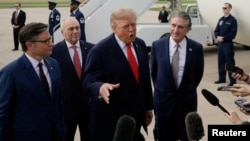
Axios quoted one source from the US and one from Israel as saying Trump and Netanyahu discussed the state of talks with Tehran, with Netanyahu pressing Trump to launch strikes on Iran immediately following the November 3 US midterm elections.
Trump was leaning toward allowing current negotiations to play out, the report said.
The Israeli source told Axios that the call was "tough." The US source said it was "direct."
Trump on October 31 insisted to reporters that talks with Tehran were "going fine," but he also said the US needed to "take care of" one or two Iranian targets.
"We still have to take care of, I would say one or two sites, but we can do that in 10 minutes," Trump told reporters.
Trump claimed Washington was not in a hurry to take offensive action because it had already wiped out Iran's military and its nuclear program.
Meanwhile, Qatari mediators arrived in Tehran over the weekend for talks with Iranian officials, state media reported.
Iranian Foreign Minister Abbas Araqchi said the purpose of the "ongoing and progressing" talks was to continue consultations with the Qatari mediators. He added that Iran was prepared for "both defense and diplomacy."
Iranian military spokesman Mohammad Akraminia told state TV that any "potential future war could last longer than previous conflict, and the American president would not be in a position to dictate the timing or the conditions of its conclusion."
With reporting by AFP and Reuters
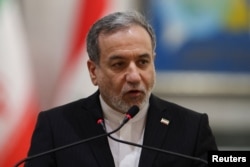
Araqchi Says Strait of Hormuz Could Reopen In 48 Hours, Instead Of A Week
Iranian Foreign Minister Abbas Araqchi said the Strait of Hormuz could be reopened in two days instead of seven, as per a suggestion by Qatar, if his country's conditions were accepted.
Quoting Araqchi, Iran’s official Press TV reported on November 1 that his country had continued diplomatic consultations through Qatari mediators over the reopening of the Strait of Hormuz.
"There has been no meeting with the American delegation, nor has one been planned," Araqchi said. He added that his country was currently discussing its own proposal through intermediaries.
The Iranian foreign minister said a senior Iranian diplomat had traveled to Qatar to continue discussions following a recent visit by a Qatari delegation to Tehran for talks with Iranian officials on October 30. On October 26, a three-member delegation of the so-called Mecca Defense Alliance held talks with Iranian security officials.
Intense diplomatic efforts by regional and international players continue, even as both Iran and the United States maintain a confrontational stance in the war, now in its ninth month.
US President Donald Trump renewed his threat to strike Iran on October 31, saying US forces still have one or two targets "to take care of," including Pickaxe Mountain, the notorious underground site where US officials say Tehran has moved thousands of centrifuges.
"We've knocked out their nuclear," Trump told reporters late on October 31 during a trip to Florida. "We still have to take care of, I would say one or two sites, but we can do that in 10 minutes."
Earlier, a message attributed to Iran's supreme leader warned Israel and the United States against resuming their air strikes.
"Any level or type of threat must be met with an immediate, impactful, and geographically unrestricted response," Iranian media, quoting Mojtaba Khamenei, said on October 31.
Pakistan-Bound Cargo Ship Targeted Near Hormuz Strait
A Pakistan-bound cargo vessel carrying liquified natural gas (LNG) was hit near the Strait of Hormuz with the green light from Iranian authorities, the Bloomberg news agency reported on November 1.
There was no comment from the Pakistani or Iranian authorities about the incident. But Doha News, a Qatar-based digital news platform, reported on November 1 that its LNG carrier, Al Mayeda, was struck by unidentified objects while transiting the Arabian Gulf on the evening of October 30.
According to Bloomberg, Pakistan negotiated with Iran to secure safe passage for the liquified natural gas carrier Al Mayeda before the ship was attacked near the Strait of Hormuz.
Pakistan is mostly dependent on its LNG and LPG imports from Qatar and Iran. According to the World Bank, Qatar supplied approximately 4.5 million tons of LNG to Pakistan in 2025, accounting for almost all of the country's LNG imports.
However, LNG imports have been affected by the US-Iran war. Earlier in October, prices for liquified petroleum gas (LPG) in Pakistan recorded an increase of more than 100 percent due to the closure of Pakistan’s border crossing with Iran.
Pakistan imports roughly 7,000 metric tons of LPG per day from Iran, according to the Pakistan LPG Association.
In mid-October, Pakistan closed its two border crossings with Iran for "technical reasons," causing hundreds of trucks to be stranded on both sides of the border.
Quoting unnamed sources, the Bloomberg report said that the Marshall Islands-flagged vessel was sailing toward the waterway loaded with LNG from Qatar when it came under fire.
Just hours earlier, Iranian authorities were understood to have provided a green light, said the report while quoting the unnamed sources. The ship subsequently turned around and headed into the Persian Gulf, according to ship-tracking data.
Iran has effectively closed the Strait of Hormuz, the international waterway accounting for roughly 20 percent of world oil supplies, since the start of US-Iran war on February 28.
Iran Designates Britain's MI6 A 'Hostile Group'
Iran has designated Britain's Secret Intelligence Service (MI6) as a "hostile" group and declared the Royal Navy and Royal Air Force "terrorist organizations."
Accusing the British government of "hostile actions," the regime’s Foreign Ministry said in a Novemer 1 statement that this step was taken as a retaliatory move against London.
The Iranian Foreign Ministry cited Britain’s military and logistical support for the United States and Israel against Iran. It also mentioned the placing of Iran's Islamic Revolutionary Guards Corps (IRGC) under the State Threat Act 2026 by the British authorities on July 13.
Iran’s designation of the top British security agencies comes at a time when regional and international actors have continued their mediation efforts to find a negotiated settlement to the lingering Middle East conflict that has now entered its ninth month.
Trump Renews Iran Threat, Says US Still Needs To 'Take Care' Of 1 Or 2 Targets
US President Donald Trump renewed his threat to strike Iran, saying US forces still have one or two targets "to take care of," including Pickaxe Mountain, the notorious underground site where US officials say Tehran has moved thousands of centrifuges.
"We've knocked out their nuclear," Trump told reporters late on October 31 during a trip to Florida.
"We still have to take care of, I would say one or two sites, but we can do that in 10 minutes."
"You probably could look at Pickaxe Mountain, and you have to take care of that. We can do that all very quickly," he added.
Trump has several times suggested he could relaunch military strikes after the US holds its midterm elections -- which will decide which party controls the House of Representatives and Senate – on November 3.
Still, US Secretary of State Marco Rubio on October 31 suggested strikes were not a certainty, saying that "if there is a diplomatic solution, we would be open to it."
Trump would "prefer to solve it diplomatically. But I think what the president expresses to you is incredible confidence that if we needed to do something militarily, we would have the ability to do it," Rubio added.
Meanwhile, Israeli Prime Minister Benjamin Netanyahu, following indecisive elections in that country, has spoken of a "historic, one-time opportunity" to topple the government in Tehran.
Earlier on October 31, a message attributed to Iran's supreme leader warned Israel and the US against resuming airstrikes as tensions mounted in the region following the Israeli election and ahead of US midterm voting.
"Any level or type of threat must be met with an immediate, impactful, and geographically unrestricted response," the supreme leader, Mojtaba Khamenei, told top military commanders, according to a statement.
Khamenei, according to the statement, also ordered military commanders to update Iran's target list to include "all types of tangible and intangible assets belonging to the American-Zionist enemy."
Khamenei has not been seen in public since the start of US-Israeli air strikes on February 28 amid reports that he had been severely injured in the attacks. Statements have periodically been released in his name.
With reporting by AFP
Iran's Khamenei Issues Threat, But Security Chief Sees 'Good Sign' In Vance Letter
A message attributed to Iran's supreme leader warned Israel and the United States against resuming airstrikes against the Islamic republic as tensions mounted in the region following the Israeli election and ahead of US midterm voting.
"Any level or type of threat must be met with an immediate, impactful, and geographically unrestricted response," the supreme leader, Mojtaba Khamenei, told top military commanders, according to a statement.
Khamenei, according to the statement, also ordered military commanders to update Iran's target list to include "all types of tangible and intangible assets belonging to the American-Zionist enemy."
Khamenei has not been seen in public since the start of US-Israeli air strikes on February 28 amid reports that he had been severely injured in the attacks. Statements have periodically been released in his name.
In the US, President Donald Trump has suggested he could relaunch military strikes after the US holds its elections -- which will decide control of the House of Representatives and Senate – on November 3.
Still, US Secretary of State Marco Rubio on October 31 said that "if there is a diplomatic solution we would be open to it."
Trump would "prefer to solve it diplomatically. But I think what the president expresses to you is incredible confidence that if we needed to do something militarily, we would have the ability to do it," Rubio added.
Meanwhile, Israeli Prime Minister Benjamin Netanyahu, following indecisive elections in that country, has spoken of a "historic, one-time opportunity" to topple the government in Tehran.
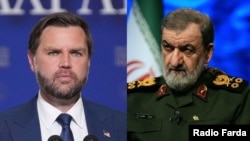
In an effort to head off any fresh fighting, Qatari mediators traveled to Tehran on October 30, while US Vice President JD Vance gas sent a letter to Iran's security chief Mohsen Rezaei.
"I read the letter," Rezaei, chief of Iran's supreme national security council, said in a video broadcast on Iranian state TV. "I haven't yet responded. Their tone has completely changed," he added, describing that as "a good sign."
Trump said Vance's letter to Tehran concerned efforts to help Iran get medical supplies, denying US media reports that it had been sent to an Iranian security official to revive peace talks.
"They need help with medical supplies and various things," Trump told reporters on October 28, adding that Vance "asked me what I thought. I said, if you want to do that, that's okay. Basically, it's getting supplies in to help people that are not well."
With reporting by AFP
Trump Says Vance Sent Letter To Iran To 'Help' With Medicine
US Vice President JD Vance's letter to Tehran concerned efforts to help Iran get medical supplies, President Donald Trump said, denying US media reports that it had been sent to an Iranian security official to revive peace talks.
"They need help with medical supplies and various things," Trump told reporters on October 28, adding that Vance "asked me what I thought. I said, if you want to do that, that's okay. Basically, it's getting supplies in to help people that are not well."
There was no immediate comment from Tehran, but Iranian media reported on October 29 that Tehran had received the letter and was yet to respond.
Trump's remark came on the same day The Wall Street Journal and The New York Times reportedthat the US president had directed Vance to send the letter to Iranian security chief. Mohsen Rezaei, in an effort to resume negotiations and avert new US strikes on Iran.
For the past few months, peace efforts to end the protracted conflict between the United States and Iran have effectively stalled.
The two countries remained apart on the negotiating terms, with Washington imposing more sanctions against Iran and resuming its maritime blockade of the country's ports. Tehran, for its part, has continued to disrupt shipping through the key Strait of Hormuz, keeping global oil prices soaring.
Asked if Vance's letter was actually sent to Iran to give a fresh start to the talks, Trump said: "No."
On October 28, Iranian Foreign Minister Abbas Araqchi said his country was discussing a seven-day plan to end the war with mediators, a framework previously rejected by Trump that included demands for the removal of sanctions on Iran's oil sector and other easing measures.
Iranian media reported that Tehran viewed any position that undermined its proposed framework as unacceptable to the country.