




Explosions Reported In Southern Iran
Iranian media reported explosions in several locations across the country's southern Hormozgan Province on November 7, including Qeshm Island, Sirik, Jask, and Bandar Abbas, amid conflicting accounts over their cause.
Iranian state television said the origin of the explosions remained unclear, suggesting they could be connected to Iranian military activities aimed at defending the Strait of Hormuz. State news agency IRNA initially reported two explosions in eastern Qeshm, while residents also reported blasts near Jask.
The semiofficial Tasnim news agency cited an informed source as saying the explosions on Qeshm were unrelated to missile strikes and instead linked to the armed forces' management of maritime traffic in the strait. However, Tasnim had earlier reported that two missiles struck the island, without providing details of possible damage. Fars also reported explosions but said their exact locations and nature were unknown.
The latest reports came a day after US President Donald Trump confirmed that American forces had conducted a limited strike against an Iranian air defense system on Qeshm Island on November 6.
IRGC Says 2 Oil Tankers Caught Fire After Hitting Mines
Iran's Islamic Revolutionary Guards Corps (IRGC) said on November 8 that two oil tankers had caught fire after hitting mines in or near the Strait of Hormuz.
In a statement, the IRGC Navy said one vessel struck a mine in the eastern part of the strait and the other inside it. It accused both tankers of switching off their navigation systems and using unauthorized routes. The statement did not identify the vessels or provide information about their crews or possible casualties.
The claims could not be independently verified. No maritime authority had confirmed the two incidents at the time of publication.
The announcement came a day after the US military disabled a commercial vessel in the Gulf of Oman, an incident Washington said was linked to its blockade of Iranian ports.
The United States first imposed the naval blockade on April 13. It was suspended on June 18 and resumed on July 14, according to US Central Command.
The latest reported incidents add to growing tensions around the Strait of Hormuz, a key international shipping route through which a significant share of the world's oil supply passes.
Abbas-Ali Kadkhodaei, secretary of Iran's Expediency Council Secretariat, said on November 8 that the strait was an important source of leverage for Iran and was tied to the country's national and financial security.
Riyadh's Aramco Tower Damaged By Debris After Missile Attacks
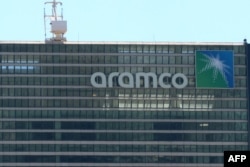
Saudi Arabia's Energy Ministry confirmed on November 8 that an administrative building belonging to Saudi Aramco in Riyadh sustained limited damage after falling debris from an attempted attack. No deaths or injuries were reported.
A Reuters witness saw shattered windows across several floors of the Aramco Tower in the King Abdullah Financial District. Several witnesses also told AFP that the building had been targeted, although Saudi authorities attributed the damage to falling debris.
The incident followed the Saudi-led military coalition's announcement that air defenses had intercepted two ballistic missiles launched toward Riyadh by Yemen's Iran-aligned Houthi group. The coalition subsequently reported intercepting two cruise missiles over Riyadh and southern Saudi Arabia.
Earlier, Saudi Civil Defense issued security warnings in the oil-rich Eastern Province, including Dhahran, Dammam, Abqaiq and Al-Ahsa. The coalition separately announced the interception of a ballistic missile heading toward the region.
Aramco was not immediately available for comment, while the Houthis had not claimed responsibility for the November 8 attack at the time of Reuters' report.
However, Houthi military spokesman Yahya Saree previously claimed the group had conducted six operations targeting Aramco facilities, Riyadh airport, and Saudi military positions.
The escalation comes amid renewed fighting in Yemen following the collapse of a 2022 truce in July. Saudi Arabia has intensified air strikes against Houthi positions, while the group has increased missile and drone attacks against Saudi infrastructure.
Friday Prayer Leader Close to IRGC Killed In Sistan And Baluchestan Province
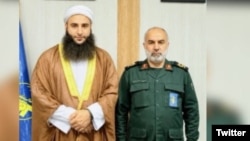
Mawlavi Mohammad Yusuf Qazi, the Friday Prayer leader of Mohtaramabad in Fanuj County, Sistan and Baluchestan Province, was killed in an armed attack on November 7.
According to Fanuj police commander Hossein Ahmadzadeh, unidentified gunmen opened fire on Qazi's vehicle as he was traveling between Mohtaramabad and Fanuj.
The police official described him as a respected local figure, head of the Qazi tribe, and commander of the Mohtaramabad combat unit base.
The local human rights group HalVash reported that the attackers forced his vehicle off the road before shooting him in the head at close range.
HalVash described Qazi as a prominent Sunni cleric with close ties to the Islamic Revolutionary Guards Corps (IRGC) and government institutions in the region, saying he had helped promote government policies in the Fanuj and Khash areas.
Following his killing, HalVash published a video showing Qazi pledging allegiance to Mojtaba Khamenei, Iran's supreme leader, who was appointed on March 8 following the death of his father, Ali Khamenei, in US-Israeli air strikes on February 28.
No group has claimed responsibility for the killing.
The killing comes amid continuing armed attacks and clashes in Sistan and Baluchestan, where Iranian security forces have repeatedly faced attacks by armed Baluch groups.
Iran Executes 3 More Detainees Over January Protests
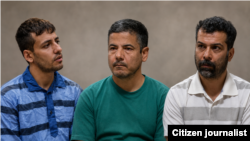
Iranian authorities have executed three men arrested in connection with the January 2026 anti-government protests in Karaj, according to the judiciary-affiliated Mizan news agency.
Hassan Dioband, Hamid Kazemi and Reza Zanganeh were executed on November 8 after Iran's Supreme Court upheld their death sentences.
Mizan accused the three men of participating in operational activities for Israel, the United States, and groups described by the authorities as hostile to Iran. The judiciary also alleged that they took part in armed attacks, damaged public property, and targeted electricity infrastructure during protests on January 8 and 9.
However, the authorities have not publicly presented independently verifiable evidence substantiating the allegations. Human rights organizations have repeatedly raised concerns about unfair trials, forced confessions, and the use of capital punishment against political detainees in Iran.
The executions come amid a broader escalation in the use of the death penalty against people arrested during the widespread protests in Iran in December and January, during which thousands of protesters were killed in a violent government crackdown, according to rights groups.
Amnesty International recorded at least 2,159 executions in Iran in 2025, making the country the world's second-largest executioner after China, where thousands of executions are believed to take place annually.
Rights organizations warn that executions are increasingly being used to intimidate society and deter further dissent.
US Forces Disable Ship Seeking To Break Iran Blockade, CENTCOM Says
The US military said it fired on and disabled a commercial ship in the Gulf of Oman after its crew ignored orders to stop and attempted to break its blockade of Iran.
"The ship’s civilian crew ignored repeated warnings and attempted to violate the naval blockade against Iran multiple times," US Central Command (CENTCOM) said in a statement on November 7.
CENTCOM said a St. Kitts-flagged cargo ship attempted to exit regional waters after stopping at an Iranian port. A US warplane fired precision munitions at it after American forces had ordered it to "abandon targeted spaces."


The action comes as the US military also said it was launching a task force to crack down on Tehran's movement of advanced weapons and other sanctioned material over its land borders and through the Caspian Sea.
"CENTCOM continues to strictly enforce America’s naval blockade against Iran. Enforcement actions since July have resulted in US forces redirecting 147 commercial vessels that complied and disabled five merchant ships that refused to comply."
The United Kingdom Maritime Trade Operations (UKMTO), which is affiliated with the British Navy, said that the status of the crew, damage assessment, and environmental impact were not immediately known.
Speculation has grown that US President Donald Trump could order fresh air strikes against Iran following the US midterm elections, although he has also said he wants to reach a negotiated deal.
Trump confirmed late on November 6 that US forces had carried out limited strikes against an Iranian air-defense system on Qeshm Island in the Strait of Hormuz.
Trump described the operation as "minor," saying US forces had destroyed a small Iranian anti-aircraft system within minutes.
UPDATE: The National Guard of the United Arab Emirates early on November 8 said it has rescued 22 people after a fire broke out on a cargo ship in the Sea of Oman, although it did not immediately discuss specifics are say if it was the vessel involved with the US action. The UAE statement said all of the people rescued are Arab nationals.
With reporting by Reuters
Iran Executes Baluch Prisoner Amid Concerns Over Unfair Trials
Iranian authorities executed Mohammad Aref Shahbakhsh, a 27-year-old Baluch man, at Zahedan Central Prison on November 7, according to rights groups and Iranian media.
Judicial officials accused Shahbakhsh of being a member of the Jaish al-Adl militant group and involvement in an armed assault on the Qaleh Bid police station in Khash, located in the southeastern Sistan and Baluchestan Province. State media claimed the attack left several police officers dead or wounded, resulting in Shahbakhsh's conviction on charges of armed rebellion and "enmity against God."
ranian human rights groups reported Shahbakhsh had been held in state custody for more than two years while being systematically denied access to an independent lawyer or a transparent trial. According to monitors, the execution was carried out secretly at dawn on November 7 without prior notification or final visitation rights granted to his family.
A recent report by RFE/RL's Radio Farda highlighted severe procedural violations in the separate Isfahan Shohada Square case, where 10 death sentences were handed down against anti-government protesters.
Citing informed sources, Radio Farda reported that several judges signed those final execution orders despite never attending the courtroom sessions, reviewing the defense files, or hearing arguments from the defendants. The report also emphasized a broader reliance on allegedly coerced confessions and the mishandling of foundational evidence, fueling widespread criticism over the total absence of due process.
CENTCOM Announces Task Force To Target Iran's Military Supply Routes
The US Central Command (CENTCOM) has announced the creation of a new task force that will work to disrupt the delivery of advanced weapons, dual-use technology, and sanctioned materials into Iran through land routes and the Caspian Sea.
Task Force Iron Gate, which will coordinate with other US government agencies, comprises around 20 military and civilian personnel and is based in Tampa, Florida, CENTCOM said in a statement on X.
CENTCOM Commander Admiral Brad Cooper said the team would also reinforce the US naval blockade of Iran's ports, in order to "further constrain Iran's ability to finance terrorism, rebuild weapons factories, and replenish their military."
Cooper added that the blockade had prevented Iran from exporting more than $25 billion in crude oil in recent months. CENTCOM said enforcement at sea would continue against all ships entering or departing Iranian ports.
The announcement comes amid a series of warnings from Iranian military officials.
On November 7, Iranian media reported that IRGC spokesman Brigadier General Hossein Mohebbi had announced the lifting of Iran's previously self-imposed 2,000-kilometre missile-range limit. He said the country's capabilities would be demonstrated in practice.
The previous day, IRGC Aerospace Force adviser Brigadier General Ali Balali warned that countries assisting a potential US attack on Iran could themselves become targets.
Iran Reiterates Terms For Reopening Strait Of Hormuz, Warns Of Military Response
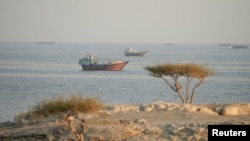
Iran says the United States must accept its seven conditions before the Strait of Hormuz can reopen, warning further military action will not change its position.
Speaking on November 6, Iranian Army spokesman Brigadier General Mohammad Akraminia told the semiofficial Tasnim News Agency that accepting Tehran's demands was the only way to reopen the strategic waterway. He warned that any renewed aggression would prompt an immediate Iranian response, potentially targeting US military assets without geographical restrictions.
Those demands reportedly include lifting US sanctions, releasing frozen Iranian assets, and paying war reparations.
Washington has not publicly responded directly to Akraminia's statement. The United States has maintained that Iran's nuclear program must be addressed in any initial negotiations.
The Islamic Revolutionary Guards Corps Navy also reiterated on November 6 that the Strait of Hormuz would remain closed until Iran's conditions were met.
The Iranian warnings came amid continued reports of attacks and other security incidents involving commercial shipping in and around the vital waterway.
The IRGC Navy claimed two oil tankers had struck naval mines while attempting to use unauthorized routes through the strait. Both vessels caught fire and were stopped, according to the statement. The claims have not been independently verified.
Separately, the United Kingdom Maritime Trade Operations (UKMTO) reported an explosion aboard a tanker approximately 16 nautical miles east of Khasab, Oman, on November 6. All crew members were safe, and the vessel continued under its own power, according to UKMTO.
UKMTO reported 11 attacks on commercial vessels across the Strait of Hormuz and the Arabian Gulf in the seven days to November 4.
Meanwhile, Greek shipping company Velos Tankers confirmed on November 6 that one crew member had died following an explosion aboard its Marshall Islands-flagged tanker MT Velos Sapphire in the Persian Gulf on November 5. The remaining crew members were unharmed, and the fire was extinguished by the crew, according to the company.
Trump Confirms US Strikes On Iran's Qeshm Island
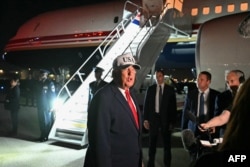
US President Donald Trump confirmed late on November 6 that American forces had carried out limited strikes against an Iranian air-defense system on Qeshm Island in the Strait of Hormuz.
Speaking to reporters in West Palm Beach, Florida, Trump described the operation as "minor," saying US forces had destroyed a small Iranian anti-aircraft system within minutes.
"They knocked it out in about 15 minutes, maybe 5," he told reporters, without disclosing the precise location of the target or providing further operational details.
His remarks followed media reports of explosions on Qeshm Island.
Iran's semiofficial Tasnim news agency reported preliminary indications that two missiles had struck Qeshm Island, while state news agency IRNA cited local witnesses reporting two projectiles hitting the Suza area after an aircraft was heard overhead.
Iranian media also claimed that the country's air defenses had intercepted and destroyed a US MQ-1 Predator drone over Qeshm.
Meanwhile, Trump said Washington continued to be in contact with Tehran. Speaking to reporters in Florida, he said, "We are talking to Iran. We have been. They desperately want a deal."
The strategic Qeshm Island sits at the mouth of the Strait of Hormuz, one of the world's most important maritime routes for energy shipments.
The island is home to a large underground missile facility, a naval base, and a major desalination plant, according to The Wall Street Journal. It has been targeted by US forces in previous rounds of fighting, and US officials have also discussed the possibility of seizing it.