




Iran Says Man Executed Over Alleged Links To Mossad

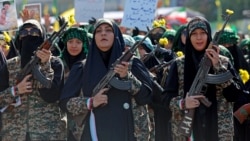
Iranian news reports said a man accused of spying for Israeli intelligence has been executed.
The Mizan News Agency, which is affiliated with Iran’s judiciary, said on September 19 that Hossein Pedaran was put to death following a Supreme Court ruling.
The agency did not say when and where it took place.
Mizan said Pedaran had allegedly provided the Israeli spy agency Mossad with information about sensitive military sites.
The agency also alleged that he had sought contact with the CIA for financial reasons, and that information he provided may have been used in attacks during the 12-day war.
The Tasnim news agency, another semiofficial news agency, said authorities allegedly found a notebook containing "top secret" missile information, encrypted memory cards, and secret imaging equipment.
The reports could not be independently confirmed.
Iran has sharply increased the number of executions it has carried out in recent years. The Abdorrahman Boroumand Center, a US-based human rights group, recorded at least 2,113 executions in 2025, the highest known annual figure since the late 1980s.
This year, at least 448 people have been executed, according to verified data as of August; many were sentenced to death in connection with the January protests where thousands were killed by security forces and tens of thousands more detained.
With reporting by RFE/RL's Radio Farda
Yemen Conflict Intensifies, Reverberating Beyond the Region
- By Frud Bezhan
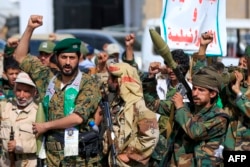
A conflict that has simmered in Yemen for years has flared in recent weeks, with consequences that could reach far beyond the Middle East.
The Houthi rebels have seized nearly all of Yemen’s Red Sea coastline, giving the Iran-aligned militant group control of the Bab al-Mandab Strait, a key chokepoint for global trade.
The Houthis have also intensified attacks on energy facilities in Saudi Arabia, the group’s foe and the world’s biggest oil exporter. Riyadh has been forced to temporarily shut down a crucial oil pipeline after a drone attack that it blamed on a pro-Iranian militia in Iraq.
The escalation in the Houthi-Saudi conflict has contributed to a recent surge in oil prices, which rose to $110 on September 15, the highest in months, before falling slightly.
Experts warn that a prolonged shutdown of Saudi Arabia’s critical East-West pipeline or a Houthi attempt to block the Bab al-Mandab Strait, which accounts for around 6 percent of the world’s seaborne-traded oil, could send shockwaves around the world.
Read more here
White House Rejects UN Report Alleging US War Crimes In Iran
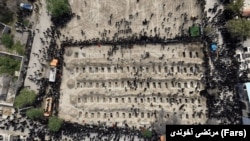
The White House has rejected a report by a UN independent fact-finding mission that said there were reasonable grounds to believe the United States had committed war crimes during two air strikes in Iran.
The Independent International Fact-Finding Mission on Iran said in a report released on September 17 that there were reasonable grounds to believe US forces committed the war crime of launching indiscriminate attacks during strikes on a school in Minab and a sports facility in Lamerd on February 28.
The two strikes killed at least 178 civilians, including women and children, according to the mission. The Minab strike hit the Shajareh Tayyebeh Primary School and killed more than 150 people, including about 120 schoolchildren.
A separate strike on a sports complex and surrounding residential area in Lamerd killed 22 civilians.
In a scathing written response to the report, White House Deputy Press Secretary Anna Kelly rejected the findings, saying: "The only party in this conflict that has committed war crimes is the Iranian regime, which has murdered thousands of its own people, killed Americans overseas, executed acts of terrorism in the Strait of Hormuz, and launched indiscriminate attacks against its neighbors in the region."
Kelly also said the UN Human Rights Council had "accomplished nothing for human rights while spouting unserious nonsense for decades."
US officials have repeatedly said military operations are conducted in accordance with the law of armed conflict and that an investigation is ongoing.
The report is scheduled to be formally presented to the 47-member UN Human Rights Council in Geneva on September 21.
The mission also found reasonable grounds to believe that Iranian authorities committed crimes against humanity during their crackdown on nationwide protests in December-January. It cited unlawful killings, arbitrary detention, torture, and other inhumane acts committed as part of a widespread and systematic attack against civilians.
IRGC Says It Struck Another Oil Tanker In Strait of Hormuz
Iran's Islamic Revolutionary Guards Corps (IRGC) Navy said on September 18 that it had struck another oil tanker in the Strait of Hormuz, setting the vessel on fire and forcing it to stop.
In a statement, the IRGC identified the tanker as the Trend, sailing under the Togolese flag. It said the vessel was struck on the night of September 17 while attempting what Iran described as an "illegal" passage through the vital waterway.
The IRGC said the tanker caught fire and was stopped. It did not provide information about the vessel's crew, cargo, possible casualties, or its current condition.
There was no immediate independent confirmation of the reported strike or fire.
Within the past 24 hours, the UK Maritime Trade Operations Organization (UKMTO) has issued three reports of security incidents involving vessels transiting the Strait of Hormuz, including one involving "a tanker being hit by an unknown projectile causing a fire onboard which has since been extinguished."
"All crew are reported safe and environmental impact is unconfirmed at present," the UKMTO added.
It remains unclear whether any of the UKMTO incidents involved the same vessel identified by the IRGC as the Trend.
The IRGC Navy said it maintains control of the Strait of Hormuz and warned that vessels attempting what it considers illegal passage would face destruction.
The United States has disputed Iran's claims of control over the waterway and has been assisting commercial vessels navigating the strait amid the conflict.
South Korea Rules Out Military Involvement in Iran War
South Korean President Lee Jae-myung has ruled out sending troops or military assets to the Middle East in a way that would involve Seoul in the war with Iran, but said South Korea may take measures to protect commercial shipping and oil shipments through the region.
"Let it be clear: There will be no dispatch of troops that will lead to involvement in a conflict. There will be no engagement or involvement in war," Lee said at a televised press conference on September 18.
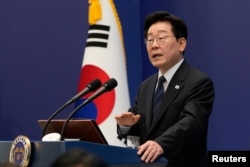
He said South Korea would maintain the principle of not dispatching military assets in a way that could involve it in the conflict.
Lee said Seoul nevertheless needed to conduct "the minimum level of activities" to protect South Korean citizens and the transportation route for crude oil, as other countries are doing.
South Korea has been considering whether to contribute military assets to efforts to secure the Strait of Hormuz amid US pressure. Lee's comments clarified that any such measures would not involve South Korea in the war.
In a phone call with Iranian Foreign Minister Abbas Araqchi on September 11, South Korean Foreign Minister Cho Hyun stressed Seoul's continued participation in international efforts to ensure freedom of navigation through the Strait of Hormuz. The call was made at Araqchi's request.
On September 7, Iranian Foreign Ministry spokesman Esmaeil Baqaei warned that any foreign military presence or participation in operations in the Persian Gulf and Strait of Hormuz would be regarded as direct support for the aggressor and would have "serious consequences."
Trump Says He Faces Decision On Whether to 'Annihilate' Iranian Regime
US President Donald Trump said on September 17 that he is approaching a major decision over whether the United States should resume large-scale attacks against Iran.
Speaking to Axios, Trump said: "I have a big decision coming up. Do I want to go in and annihilate them [the Iranian regime] or do I not? It's a big decision. Anything could happen with me."
The comments came ahead of a planned meeting between Trump and leaders of the six Gulf states -- Saudi Arabia, the United Arab Emirates, Qatar, Bahrain, Kuwait, and Oman -- on September 22 on the sidelines of the UN General Assembly in New York.
Axios reported that the meeting could help shape the next phase of the war, including whether diplomacy resumes or military action escalates. Trump said he wanted to hear directly from regional leaders about the next steps.
"I want to know what their situation is and how they are doing. We have been providing them with a lot of support and protection," he told Axios.
Trump also said he was "very pleased" that the US blockade had prevented Iranian oil exports.
"Since we started, not a single ship has gone to Iran. They tried and we blew them up," he said, according to Axios.
Trump has also said Iran contacted his government and was "very keen" to reach an agreement, and expressed hope that the war was nearing an end. Iran's Supreme National Security Council Secretary Mohsen Rezaei, however, rejected talks on September 15, saying: "No talks until Iran's conditions are met. Period!"
Iran Expels Swedish Diplomat In Response Expulsion Of Embassy Employee In Stockholm
Iran's Foreign Ministry on September 17 gave a Swedish diplomat in Tehran 48 hours to leave the country.
The move came after the Swedish government on September 16 expelled an employee of the Iranian Embassy in Stockholm and summoned Iran's ambassador to the Foreign Ministry.
According to the Swedish government, the Iranian embassy employee was expelled for taking actions "incompatible with the Vienna Convention on Diplomatic Relations."
Swedish Justice Minister Gunnar Strommer said the decision was related to alleged Iranian activities targeting Jewish and Israeli interests in Sweden. Swedish authorities have also raised concerns about alleged Iranian activities against opposition figures.
Iran rejected Sweden's allegations and condemned the expulsion of the Iranian diplomat as unjustified. The Iranian Foreign Ministry summoned Sweden's ambassador to Tehran to lodge a formal protest and informed him that a Swedish diplomat had been ordered to leave within 48 hours.
The expulsions mark a reciprocal diplomatic escalation between Sweden and Iran, with each country taking action against a diplomat or embassy employee of the other within a day of the other's decision.
US Allows Iranian Delegation To Attend UN Assembly In New York
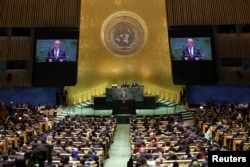
The United States has allowed an Iranian delegation to attend the UN General Assembly in New York next week, even as the seven-month-old war between the two countries continues.
"Consistent with our host country obligations, the core delegation from the Iranian regime will be able to attend UN General Assembly High Level Week," the State Department said in a September 17 statement.
However, it added that the delegation would be smaller than last year's and that its members would face travel restrictions and prohibitions on purchases of luxury goods and other products in the United States.
The move comes as negotiations between Washington and Tehran have effectively stalled in recent months, with US and Iranian forces exchanging strikes and key issues in the conflict remaining unresolved.
Shipping through the Strait of Hormuz and the Bab al-Mandab Strait off Yemen remains restricted and under threat from attacks by Iran and Yemen's Tehran-aligned Houthi rebels, while disputes over Tehran's nuclear and ballistic missile programs pose another obstacle to a negotiated agreement.
On September 17, Iran’s allies, Russia and China, vetoed a UN Security Council proposal to extend the mandate of the panel of experts monitoring nuclear-related sanctions against Iran.
With reporting by Reuters.
US Sanctions Iranian Crypto Exchange Over Hormuz Payments

The United States imposed sanctions on an Iranian cryptocurrency exchange controlled by sanctioned financier Babak Zanjani on September 17, accusing it of processing payments linked to safe passage for ships through the Strait of Hormuz and channeling hundreds of millions of dollars to Iran’s Islamic Revolutionary Guards Corps (IRGC).
The Department of the Treasury’s Office of Foreign Assets Control (OFAC) said Iran’s Hormuz Safe Marine Services Authority had used BitBank since June to transfer payments it received to the Iranian government.
Between June and July, Zanjani used the exchange to facilitate transfers of hundreds of millions of dollars in Bitcoin to the IRGC, OFAC said.
“Today’s designations of Iranian digital asset infrastructure make perfectly clear that efforts to finance the Iranian regime using cryptocurrencies are not beyond OFAC’s reach,” Treasury Secretary Scott Bessent said. “If you support the Iranian regime, the Department of the Treasury will sanction you.”
OFAC also designated BitBank software developer Pishtaz Simorgh Electronic Trade Company and three Zanjani associates -- Hossein Ali Zaker Hossein, Mohammad Mahdi Zaker Hossein, and Seyed Adel Heidari.
Zanjani, a longtime figure in Iranian sanctions-evasion networks, was sentenced to death for embezzlement in 2016 before his sentence was commuted in 2024. He later reemerged as a backer of government-linked economic projects.
In January, Washington sanctioned Zanjani and two of his digital-asset projects, accusing them of laundering money for the IRGC, and in July targeted nine more companies linked to him in Iran, Turkey and the United Arab Emirates.
With reporting by Reuters
Billions Go Missing From Iran's Secret Oil Cash Network
Billions of dollars in oil revenue are missing from Iran’s coffers. At the center of the scandal are shadowy middlemen known as "trustees" who help Tehran sell oil, steel, petrochemicals, and other goods abroad while bypassing international sanctions. But the middlemen Iran used have not all been handing over the sales revenues -- instead, many have absconded with it, to the tune of over $11 billion. Roya Maleki from RFE/RL's Negah-e-Farda (Iran Tomorrow) program explains. (Video by RFE/RL's Radio Farda, Roya Maleki, and Will Tizard)