



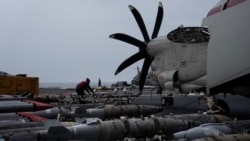

In Iran's South, A Renewed War Means No Power, No Fuel, And Boats Lost
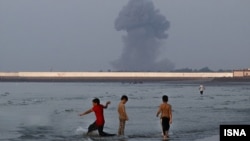
Some blame Tehran. Others blame Washington. But pretty much everyone on Iran's southern coast can agree on one thing: The renewal of air strikes between the United States and Iran is hitting hard, bringing a summer without electricity, fuel, or a way to make a living.
Across the shores of Khuzestan and Bushehr on the Persian Gulf, and along the Makran coast in Hormozgan on the Sea of Oman, life has long been tied to the water.
But recent US strikes -- which Washington says were sparked by Iranian attacks on commercial ships in and around the Strait of Hormuz -- on ports, vessels, and fishing boats have upended the livelihoods of fishermen, sailors, and anyone dependent on maritime trade.
"So many boats have sunk, gone under the missiles," a resident of the south said in a video shared on social media. "So many boats burned… Forget the money -- think how many lives were lost."
Read more here
Iranian President Claims Interaction With Supreme Leader Khamenei Increasing
- By RFE/RL
Iranian President Masud Pezeshkian says access and interaction with Supreme Leader Mojtaba Khamenei, who has not been seen in public since an air strike on February 28 killed his father, Ayatollah Ali Khamenei, is increasing.
Speaking at a ceremony to commemorate the National Day of Industry and Mining on July 21, Pezeshkian said "measures have been organized based on his [Mojtaba Khamenei's] guidelines" with regard to the war with the United States.
Mojtaba Khamenei was reportedly seriously wounded in the same Israeli air strike that killed his father and has not been seen in public since his succession in March. The son and successor of Iran’s longtime leader, was even out of sight earlier this month throughout elaborate mourning ceremonies and rallies for his father.
While the 56-year-old has made written statements, no image, video, or voice recording of him has been issued.
Despite his absence from public life, Mojtaba Khamenei still plays a prominent role in war strategy and managing peace talks with the United States, according to US intelligence.
Nearly 100 US Troops Injured in Iranian Attacks Since July 7, Says Pentagon
The US Department of Defense says that dozens of American soldiers have been injured in Iranian attacks over the past two weeks.
Pentagon spokesman Sean Parnell wrote on X on July 20 that “nearly 100 service members were deemed to have some degree of injury since July 7.” He added that 96 percent of them had already returned to duty and were “determined to get back in the fight.”
Parnell described the “vast majority” of the injuries as “minor concussions.”
Over the past 10 days, the Iranian government has responded to overnight US strikes in southern Iran by launching missiles at American military bases in Arab countries across the Persian Gulf.
After three American soldiers were killed in these attacks, The New York Times published a report on July 20 alleging that the Pentagon had “withheld dozens of US injuries” in the Iran war.
Hours before releasing the latest casualty figure, Parnell rejected the claims made in the report, saying they were "baseless and malicious."
Iranian Interior Minister Visits Pakistan
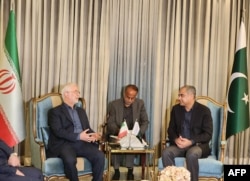
Iran’s Interior Minister Eskandar Momeni arrived in Islamabad late on July 20 for talks with top Pakistani officials, including Prime Minister Shehbaz Sharif and the country’s powerful army chief, Field Marshal Asim Munir.
The Iranian delegation was welcomed by Pakistan Interior Minister, Mohsin Naqvi, at Nur Khan air base in Rawalpindi. Briefly speaking to reporters, Momeni said the two sides would discuss bilateral relations, trade and development, among other issues.
Pakistan and Iran share a 900-kilometer border with ethnic Baluch communities mostly living on either side of the geographical divide. The border region is also used by armed religious and sectarian groups that periodically launch attacks in both countries.
The militant and separatist violence has frequently strained ties between Tehran and Islamabad, who otherwise claim to enjoy cordial relations.
In January 2024, Iran carried out missile and drone strikes in Pakistan’s Balochistan Province to target the Iranian Baloch militant group, Jaish al-Adl. Two days later, Pakistan retaliated with air strikes in Iran’s Sistan-Baluchistan Province, claiming that they targeted the hideouts of Pakistani Baloch separatists.
Despite these tensions, Pakistan has emerged as a key mediator in the ongoing US-Iran conflict.
Senior Pakistani officials held repeated diplomatic contacts with Tehran as Islamabad sought to broker a cease-fire between the two sides.
Pakistan also recently hosted the first direct talks between Iran and the United States in Islamabad, the first since Iran’s 1979 Islamic Revolution.
Iran Claims To Have Struck Amazon Data Infrastructure In Bahrain
Iran's Islamic Revolutionary Guard Corps (IRGC) claims it "destroyed" what it described as Amazon's "central data infrastructure" in Bahrain in a cruise missile strike in the early hours of July 21.
Earlier, its Aerospace Force also claimed it had carried out "extensive missile and drone attacks" against "a Patriot air defense system and a US forces radar in Muharraq and a Patriot system in Riffa, Bahrain."
Additionally, the IRGC said it targeted facilities at the Ahmed Al Jaber Air Base and a hangar housing US MQ-9 drones at Ali Al Salem Air Base in Kuwait.
The IRGC claimed the targets had been completely destroyed. The US military, Kuwait, and Bahrain have not yet commented.
With reporting by RFE/RL's Radio Farda
US Completes 10th Consecutive Night Of Strikes On Iran
The US military said it completed another round of strikes against Iran on July 20, targeting military command centers, maritime capabilities, missile and drone launch sites, and air defense systems.
US Central Command (CENTCOM) said the strikes were intended "to degrade Iran's ability to continue attacking commercial vessels flowing through the Strait of Hormuz," where Washington and Tehran have been battling for control during the conflict in the Middle East.
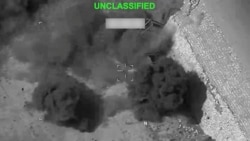

It marked the 10th consecutive night of US strikes on Iran.
CENTCOM also said commercial shipping continued through the waterway and that US forces had helped facilitate the transit of about 900 commercial vessels and 450 million barrels of crude oil since early May.
US Resumes Strikes Against Iran
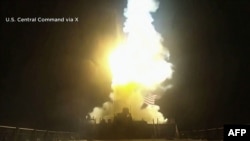
US military’s Central Command announced yet another round of night air strikes against Iran to “further degrade Iranian military capabilities used to attack commercial shipping in the Strait of Hormuz.”
Iranian media reports explosions in a number of areas.
Houthis Declare Saudi Maritime Embargo, Threatening Red Sea Oil Route
Yemen's Iran-backed Houthi rebels announced a maritime embargo against Saudi Arabia on July 20.
The group did not explain how it would enforce the embargo, which came as Tehran said it had returned to a "full-scale war" with the United States and as both sides battled for control of the strategic Strait of Hormuz.
The announcement followed the first exchange of strikes between Saudi Arabia and the Houthis in years, raising concerns over the collapse of a fragile 2022 truce.
The Houthis said the embargo was "based on the equation of 'an eye for an eye,' effective immediately."
If enforced, the blockade could disrupt Saudi oil exports through Red Sea ports, threatening one of the kingdom's main alternatives to the Strait of Hormuz as the escalating US-Iran war jeopardizes shipping through the waterway. That could further strain global markets that rely on the world's largest crude exporter.
UN spokesman Stephane Dujarric warned the threat risked an "even wider" regional conflict.
With reporting by AFP
Trump Says Iran Will 'Pay' For Killing US Soldiers
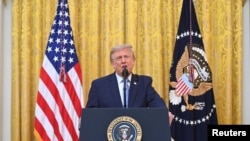
US President Donald Trump has said Iran will "pay" for killing US soldiers.
Writing on Truth Social on July 20 after three service members died over the weekend, Trump said: "Every time Iran kills an American Soldier they will pay for that killing many times over." He added that he had passed this "directive" on to US Defense Secretary Pete Hegseth as well as "every leader in the military."
His remarks came after two US service members were killed in Iranian missile and drone attacks on an American military base in Jordan on July 17. The US military later said on July 19 that a third servicemember had been killed following an Iranian drone attack in Iraq.
US Says Seven Commercial Vessels Redirected In Iran Blockade
US Central Command (CENTCOM), which oversees US military operations in the Middle East, said on July 20 that its forces were continuing flight operations from the amphibious assault ship USS Boxer in support of the naval blockade of Iran.
CENTCOM said the military had redirected seven commercial vessels and disabled one to prevent ships from entering or leaving Iranian ports.