




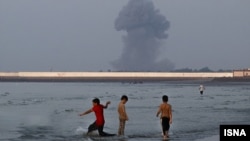
Some blame Tehran. Others blame Washington. But pretty much everyone on Iran's southern coast can agree on one thing: The renewal of air strikes between the United States and Iran is hitting hard, bringing a summer without electricity, fuel, or a way to make a living.
Across the shores of Khuzestan and Bushehr on the Persian Gulf, and along the Makran coast in Hormozgan on the Sea of Oman, life has long been tied to the water.
But recent US strikes -- which Washington says were sparked by Iranian attacks on commercial ships in and around the Strait of Hormuz -- on ports, vessels, and fishing boats have upended the livelihoods of fishermen, sailors, and anyone dependent on maritime trade.
"So many boats have sunk, gone under the missiles," a resident of the south said in a video shared on social media. "So many boats burned… Forget the money -- think how many lives were lost."
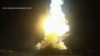
Iranian authorities say the bombings have killed around 50 people, including civilians, since the US started targeting southern Iran in late June. The attacks have become daily over the past nine days.
The United States says its primary objective is the systematic degradation of Iran's maritime and anti-access capabilities around the Strait of Hormuz, a vital global energy transit corridor that Iran has effectively blocked in response to the war. Washington says the strikes are aimed at military targets used to threaten shipping through the strait.
Residents say the impact extends deep into daily life.
Strikes on power plants and transmission substations along the coast have knocked out cooling systems in a region where July heat often breaks 40 degrees Celsius. In the port city of Bandar Abbas, one resident described sitting in a parked car with his family because their home was without electricity.
"We have no power. At night when we want to sleep, it's the sound of war, of bombs... What did we do to deserve this -- sitting in a car with the whole family at noon instead of sleeping at home? In 41-degree heat, without power, you just boil."

In the oil-rich Khuzestan Province, residents describe rolling blackouts layered onto an already brutal heat wave.
"They're cutting power in this heat," one person said of Abadan, Khorramshahr, and the wider province. "It's unbearable."
Meanwhile, damaged roads and bridges have compounded the crisis, choking off routes in and out of coastal cities, with drivers taking to social media to urge people not to attempt to travel by road.
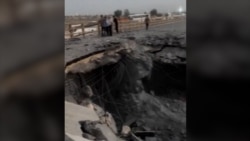


Long fuel lines have become part of the daily routine, and blackouts have cut into communication networks as well, leaving families anxious for hours, unable to check on relatives in affected areas.
While US strikes have been scattered around the country, the main focus has been on Iran's southern coastline where thousands of vessels have been stranded in the Persian Gulf by the war.
Both sides have pointed fingers at the other for the breakdown of a memorandum of understanding, signed last month, that had halted the fighting to allow for a 60-day period of peace talks to resolve the conflict that broke out on February 28.
The situation has become so severe that tens of thousands of Iranians last week signed an online petition urging the country's hard-line leaders to visit the south and experience conditions firsthand rather than making decisions from afar that put ordinary lives at risk.
"This action can lead to empathy, more effective support, and more realistic decision-making at the national level," the petition says.
Others, frustrated by the return of war, said Washington also bears responsibility for the renewed fighting. One man described what he called a campaign "that won't let us sleep."
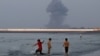
The conflict has also taken a heavy toll on tourism -- historic sites in Khuzestan and on Qeshm Island have avoided direct damage, but coastal areas have been folded into security zones, emptying guesthouses and idling tour guides ahead of what was meant to be the region's peak autumn and winter season.
In Qeshm and Sirik, burned wooden boats have taken with them not just fishermen's livelihoods but a fading piece of the south's maritime heritage.
But amid the damage, residents describe a current of solidarity -- Iranians elsewhere opening their homes to those displaced from hard-hit areas.
It is that connection, as much as any hope for an end to the war itself, that people along the Persian Gulf say is keeping them going.
"The first thing we have to check is whether we're alive, whether our neighbor is alive, whether we still have friends and family around," one female resident of the south said.