



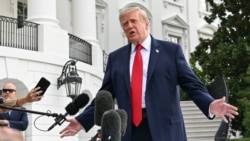

Trump Says US Will Hit Iran 'Hard' After Tehran Fires Missiles At US Bases In Jordan
- By RFE/RL
President Donald Trump angrily warned Iran that US forces will strike back "hard" after a missile attack against US bases in Jordan.
"We'll be hitting them hard. They're going to get a beating," a Fox News correspondent quoted Trump as saying during a brief interview on July 29. "We are going to beat the 'effing s' out of them."
Iran resumed missile attacks on what it says are US targets in the Middle East on July 29 by firing several missiles at the Muwaffaq Salti Air Base and the headquarters of the U.S. military’s Central Command in Jordan, according to the official state-run IRNA news agency.
Jordan's military said five missiles were intercepted in the attack, giving no reports of any casualties or damages.
Iran's attack came hours after US and Saudi forces carried out strikes on Iran-aligned targets in eastern Iraq late on July 28 in what US Central Command (CENTCOM) said was a response to recent drone attacks on American forces and Saudi energy infrastructure.
CENTCOM said in a statement the strikes targeted logistics and weapons sites used by Iran-backed groups following more than 30 drone attacks over the past 72 hours. It said the attacks on US forces were unsuccessful.
The attacks have raised fears that after a short lull in the conflict, both sides will resume the fighting.
Iran Reports 88 Percent Inflation Amid Hyperinflation Warnings
Iran's Statistical Center reported that the country's year-on-year inflation rate reached 87.9 percent, according to its latest monthly data.
The figure, which measures the change in the consumer price index compared with the same month a year earlier, indicates that the cost of an identical basket of goods and services has nearly doubled over the past 12 months.
The Statistical Center also said annual inflation for the 12-month period ending in late July stood at 66 percent, compared with 62 percent previously reported by Iran's Central Bank.
The latest figures come amid growing concern among Iranian economists over accelerating price growth. In recent weeks, several economists have warned that inflation exceeding 100 percent could signal the onset of hyperinflation.
Iran-Backed Militias In Iraq Say 20 Members Killed In US-Saudi Strikes
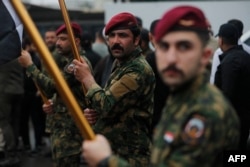
The Popular Mobilization Forces (PMF), an umbrella organization of mostly pro-Iranian militias that has formally been part of Iraq's security forces since 2016, said the death toll from joint US-Saudi air strikes had reached 20.
In a statement issued on July 29, the PMF described the toll as preliminary and said at least 32 people were wounded.
According to the PMF, the strikes targeted positions in Baghdad, Wasit, Nineveh, Basra, Kirkuk, Karbala and Diyala provinces, causing damage to military facilities and equipment.
U.S. Central Command (CENTCOM) said the operation was conducted on July 28 after more than 30 drone attacks over the previous 72 hours. It said the targets were "Iran-aligned terrorists" directed by Iran's Islamic Revolutionary Guard Corps (IRGC) to attack U.S. forces and Saudi Arabia's energy infrastructure.
China Reportedly Sending Iran Shoulder-Launched Missile Systems
Iran expects to receive the first shipment of up to 400 Chinese-made shoulder-launched air defense systems in the next few weeks, Reuters has reported.
Citing three informed sources, Reuters said the contract, worth $60 to $70 million, includes the purchase of up to 400 QW-12 and FN-16 systems and is part of Tehran's effort to rebuild its short-range defenses following the war with the United States and Israel.
The contract was reportedly signed with Hong Kong-based Zhongqing Baoshang International Investment, a company that has acted as an intermediary between the Iranian side and the Chinese supplier, the sources said.
According to the plan agreed upon by the parties, the cargo will first be transported by air from Urumqi in western China and then via Pakistan to Iran. The sources did not specify whether the transfer from Pakistan to Iran will be by air or by land.
China's Foreign Ministry called the report "completely baseless," and Pakistan's military public relations department denied any role in the transfer of the equipment to Iran.
Iranian officials have not yet commented.
US, Saudi Forces Strike Iran-Aligned Targets in Iraq, CENTCOM Says
WASHINGTON -- US and Saudi forces carried out strikes on Iran-aligned targets in eastern Iraq on July 28 in response to recent drone attacks on American forces and Saudi energy infrastructure, US Central Command (CENTCOM) said.
CENTCOM said in a statement the strikes targeted logistics and weapons sites used by Iran-backed groups following more than 30 drone attacks over the past 72 hours. It said the attacks on US forces were unsuccessful.
Saudi Arabia said the operation was carried out in self-defense under international law after what it described as drone attacks by Iranian-backed militias on the kingdom's oil facilities.
The strikes appeared to be separate from Iran's reported launch of ballistic missiles toward US forces in the Middle East earlier on July 28.
CENTCOM said all of the missiles were intercepted, while senior US officials told reporters the intended target was a US base in Jordan.
The developments come amid a brief pause in fighting between the United States and Iran after the US military carried out strikes over 13 consecutive nights against targets mainly in the country's south. In response, Iran fired missiles and launched drones at what it says were American targets around the Gulf region.
Iran Rejects Omani Proposal, Claims Strait Of Hormuz Won't Return To Pre-War State
Iran's Deputy Foreign Minister said Tehran has rejected Oman's proposal to equally divide the passage routes between the two countries in the Strait of Hormuz, a key waterway that has become the focal point of the war with the United States.
In an interview to Iran's state television on July 28, Kazem Gharibabadi said the Omani proposal saw designating a route that would be 50 percent controlled by Iran and 50 percent by Oman, which lies on the other southern bank of the strait.
“We said this does not address Iran’s concerns.” Gharibabadi said, adding Tehran has “no plans to negotiate with the US” over the issue.
He added that the Strait of Hormuz "will never return to its pre-war state," and that if it does, Iran's "success" in the war would be "incomplete."
Earlier, Reuters cited an informed source who said Oman had submitted a proposal to Iran to establish a joint regional mechanism with voluntary payment of tolls or transit fees to manage the Strait of Hormuz, which before the war accounted for about one-fifth of the world's oil and gas transit.
According to the source, Oman's proposal is supported by countries in the region.
Gharibabadi said Tehran was proposing that it would manage shipping through its side of the strait while Muscat would manage part, but not all, of the its side of the waterway. Oman has not confirmed such a proposal was made.
US Senate Set To Extend Iran Sanctions In Revised Russia Bill Named After Lindsey Graham
WASHINGTON -- The US Senate is set to extend a cornerstone of US sanctions on Iran by adding a renewal of the Iran Sanctions Act of 1996 to a broader bipartisan Russia sanctions package expected to receive its first procedural vote on July 28.
According to the revised draft reviewed by RFE/RL, the legislation would rename the measure the "Lindsey O. Graham Sanctioning Russia and Iran Act of 2026" and include Section 201, "Extension of the Iran Sanctions Act of 1996," preserving a key pillar of the US sanctions framework against Tehran while honoring the late senator in the process.
The addition came after President Donald Trump pushed to include the Iran sanctions extension in the Russia package.
Supporters say the change helped secure broader Republican support without significantly altering the bill's overall framework.
"It helps the bill become law to add Iran into the package. I don't think it's an obstacle. I think it enhances the prospects, particularly with Republicans, and I have no objection to the addition," Democratic Senator Sheldon Whitehouse told RFE/RL hours before the vote.
In a joint statement, the bill's sponsors said the legislation would both target purchasers of Russian oil and gas and "continue restricting the Iranian regime's ability to support terrorism and build its nuclear program."
Graham, who was one of the Republican conferences most outspoken Ukraine allies, had been negotiating tirelessly to negotiate the package with the White House, before he died on July 11 at the age of 71 from a heart condition.
CENTCOM Announces Joint AI Working Group With UAE
The US Central Command (CENTCOM) said that it has reached an agreement with the United Arab Emirates (UAE) to form the first bilateral working group aimed at accelerating the development of artificial intelligence applications in the military.
CENTCOM announced on July 28 that the task force, called the Talon Synapse Task Force, will begin its activities in Abu Dhabi in the coming weeks and will include about 20 American and Emirati experts in the fields of artificial intelligence, data, and cybersecurity.
The task force will focus on developing AI applications for intelligence support, critical infrastructure protection, and regional security situation monitoring, according to CENTCOM. Admiral Brad Cooper, commander of CENTCOM, described the collaboration as a "historic milestone" in expanding military cooperation between the two countries.
The UAE has repeatedly come under Iranian missile and drone attack during the U.S.-Israeli war against Iran.
Trump Tells Fox News There Have Been 'Good' Talks With Iran
US President Donald Trump told Fox News in an interview on July 28 that there have been some "good" talks with Iran, but warned that if Tehran won't make a deal the United States may have to target civilian infrastructure in a new wave of strikes.
Speaking hours before a scheduled meeting with Israeli Prime Minister Benjamin Netanyahu, Trump said the United States has a "very strong position right now," though he'd like to avoid bombing Iran further.
"We cannot have them break deals anymore.... We have had some very good talks," he said.
The US president said he was aware of reports of satellite images that appear to show Iran is accelerating work at a secretive nuclear-related site deep beneath Kuh-e Kolang mountain, known as Pickaxe Mountain.
Intelligence agencies suspect this is where Iran is seeking to build a secret uranium enrichment facility.
"I know exactly what's going on at Pickaxe. It's not a big problem. We took out their nuclear sites, and we'll have to take out Pickaxe if we don't make a deal. We don't make a deal, we'll take it out very easily," Trump said.
Ukraine Hits At Iran In The Caspian Sea. And Things Get Even Messier.
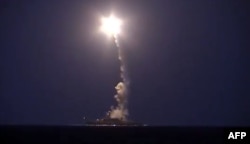
Iranian-designed drones have wreaked havoc for Ukrainian forces battling Russian troops as Moscow took Tehran's technology and ran with it, supercharging production and deploying drones in devastating droves in its all-out war against Kyiv.
As far as Ukraine is concerned, that makes Iran an indirect combatant. And that means Iranian cargo ships heading to Russia are fair game as far as military targets go.
That's what happened this weekend in the Caspian Sea, and Tehran is not happy.
Moscow's 53-month-old invasion has scrambled politics for Europe. The US-Israeli war with Iran has scrambled politics for the Middle East.
So what do Ukrainian strikes on Iranian cargo -- or Russian ships -- in the Caspian mean for the two wars?
"If the Ukrainians continue doing this, it's going to obviously make it more difficult for both Iran and Russia," said Nicole Grajewski, an Russia-Iran expert with Sciences Po, the famed French university. But, she added, "I don't see this as being a fundamental game changer in the war."
"The Ukrainian strike against an Iranian ship represents a significant shift in tactics and sends a clear message that Ukraine will not tolerate aggression, regardless of where it originates," said Luke Coffey, a Russia expert at the Hudson Institute, a Washington think tank.
"I suspect these types of operations will make shipping between Russia and Iran across the Caspian increasingly difficult," he said.
To read the full report, click here.