



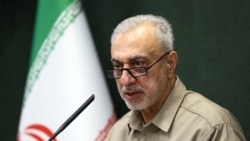

USS Abraham Lincoln To Dock In Thailand After Long Iran War Deployment
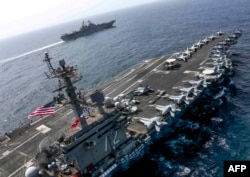
The US aircraft carrier USS Abraham Lincoln, which left the Middle East on August 22 after a prolonged deployment supporting US military operations against Iran, is scheduled to dock in Thailand next week for crew rest and recreation, a Thai official said.
The ship, carrying roughly 5,000 sailors and Marines, has gone more than 200 days without a port call, setting a modern-day record for consecutive days at sea. The carrier has been deployed for 274 days since leaving its home port of San Diego in November.
Reports in recent weeks have cited food and water shortages, plumbing problems, disrupted mail, and deteriorating morale among the crew. Families of sailors have also raised concerns about mental health. The Pentagon has disputed reports that conditions aboard the ship have significantly deteriorated.
Democratic lawmakers have demanded answers from the Pentagon over the prolonged deployment and conditions aboard the carrier. Senator Richard Blumenthal, a Connecticut Democrat, sent Defense Secretary Pete Hegseth a list of questions about the deployment and its impact on the crew.
US President Donald Trump has downplayed concerns about the sailors, saying the ship was "beautifully maintained and beautifully taken care of," while Hegseth said reports of deteriorating conditions had "completely misrepresented" the situation.
US Suspends Sports Exchanges License for Iran

The US Treasury Department has indefinitely suspended a general authorization for professional and amateur sports activities and exchanges between the United States and Iran, effective August 24.
General License F previously authorized certain services supporting sports activities and exchanges between the two countries, including sports matches and events, sponsorship of players, coaching, refereeing, and training. The suspension means activities that are not otherwise authorized will require a specific license from the US Treasury Department's Office of Foreign Assets Control.
OFAC also indefinitely suspended General License G, which covered certain academic exchanges and educational services, as well as separate authorizations covering certain educational activities in third countries, noncommercial personal remittances to or from Iran, and services related to conferences.
The suspensions are part of the Trump administration's broader campaign to increase economic pressure on Iran. Treasury Secretary Scott Bessent has warned that Washington intends to cut off Iran's economic lifelines.
OFAC issued a separate general license allowing transactions ordinarily incident and necessary to wind down activities that had previously been authorized under the suspended provisions through September 8.
US Secret Service Says Aware of Iran Video 'Appearing to Threaten' Trump's Son
The US Secret Service said on August 24 that it was aware of a video aired by Iran's state broadcaster that appears to threaten Barron Trump, the youngest son of President Donald Trump.
The video, which was aired on Iran's state broadcaster IRIB, purported to show information about Barron Trump's whereabouts and movements in New York City, including his university, escort vehicles, and the positions of Secret Service personnel. It also claimed that his movements were "fully monitored." The claims in the video could not be independently verified.

A Secret Service spokesperson told CNN that the agency "investigates anything that can be perceived as a threat" toward its protectees, but declined to discuss protective intelligence for operational-security reasons.
CNN reported that Iranian hard-line media have repeatedly featured content threatening Trump and members of his family since the assassination of Iran's Supreme Leader Ayatollah Ali Khamenei and several members of his family at the outset of the US-Israeli war with Iran in February.
In late July, Tasnim, an Iranian news agency affiliated with the Islamic Revolutionary Guards Corps, published a video discussing alleged vulnerabilities in the security of first lady Melania Trump and suggesting ways she could be attacked. The video also included a threat directed at Barron Trump.
China Says New US Sanctions Won't Disrupt Business With Iran
In response to the latest US sanctions against Iran, China's Foreign Ministry said on August 25 that cooperation between Beijing and Tehran is conducted within the framework of international law and “should not be interfered with or disrupted.”
Ministry spokesman Lin Jian said China was closely following developments and would take "all necessary measures" to firmly safeguard its rights and interests.
He reiterated China's opposition to what it calls illegal unilateral US sanctions, saying economic warfare and maximum pressure "will only further fuel conflicts."
The United States on August 24 imposed sanctions on nearly 60 individuals, entities, and vessels linked to Iran, as part of a campaign Treasury Secretary Scott Bessent said was aimed at cutting off the Islamic republic's economic lifelines.
"Our objective is to sever every economic lifeline that sustains this tyrannical regime until Tehran stands alone," Bessent said at a press conference on August 24.
Washington's $10 Million Wanted List Has A Dead Man On It
- By Kian Sharifi
The US State Department’s Reward for Justice program is offering up to $10 million for information on five senior Islamic Revolutionary Guards Corps (IRGC) commanders it says are responsible for attacks on US personnel and infrastructure.
But at least one of the men pictured in its latest appeal has been dead for months.
The program posted the appeal on X on August 24, describing the five as IRGC leaders who command units involved in attacks against US personnel and malicious cyber operations.
Among them is Majid Khademi, the former head of the IRGC’s notorious Intelligence Organization. Khademi was killed in an Israeli air strike in Tehran on April 6, during the US-Israeli war against Iran. His death was confirmed by both the IRGC and Israel.
Another man pictured, Saeed Aqajani, the IRGC Aerospace Force’s drone commander, was also reported killed in an Israeli strike in northern Iran on March 2,1 though Iran has not confirmed his death.
The other names on the list include Ahmad Vahidi, who now commands the IRGC, Ali Abdollahi, who was recently promoted to chief of staff of Iran’s armed forces, and Hamidreza Lashgarian, who leads the IRGC's cyber electronic command.
Oil Tanker Disabled By Projectile Off Coast Of Oman, Says Shipping Monitor
An oil tanker was struck and disabled by an unknown projectile in the Strait of Hormuz off Oman early on August 25, a British shipping security monitor said, in the latest incident to hit shipping in the strategic waterway.
United Kingdom Maritime Trade Operations (UKMTO) said the projectile damaged the vessel’s engine room, leaving it disabled, but that its crew was safe. The incident occurred nine nautical miles (16.7 kilometers) northeast of Ash Shishah, Oman. UKMTO did not identify the tanker or what flag it was sailing under.
Tehran has largely restricted passage through the strait since the United States and Israel struck Iran in late February, attacking vessels it accuses of circumventing its preferred shipping route.
The attack comes amid persistent threats to shipping during the six-month conflict.
The International Maritime Organization has confirmed 68 incidents in the Persian Gulf and nearby waters -- an average of one every 2.6 days -- with at least 20 seafarers or port workers killed, 35 wounded, and one missing.
Around half the incidents involved tankers. The rate slowed during peace talks but has risen since their collapse to one incident every 2.8 days.
With reporting by AFP
US Not Ruling Out Military Force Against Iran, Hegseth Says
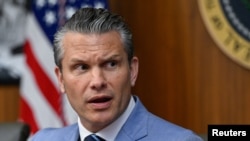
US Defense Secretary Pete Hegseth said that the United States was not ruling out the use of military force against Iran, as Washington imposed new sanctions on nearly 60 entities, individuals, and vessels as part of a major effort to economically pressure Tehran.
“By no means are we foreclosing using kinetic strikes anywhere in the Strait of Hormuz or around Iran,” Hegseth told reporters on August 24, adding that Iran would not be able to withstand the economic pressure being placed on it.
Earlier this month, Hegseth said that US forces could maintain the naval blockade of Iran indefinitely, adding that Washington could rotate its military ships in and out of the region as needed.
Hegseth’s latest comments came as the US Treasury Department announced the launch of an “economic D-Day” against Iran and warned that countries continuing to support Tehran risked becoming a “global pariah.”
Washington says the campaign is intended to sever the economic lifelines that sustain the Iranian government and further isolate Tehran internationally.
Bessent Says US Launching 'Economic Onslaught' On Iran, Demands Countries Cut Trade Ties With Tehran
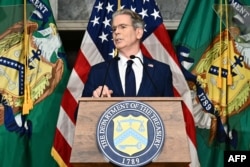
WASHINGTON -- US Treasury Secretary Scott Bessent announced a new effort to ramp up the pressure on Tehran, saying the United States is "launching an economic onslaught against Iran’s financial connections around the globe."
"Our objective is to sever every economic lifeline that sustains this tyrannical regime until Tehran stands alone," Bessent told a news conference in Washington on August 24, days after he and President Donald Trump warned of an "economic D-Day."
The announcement came nearly six months after the start of the US-Israeli war with Iran, which has choked off energy supplies from the Persian Gulf via the Strait of Hormuz.
The US is "ending" the threat from Iran, Bessent said, warning third countries that the United States will "be uncompromising in targeting any source of the [Iranian] regime's illicit revenue."
Bessent said that Trump was making phone calls to world leaders with specific requests, and that ever country would be given a defined timeline to "shut down...Iran-related activity we have identified."
Any country supporting Iran must be prepared to face US Sanctions, he added.
Reports: Trump Spoke With Pakistan Army Chief Ahead Of Tehran Visit
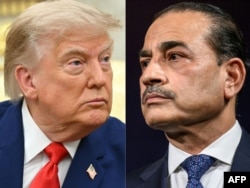
US President Donald Trump spoke with Pakistan’s army chief, Asim Munir, last week ahead of Munir’s visit to Tehran, as Islamabad makes a fresh attempt to mediate between Washington and Iran, according to Reuters and AFP.
Reuters cited three Pakistani sources, with one saying Washington’s main request was for Pakistan to use its influence to bring Iran back to negotiations. Two sources said Trump had initiated the call, although details of the conversation remain unclear.
AFP reported separately on the call, citing a US source familiar with the matter.
Munir arrived in Tehran on August 24 with Interior Minister Mohsin Naqvi.
The Pakistani military said the visit was “part of Pakistan’s efforts to promote regional peace and stability.”
Islamabad has played a key mediating role during the conflict, helping broker an framework agreement in June that later broke down as fighting resumed.
The latest diplomatic push comes as Washington threatens economic consequences for countries providing what Trump called “any type of lifeline to Iran,” potentially putting pressure on Pakistan, which continues to trade with its neighbor.
One Pakistani source told Reuters that there was “a trust deficit on both sides” between Washington and Tehran, adding that Munir’s aim was to reduce that gap.
Based on reporting by Reuters and AFP
China Warns Against Escalation As US Targets Iran Trade
China has urged Iran and the United States to exercise restraint and said it would take measures to protect its interests if Washington imposes secondary sanctions on countries doing business with Tehran.
“Sanctions and pressure will not help resolve problems. They will only heighten tensions and escalate the situation, which serves no party's interests,” the China Daily quoted Chinese Foreign Ministry spokesman Lin Jian as saying.
Lin's comments came hours before the United States was set to unveil a sweeping new economic campaign against Iran, including fresh sanctions that President Donald Trump has said will be “unprecedented.”
Lin urged the parties to return to dialogue as soon as possible and seek a political settlement.
US Treasury Secretary Scott Bessent is due to announce details of the new economic measures later on August 24.