

Live Blog Closing For The Day
We are closing the live blog for now, but we'll be back again tomorrow at 7:30 a.m. Central European time.
State Media Claims 3 Million At Pro-Regime Rally In Tehran
The Fars news agency, which is close to the Islamic Revolutionary Guards Corps, has reported that "3 million people" took part in the government march against the protesters, which took place in the capital Tehran today.
The rallies were backed by the police and aired live on Iran’s state-run television channels.
Take those claims with a grain of salt, though, as Fars, along with other media outlets close to or run by the state, publishes narratives approved by the regime.
Fars claimed that "based on aerial images, the geographical area leading to Tehran's Enqelab (Revolution) Square, namely Roshandalan Bridge from the east, Keshavarz Boulevard from the north, the Navab highway from the west, and Jomhuri Street from the south, was filled with people."
Given that independent media outlets, including RFE/RL's Radio Farda, are unable to operate in Iran and most communication channels between Iranians and the outside world have been severed, it is impossible to verify the news agency's claim.
Khamenei Says Pro-Government Rallies Are A Warning To US
Supreme Leader Ayatollah Ali Khamenei called today's pro-government rallies against the protesters a "warning" to American politicians, saying they must "stop their deception and not rely on traitorous mercenaries."
The rallies were organized by pro-government forces, supported by the police, and broadcast live on Iranian state television.
Participants chanted and raised banners criticizing the United States, Israel, and the protesters, who Iranian officials have described as "armed terrorists."
"You did a great job today and created a historic day," Khamenei said.
Our Senior International Correspondent Ray Furlong looks at what the US options are on Iran, from limited strikes to a Maduro-like operation.
Iranian Diplomats Banned From European Parliament
Roberta Metsola, the president of the European Parliament, announced on X that all Iranian diplomats and other representatives of the Iranian government are now banned from entering the offices and premises of the parliament.
“It cannot be business as usual," Metsola wrote. "As the brave people of Iran continue to stand up for their rights and their liberty, today I have taken the decision to ban all diplomatic staff and any other representatives of the Islamic Republic of Iran from all European Parliament premises.”
On January 11, Metsola called on Iranian protesters to continue their protests despite the brutal reaction of the country's security forces.
Metsola also urged EU member countries to increase their pressure on Tehran, while at the same time calling on the leaders of the Iranian regime to "change course and end the killing and repression of innocent people."
Authorities Announce Shutdown Of Student Dormitories
The University of Tehran has issued a notice announcing the closure of all undergraduate student dormitories for at least 10 days.
According to the Tasnim news agency, which is close to the Islamic Revolutionary Guards Corps, the closure will begin at 10 a.m. on January 22 and will continue until February 2.
According to the Tasnim report, students have been asked to vacate their dormitories as soon as possible.
Student dormitories have been one of the protesters' main hubs over the past two weeks. This latest move has reportedly been carried out in coordination with Iran's Science Ministry and the security agencies.
Chants Against The Supreme Leader At Tehran Protester Funerals
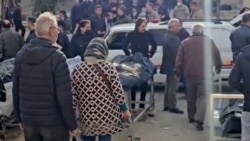
Footage is coming out of Iran showing funerals in Tehran for those killed during the recent protests. Families of the victims can be seen chanting slogans against Iran's supreme leader, and vowing to avenge their loved ones' deaths.

Parliament Speaker Says Iran Would Target US Facilities, If Attacked
With Iran saying it's prepared for both talks and war with the United States after US President Donald Trump said he is considering "very strong options" against Tehran, other key players in the Iranian regime are weighing in.
Mohammad Baqer Qalibaf, the speaker of the Majles, Iran's unicameral parliament, said that if the US threats against the Islamic Republic are implemented, Iran will attack US "facilities" in the region.
Qalibaf also called the US president "delusional" and a "tyrant ruler" -- a term Iranian protesters use for Islamic Republic officials.
As the crackdown on protests in Iran intensifies, Trump has repeatedly warned Iran and said that Washington is considering various options, including military ones, against Tehran.
Belarus's Tsikhanouskaya Commends Iran Protesters
Belarusian opposition leader Svyatlana Tsikhanouskaya added her support to the protesters in Iran "risking their lives" by seeking change in the Islamic republic.
"My heart is with the people of Iran 🇮🇷 who are risking their lives on the streets for freedom. When a regime silences communication, it reveals its weakness and fear of the people," Tsikhanouskaya wrote on X on January 12.
"Belarusians know this reality all too well. Freedom cannot be shut down, and it will prevail."
China Opposes 'Interference' In Iranian Affairs As Germany, Finland Support Protesters
A Chinese Foreign Ministry spokesperson said in response to a media question about US President Donald Trump’s threat to intervene militarily in favor of Iranian protesters that Beijing opposes "the use of force or the threat of use of force" in international relations.
"We have always opposed interference in other countries' internal affairs and consistently advocated that the sovereignty and security of all nations should be fully protected by international law," spokeswoman Mao Ning said at a regular news briefing.
This stance comes at a time when a number of European leaders have voiced support for Iranian protesters. In a message, Finnish President Alexander Stubb called for an end to attacks on protesters and the release of detainees. German Chancellor Friedrich Mertz also described the violence used against protesters in Iran as "disproportionate" and "brutal" and considered it a "sign of weakness."