




Davos Says Iran FM Won't Attend World Economic Forum
The World Economic Forum announced that Iranian Foreign Minister Abbas Araqchi will not attend its annual meeting in Davos, Switzerland, this week. The statement comes after a wave of political and human rights criticism over his possible participation in this year's event.
The forum wrote in a message: "Although he was invited to this meeting last fall, the tragic loss of civilian lives in Iran in recent weeks means it is not right for the Iranian government to be represented at Davos this year."
The annual meeting of the World Economic Forum runs from January 19-23.
Internet Blackout Enters 12th Day
The Internet monitoring organization NetBlocks announced on January 19 that the nationwide Internet shutdown in Iran had entered its 12th day, with data showing the level of national connectivity is still at the lowest possible level.
According to NetBlocks, the filtering system has occasionally allowed some messages to pass through, which could be a sign that the government is testing a domestic intranet with more stringent filtering.
Meanwhile, Iranian President Masud Pezeshkian said at a cabinet meeting on January 18 that he had recommended to Ali Larijani, the secretary of Iran's Supreme National Security Council, that the restrictions on the Internet be lifted as soon as possible given the need to facilitate online businesses and improve communications.
Pezeshkian did not indicate why this was directed toward Larijani and not the relevant telecommunications providers.
The ongoing Internet blackout in Iran, ordered by security officials, has caused significant financial losses to all businesses, large and small.
Reza Olfat Sefat, secretary of the Internet Business Association, said that the blackout has caused more than $37 million in damage to businesses.
Outcry Over Iranian FM's Invitation To Davos Summit
Ahead of the start of the annual meeting of the World Economic Forum in Davos, the invitation of Iranian Foreign Minister Abbas Araqchi has been met with a wave of political and human rights criticism.
In a message on January 19, the press office of former Crown Prince and opposition leader Reza Pahlavi called Araqchi "the voice of a regime that has killed more than 16,000 people in the past two weeks." Pahlavi's office emphasized that he "does not represent Iran" and should not have a platform in Davos.
The office also called on "all honorable people" to condemn Araqchi's presence at the meeting.
Meanwhile, prominent Republican Senator Lindsey Graham, in a message on X, strongly criticized Araqchi being invited to the Davos meeting.
Graham likened it to "inviting Hitler to a world event after Kristallnacht." Addressing the organizers of the meeting, he said such a move sends "the worst possible message" to Iranian protesters and is a clear sign of the "moral decline of the European elite."
Hillel Neuer, an international human rights lawyer and executive director at UN Watch, also warned that if Araqchi travels to Switzerland, a criminal complaint will be filed against him with the country's prosecutors. According to Neuer, Araqchi's role on the Supreme National Security Council of the Islamic republic in suppressing protesters could amount to a crime against humanity and is beyond the scope of international immunity.
The World Economic Forum in Davos runs from January 19 to 23, and so far forum officials have not responded to the outcry over Araqchi's invitation. This is despite the Munich Security Conference having previously canceled its invitation to Iranian officials due to the bloody crackdown on protests in Iran.
As of January 18, the US-based rights group HRANA had verified the deaths of 3,685 protesters, while 8,949 additional deaths are still being reviewed. More than 24,000 people have been detained.
Head Of Iran Telecom Firm Fired Over Failure To Comply With Blackout
Fars News Agency reports that the head of one of Iran's largest telecommunications companies, Irancell, has been dismissed for "failure to comply with the rules" after the government decision to cut off Internet access nationwide amid mass protests.
The firing of CEO Alireza Rafiei followed "the operator’s actions during the protests on the morning of Saturday, January 10," the report said.
Irancell was founded in 2005 and has 70 million subscribers.
Fars quoted officials as saying that "Irancell disobeyed the orders of the decision-making institutions in implementing the announced policies regarding the restriction of internet access in crisis situations."
Fars, a media outlet close to the Islamic Revolutionary Guards Corps, also quoted an official as saying: "The new appointment made for Alireza Rafiei will also be dealt with legally."
Iranian President Says Attack On Khamenei Would Mean 'War'
Iranian President Masud Pezeshkian, previously considered by many to be a relative moderate among Iran's rulers, on January 18 warned that an attack on the country's supreme leader, Ayatollah Ali Khamenei, would bring about an "all-out war."
"An attack on the great leader of our country is tantamount to a full-scale war with the Iranian nation," Pezeshkian said in a post on social media.
In a speech on January 17, Khamenei praised Pezeshkian's role in the suppression of recent demonstrations, while acknowledging that "several thousand" people had been killed during the protests.
US President Donald Trump has taken the forefront among Western leaders in calling out the Iranian regime for its brutal crackdown on anti-government protesters.
Trump told Politico in remarks published on January 17 that Khamenei was guilty of "the complete destruction of the country and the use of violence at levels never seen before" and said it was time to look for "new leadership" in Iran.
Read more in our latest news story here.
Iraqi Foreign Minister Meets with Masud Pezeshkian
Iraqi Foreign Minister Fuad Hussein met with Masud Pezeshkian late on January 18, continuing his official visit to Tehran.
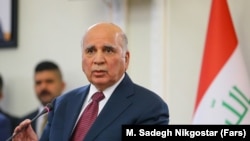
According to the Tasnim News Agency, during the meeting, Hussein said that he had heard concerns from leaders and officials of other countries about tensions in Iran, emphasizing that the security of the region is interconnected.
Hussein also met with Abbas Araqchi, his Iranian counterpart, and Ali Larijani, secretary of the Supreme National Security Council.
In recent days, there have been reports of Iraqi militias being deployed to a number of Iranian cities to help the Islamic republic's suppression of protesters. Eyewitnesses say that some of the forces involved in the killing of protesters were not Iranian.
We are now closing the live blog for today. We'll be back again tomorrow morning to follow all the ongoing developments in Iran at 7:30 a.m. Central European time.
Amid Brutal Repression In Iran, Exiles Abroad Call For Regime Change
In Romania, Iranian exiles are following events in Iran with a mix of fear and hope.
Anti-government protests, sparked by a dire economy and an oppressive regime, have escalated into deadly clashes with thousands of demonstrators estimated killed over the last three weeks by human rights groups.
Different activist groups have put the death toll far higher, but an internet blackout has made it difficult to verify the information.
Those who have moved abroad share insights on what's driving the calls for regime change in Tehran.


In our latest news wraps on Iran, we have details on the latest comments from an Iranian judiciary official who said that the "severest Islamic punishments" would be coming for those deemed "hostile."
Security Forces Reportedly Checking Citizens' Phones
A man in his 70s who left Iran on January 17 told RFE/RL's Radio Farda that “the feeling of martial law is completely in place at night."
"One of the reasons for that," he added, "is that the armed forces randomly stop cars. They check the entire car and also mobile phones. They ask people to unlock their phones.”
The security forces are then "checking citizens’ activities on social media as well as their phone photo galleries," he said, "looking for evidence of the individual’s presence at the protests.”
The Iranian man, who said he was stopped in an area north of Tehran and had heard the same thing from others. "That's why people are telling each other to stay home after 8 p.m.," he said.