



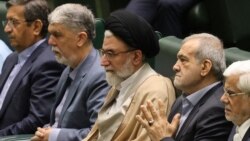
Videos Emerge Showing Brutal Tactics Of Iranian Security Forces
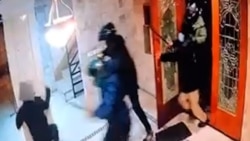
Newly emerging videos show Iranian security forces firing into crowds of protesters on January 8 and breaking into buildings and homes to arrest and beat people in the wake of countrywide mass protests. RFE/RL's Radio Farda spoke to the family of a protester killed in the crackdown. HRANA, a US-based human rights organization has said more than 3,900 were killed in clashes but that number is expected to grow higher.


UN Rights Commissioner Says Iran Using Death Penalty As 'Tool Of State Intimidation'

The United Nations has accused Iran of using the death penalty as "as a tool of state intimidation,"
The UN high commissioner for human rights was reported as saying in a statement that according to reports received, Iran carried out 1,500 executions in the past calendar year alone.
Volker Turk warned that "the scale and pace of executions suggest a systematic use of capital punishment as a tool of state intimidation, with disproportionate impact on ethnic minorities and migrants."
Many of the executions were “for offences not meeting the ‘most serious crimes’ threshold required under international law,” Turk said, also criticizing “the continued execution of people convicted of crimes committed as children, as well as persistent secrecy around executions.”
“This is not only incompatible with international law but also ineffective in deterring crime,” he added.
The sharp increase has been driven in part by executions for drug-related offences not involving intentional killing, with the UN rights office saying that at least 47 percent of executions in Iran in 2025 were linked to drug crimes.
Erdogan Calls Iran Protests a “New Test” for Tehran
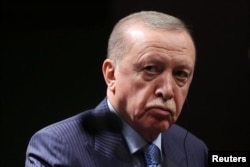
In his first official reaction to the recent protests in Iran, Turkish President Recep Tayyip Erdogan has described the unrest as a “new test” for Tehran.
In a televised speech after a weekly cabinet meeting on January 19, Erdogan said that following Iran's recent conflict with Israel, the country "is now facing a new test that targets its social peace and stability.”
"We are all watching the scenarios that are being attempted to be written through the streets," he added.
Erdogan said he hoped Iranian authorities would overcome the situation “with a policy prioritizing dialogue and diplomacy,” adding that he believed Iran could “get through this trap-filled period.”
Erdogan also stressed that Turkey would continue to “stand against any initiative that risks dragging our region into uncertainty.”
On January 15, Turkish Foreign Minister Hakan Fidan said that Ankara was oppposed to any military intervention against Iran and believed Tehran should address its internal issues independently
'A Stain Of Shame': Iranian Man Says 3 Family Members Killed During Protests
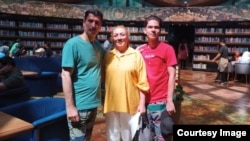
Mikaeil Askari, an Iranian who lives abroad, has been speaking to RFE/RL's Radio Farda about how three members of his family were killed on the evening of January 9 as a result of security forces firing at their car in the Gohardasht district of the city of Karaj in north-central Iran.
Askari says his cousin, Zahra Bani-Amerian, along with her husband, Bijan Mostafavi, and their child Daniel Mostafavi, were shot and killed while they were in their private vehicle after military forces opened fire on them. Another child of the family -- Davud Mostafavim, who was driving -- was injured.
Askari says “it’s not quite clear” how the incident occurred.
“The window on the side of the driver [Davud] was opened. He either chanted slogans or honked, and they shot him with pellets. He panicked and tried to get away from there. They fired live ammunition at the car from behind,” killing three of its occupants.
According to Askari, security forces then beat up Davud, who was injured, before taking him to hospital. He was later released on bail.
Askari added that his cousin’s husband was a “war veteran” and that it was a “bitter irony” that he died in this way.
Bijan “fought on the front lines against Saddam Hussein. And [Supreme Leader Ayatollah Ali] Khamenei brought soldiers to the streets of Tehran and Karaj to kill people,” he said. “This crime is a stain of shame that will remain on the face of the Islamic republic.”
Askari said the bodies of the family members were buried in Kermanshah Province in the presence of security forces, and that their relatives in Iran are under surveillance and pressure from authorities.
Meta Confirms Hiding Follower Lists Of Some Iranians
Meta, the US-based technology company that operates Facebook, Instagram, and WhatsApp, has confirmed that it is restricting access to the lists of followers and followed accounts for some Iranian users.
“ We know accounts of activists and journalists are often targeted and we’ve designed policies to give these groups more protections from threats of violence -- including removing content that “outs” people as activists in situations that could put them in danger,” a Meta spokesperson told RFE/RL’s Radio Farda.
“And when we become aware of human rights defenders who have been arrested or detained as a result of their work, we take steps to thwart unauthorized access to their accounts -- as we have done here, they added.
Screengrabs of the Instagram account of Iranian rapper Toomaj Salehi, showing that Meta has hidden both his followers and the accounts he follows.


Salehi has gained prominence for lyrics that rail against corruption, widespread poverty, executions, and the killing of protesters in Iran.
He was sentenced to death by a revolutionary court in April 2024, but the sentence was overturned by Iran’s Supreme Court, and he was released from prison in December 2024 after serving a separate sentence.
Iranian Vice President Says Country’s Internet Will Return To Normal This Week
Iran’s vice president for science, technology and the knowledge economy says that the country’s Internet services will return to normal by the end of the week.
According to Telegram channels of Iranian media outlets, Hossein Afshin said that “the country’s internet network “will gradually return to normal operations this week” and the “existing restrictions will be lifted soon.”
With Iran’s Internet blackout now continuing for a 12th day, the NetBlocks website, which monitors Internet availability worldwide, says the country’s “national connectivity remains minimal,” although authorities appear to have “occasionally allowed messages through, suggesting that the regime is testing a more heavily filtered intranet.”
Serhiy Danilov, the deputy director of the Center for Middle Eastern Studies in Kyiv, spoke to Current Time today about the situation in Iran. Here are some of the things he had to say:
"The protests are temporarily suppressed, but the problems have not gone away. There is no doubt that this regime is doomed. Whether it will fall this winter or next summer, during another water crisis, energy crisis, or inflation -- this is a matter of time."
"An American strike is currently postponed, but the likelihood of such a strike in a week or two, particularly on [Supreme Leader Ayatollah]Ali Khamenei's bunker, remains quite high."
"[Ruling groups] are preparing, getting their allies ready, and gearing up for a power struggle in post-Khamenei Iran. .... They are bribing supporters, forming coalitions, and recruiting people from the Islamic Revolutionary Guards Corps to have resources ready at the right moment. The main resource is power. Each faction within the Revolutionary Guards has its own groups, trends, and ideas. Importantly, even among the staunchest supporters of Khamenei and the Islamic republic, there is a belief that something will have to change."
Reformist Newspaper In Iran Seized
The Khabar Online news agency reported on January 19 that the reformist newspaper Ham-Mihan has been seized by the authorities.
According to the report, Ham-Mihan editor in chief Mohammad Javad Rooh announced that the Press Supervisory Board had cited two of the newspaper's recent articles as the reason for the seizure.
One was an editorial by Javad Rooh from January 15, and the other was an article titled "When the Privilege of Treatment Was Broken" by Elaheh Mohammadi in January 17, the issue of which was headlined "The Adventures of Hospitals from Ilam to Sinai."
In its latest issue, Ham-Mihan published a note titled "Statistics and Trust" that criticizes the lack of transparency after the recent violence, saying the Internet blackout and the government's failure to announce official statistics on the number of people killed and detained have exacerbated the crisis of public trust. The author warns that this situation, in addition to seriously damaging the digital economy, will transfer news authority to foreign media outlets.
The author warns that officials should not ignore responsibility for their decisions by following models such as China.
Iran has a long history of media censorship and restricting access to news as a constant tool of the government to control the flow of information. The Hammihan newspaper has faced censorship and restrictions several times before.
Davos Says Iran FM Won't Attend World Economic Forum
The World Economic Forum announced that Iranian Foreign Minister Abbas Araqchi will not attend its annual meeting in Davos, Switzerland, this week. The statement comes after a wave of political and human rights criticism over his possible participation in this year's event.
The forum wrote in a message: "Although he was invited to this meeting last fall, the tragic loss of civilian lives in Iran in recent weeks means it is not right for the Iranian government to be represented at Davos this year."
The annual meeting of the World Economic Forum runs from January 19-23.
Internet Blackout Enters 12th Day
The Internet monitoring organization NetBlocks announced on January 19 that the nationwide Internet shutdown in Iran had entered its 12th day, with data showing the level of national connectivity is still at the lowest possible level.
According to NetBlocks, the filtering system has occasionally allowed some messages to pass through, which could be a sign that the government is testing a domestic intranet with more stringent filtering.
Meanwhile, Iranian President Masud Pezeshkian said at a cabinet meeting on January 18 that he had recommended to Ali Larijani, the secretary of Iran's Supreme National Security Council, that the restrictions on the Internet be lifted as soon as possible given the need to facilitate online businesses and improve communications.
Pezeshkian did not indicate why this was directed toward Larijani and not the relevant telecommunications providers.
The ongoing Internet blackout in Iran, ordered by security officials, has caused significant financial losses to all businesses, large and small.
Reza Olfat Sefat, secretary of the Internet Business Association, said that the blackout has caused more than $37 million in damage to businesses.