



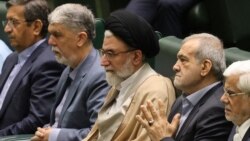
US Aims Sanctions At Iran's 'Shadow Fleet'
US Aims Sanctions At Iran's 'Shadow Fleet'
The US Treasury Department on January 23 also announced sanctions on nine ships that are part of what it called Iran's "shadow fleet" that carry embargoed Iranian oil and petroleum products around the world.
"Today's sanctions target a critical component of how Iran generates the funds used to repress its own people. As previously outlined, Treasury will continue to track the tens of millions of dollars that the regime has stolen and is desperately attempting to wire to banks outside of Iran," Treasury Secretary Scott Bessent said in a statement.
With US Strike Group On Way To Middle East, Deputy IRGC Leader Remains Defiant
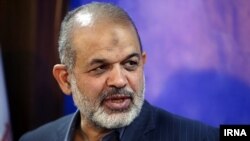
Just hours after US President Donald Trump said the US has "a massive fleet heading" to Iran, the deputy commander of the IRGC, Ahmad Vahidi, has said that "the enemy should know that it can not hurt the Islamic revolution of Iran."
Vahidi, a former interior minister, also said on January 23 that the IRGC are here "to drive ISIS and terrorists out" and "thwart all their efforts."
The IRGC was established after the 1979 Islamic revolution on the orders of Ruhollah Khomeini, the first supreme leader who overthrew the shah. The group's aim was to guard the "Islamic revolution and its achievements."
In his comments, Vahidi did not specifically mention the involvement of IRGC forces in the unprecedented and deadly suppression of the January protests.
A recent statement from the Intelligence Organization of the IRGC referred to the unrest as "terrorist riots" and announced that this "sedition and chaos were thwarted by the preparedness of the security and law enforcement institutions."
As for the high number of protester deaths, the IRGC attributed the blame to "terrorist rioters" and, without offering evidence, claimed they were part of a "grand American-Zionist plan to disintegrate Iran's identity and geographical integrity."
The IRGC's security agency said that, during the protests, 735 people had been arrested or summoned, 743 "illegal combat and hunting weapons" had been seized, and 46 people had been identified as collaborating with foreign powers.
The US-based Human Rights Activists News Agency (HRANA) says that the number of confirmed fatalities has reached 5,002, while the number of deaths still under investigation has risen to 9,787. Different activist groups have put the death toll far higher, but an internet blackout has made it difficult to verify the information.
The EU is currently weighing more asset freezes and visa bans against members of the IRGC thought to be responsible for the crackdown. The bloc has been under pressure for a while to designate the IRGC a terrorist organization. To do that, however, a consensus of all EU members is required, and reports indicate that France, Italy, and Spain have so far opposed such a move.
Joint British-Qatari Air Squadron Departs For Persian Gulf
The UK has announced that a joint British-Qatari Royal Air Force squadron, known as Squadron 12, has been deployed to the Persian Gulf region with Typhoon fighter jets.
In a January 22 press release, the British Ministry of Defense announced the news, adding that "this action was taken in the wake of regional tensions" and "for purely defensive purposes."
According to the UK's Ministry of Defense, the deployment was made at the invitation of the Qatari government and aims to showcase the "strong and enduring defense relations" and to "maintain regional stability."
British Defense Secretary John Haley, in remarks quoted in the press release, said that Qatar and the UK are "close partners with historic defense ties" and that this cooperation strengthens "the national security of both our nations" and supports "stability in the Gulf region."
Squadron 12 has been regularly deployed to Qatar and has participated in joint training and exercises, the press release said.
The USS Abraham Lincoln Carrier Strike Group (CSG) is expected to arrive in the Middle East in the coming days.
The nuclear-powered aircraft carrier, along with its planes and flight crews, was rerouted from the South China Sea and is accompanied by destroyers and a cruiser.
Grieving Mother Of Protester Calls Khamenei An 'Executioner'
In a video being widely shared, the mother of Daniyal Diani, a victim of the authorities' crackdown in the southeastern city of Kerman, can be seen clutching a photo of her son at his funeral.
Seemingly resigned to her fate and the high death toll, the mother calls Khamenei an executioner and appeals for him to "rule over the blood of our children."(It isn't an invitation to rule per se but an implication that Khamenei rules over a system that sustains its power through bloodshed.)
According to various media reports, Daniyal Diani was a native of Kerman and a law student at Razi University in Kermanshah, a city in western Iran. He was reportedly shot and killed when security forces attempted to quell the protests in Kerman on January 8.
Iran Protest Deaths Could Reach 20,000

Mai Sato, the UN special rapporteur on human rights in Iran, has said that the number of people reported killed in Iran’s protest crackdown has surged, with one estimate suggesting the total could be more than 20,000.
In an interview with ABC News this week, Sato estimated that the number of civilians killed was at least 5,000. However, she also said that figure could be 20,000 or more, according to reports she had received from doctors inside Iran.
The US-based Human Rights Activists News Agency (HRANA) says that the number of confirmed fatalities has reached 5,002, while the number of deaths still under investigation has risen to 9,787.
In addition, at least 7,391 people have suffered serious injuries during the protests, and the total number of arrests has increased to 26,852, according to HRANA.s
Good morning. We're opening the live blog now with US President Donald Trump speaking to reporters on Air Force One while flying back from Davos.
Trump said that the US is watching Iran closely:
"You know we have a lot of ships going that direction, just in case. We have a big flotilla going in that direction, and we’ll see what happens."
"I said, if you hang those people, you're going to be hit harder than you've ever been hit. It will make what we did to your Iran nuclear [infrastructure] look like peanuts."
"And they actually said they canceled [the hangings], they didn't postpone it, they canceled it -- so that was a good sign."
"We have a massive fleet heading in that direction and maybe we won't have to use it, we'll see."
Meanwhile, NetBlocks reports that Iran's national internet blackout continues, now in its third week. The monitoring group noticed only a slight rise in overall connectivity and "tunneled users," which refers to Iranians who have managed to bypass the blackout.
The US-based Human Rights Activists News Agency (HRANA) says that the number of confirmed fatalities has reached 5,002, while the number of deaths still under investigation has risen to 9,787. In addition, at least 7,391 people have suffered serious injuries during the protests, and the total number of arrests has increased to 26,852, according to HRANA.
We are now closing the live blog for today. We'll be back again tomorrow morning at 7:30 a.m. Central European time to follow the latest developments in Iran.
Iranians Mourn Family Members Killed In Mass Protests
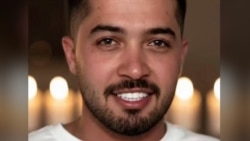
Family and friends of Alireza Rahimi lit candles and played his favorite music on what would have been his birthday following weeks of a deadly state crackdown on protesters throughout Iran. Rahimi was killed, along with more than 4,900 others in Iran according to the HRANA human rights organization, during recent protests over a dire economy and the repressive theocracy headed by Supreme Leader Ayatollah Ali Khamenei.

Iranian Parliament Speaker: Internet Blackout Prevented Threats To Officials
On Thursday, February 20, the deputy speaker of Iran's parliament defended the nationwide Internet blackout, which has now surpassed two weeks, claiming the measure prevented threats against "sensitive sites" and the residences of Iranian officials.
Hamidreza Haji Babaei did not provide further details. He added that cutting off the Internet succeeded in to "locking the American sword and warship" inside mobile phones.
Reports by monitoring organizations such as NetBlocks indicate that in recent days a small number of people, under what has been described as a "whitelist," have gained Internet access, while millions still do not have this possibility.
As Iran has plunged into a digital blackout, reports indicate that thousands of people have been killed in the government's brutal crackdown on nationwide protests.
EU To Target Iranian Officials Over Deadly Crackdown On Protesters
The European Union has proposed sanctions against Iran's interior minister and 14 other senior officials for their role in a violent crackdown on nationwide protests that erupted in late December, documents obtained by RFE/RL show.
The bloc's foreign ministers could adopt the measures, which include asset freezes and visa bans, when they meet in Brussels on January 29. All member states must vote in favor for the sanctions to be adopted.
The proposal, dated January 20 and circulated within the EU Council, targets Interior Minister Eskandar Momeni, who oversees Iran's Law Enforcement Forces (LEF), and security units of the Islamic Revolutionary Guards Corps (IRGC) that are blamed for hundreds of protester deaths.
Prosecutor-General Mohammad Movahedi-Azad faces designation for threatening demonstrators with death penalties on charges of "enmity against God" during the unrest.
Momeni, also deputy commander-in-chief, commanded forces that "suppressed street protests," which saw thousands of casualties, according to the EU document.
Regional IRGC commanders including Heydar Olfati in Ilam Province and Ahmad Ali Feyzollahi of the IRGC Ground Forces elite Saberin Brigade are accused of ordering troops to open fire on peaceful crowds.
To read the whole news story, click here.