



EU Set To Approve New Sanctions On Iran Over Rights Abuses
- By RFE/RL
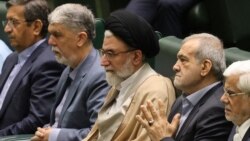
European Union foreign ministers are set to rubber stamp a new round of sanctions against Iran during their meeting in Brussels today.
The asset freezes and visa bans are targeting 16 people and three entities who the bloc believes are responsible for human rights abuses during a crackdown on demonstrators in Iran earlier this year.
Among those targeted are Qolam Ali Mohammadi who oversees all Iranian prisons, and Mohammad Moazami Goudarzi, chief of the country's so-called preventive police, a branch of the national police responsible for public order and crime prevention.
The sanctions also include the head of Greater Tehran’s cyber police, Davud Moazami Goudarzi who according to documents seen by RFE/RL “frequently targets dissidents and regime opponents, but also important cultural figures who do not conform to strict social and gender roles, such as female artists.”
Among the entities designated for sanctions by Brussels is Iranian cyberoperations group Emennet Pasargad, which stands accused of compromising the subscriber database of the French satirical magazine Charlie Hebdo and advertising it for sale on the dark web. It is also accused of targeting advertising billboards during the Paris Olympic Games in 2024.
The Naji Research and Development Company (NRDC) --which developed the Nazer mobile application that is used as a surveillance tool to monitor Iranian citizens for the country’s law enforcement forces -- is also set to be sanctioned.
EU Eyes Naval Mission To Help Secure Strait of Hormuz

EU foreign ministers will discuss extending the bloc’s Red Sea naval mission to help secure the Strait of Hormuz, EU foreign policy chief Kaja Kallas said, as the Iran war has largely halted shipping through the crucial waterway.
"It is in our interest to keep the Strait of Hormuz open, and that's why we are also discussing what we can do in this regard," Kallas told journalists in Brussels ahead of the talks on March 16.
About 20 percent of the world’s crude oil normally passes through the strait, and disruptions have pushed energy prices higher.
One option that will be discussed is to expand the mandate of Operation Aspides, an EU naval mission launched in 2024 to protect vessels from attacks by Iran-backed Houthi rebels in Yemen.
Kallas said adapting the existing mission would be the fastest way to bolster maritime security, though member states must agree.
Alternatives include forming a “coalition of the willing,” with France already signaling support for a "defensive" mission to reopen the strait.
Based on reporting by AFP
Oil-Loading Operations Suspended Again At Crucial UAE Port
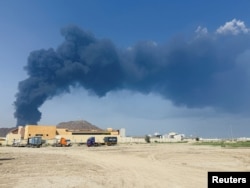
Oil-loading operations have been suspended at the United Arab Emirates port of Fujairah after a drone attack sparked a fire in the emirate's petroleum industrial zone, according to Reuters
Fujairah, located on the Gulf of Oman just outside the Strait of Hormuz, is typically a critical exit point for about 1 million barrels of crude oil per day, which amounts to roughly 1 percent of global demand.
Civil defense teams are now working to bring the fire under control, Fujairah authorities said, adding that no casualties have been reported.
The suspension marks the second major disruption at the vital ship-refueling hub in recent days. Operations at Fujairah had only just resumed on March 15 after a separate drone strike over the weekend.
Based on reporting by Reuters
Reuters has now shared some user-generated footage of the fire at Dubai's international airport this morning.
Iranian Foreign Minister Says Jailed Dual Nationals Will Be 'Safe' If Prisons Not Attacked

Iranian Foreign Minister Abbas Araqchi says Iranian-American prisoners held in the Islamic republic will remain “safe” as long as the United States and Israel do not attack Iran’s prisons.
He made the remarks in response to a question from Margaret Brennan, host of a CBS television program, about the status of imprisoned Iranian-Americans Reza Valizadeh, a journalist, and Kamran Hekmati, another Iranian-American detainee, amid wartime conditions.
Valizadeh, who previously worked as a journalist for RFE/RL's Radio Farda for 10 years, resigned from the outlet in November 2022. After living abroad for some time, he returned to Iran in March 2024 to visit his family and was arrested the following September. He was sentenced three months later to 10 years in prison on charges of "collaborating with a hostile government."

According to informed sources who spoke with CBS News, Valizadeh is one of at least four Iranian-American citizens currently imprisoned in Iran, including Kamran Hekmati, 70 and one other woman in her seventies.
Since the start of the war on February 28, Valizadeh’s lawyer and friends abroad say they have had no information about his condition or that of his family.
Araqchi’s comments come as reports continue about poor conditions in Iranian prisons.
The Washington-based human rights organization HRANA has also reported disruptions in the provision of some basic necessities for prisoners.
A report it published on March 11 says developments linked to wartime conditions in Iran have led to shortages of clean drinking water, food, and medical care.
In the weeks and months leading up to the outbreak of the war, families of prisoners, lawyers, and human rights activists repeatedly warned that detainees’ lives were at risk, calling for their release or at least temporary furloughs during times of conflict.
Dubai Airport Resumes Flights After Drone-Related Fire
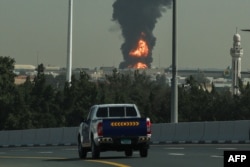
Dubai International Airport has begun gradually resuming flights after a drone-triggered fire forced a temporary suspension, United Arab Emirates authorities said on March 16, highlighting ongoing risks to aviation amid the US-Israel war with Iran.
The conflict has disrupted global air travel, with widespread cancelations and rerouting as much of Middle Eastern airspace remains closed and fuel prices surge.
The attack in Dubai damaged a fuel tank near the airport but caused no injuries.
The Emirates and flydubai airlines briefly halted operations, diverting some flights to Al Maktoum International Airport, and expected a partial restart from 10 a.m. local time.
It was the third strike on the airport since Iran launched attacks across Persian Gulf states on February 28, targeting sites linked to US diplomatic missions and military bases as well as civilian infrastructure.
The United Arab Emirates' air defence systems were again intercepting Iranian missiles and drones on the morning of March 16, the Gulf nation's Defense Ministry said.
"UAE air defenses are currently responding to incoming missile and drone threats from Iran," the ministry posted on X.
Based on reporting by Reuters and AFP
Country-By-Country Casualty Tolls From Middle East War
The French AFP news agency has assembled casualty figures from around the Middle East since the United States and Israel launched its air strikes on Iran on February 28.
AFP said the figures are based on numbers released by governments, militaries, health authorities. and rescue organizations in the affected countries. It cautioned that it has not been able to independently verify all of the figures.
IRAN
The Health Ministry on March 8 said more than 1,200 people had been killed, including around 200 women and 200 children under the age of 12, with more than 10,000 civilians injured.
The US-based Human Rights Activists News Agency (HRANA) on March 11 said at least 1,825 people had been killed, including 1,276 civilians -- among them at least 200 children -- as well as 197 military personnel and 352 people whose status had not been classified.
Due to reporting restrictions, AFP and other news agencies have not been able to access the sites of strikes or independently verify the tolls.
ISRAEL
Israeli authorities have reported 14 people killed.
First responders and local authorities say Iranian missile fire has killed 12 people inside the country, including four minors, since the start of the war, AFP reported based on their announcements.
Israel's military separately confirmed the deaths of two soldiers in combat in southern Lebanon.
LEBANON
The Health Ministry on March 14 said Israeli strikes have killed 850 people, including 66 women and 107 children, since the start of the war with Hezbollah, adding that 2,105 others were wounded.
The ministry said 31 paramedics were among the dead.
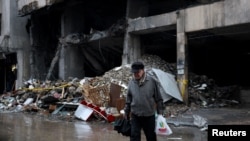
Lebanon's has said three of its soldiers have been killed.
Hezbollah has not revealed its losses.
THE GULF
Gulf state authorities and the US Central Command have reported 26 people killed -- 13 of them civilians. The rest of those killed were military or security personnel, including seven US service members.
Kuwait reported six deaths: two soldiers, two border guards and two civilians, one of them an 11-year-old girl.
The United Arab Emirates reported six deaths: four civilians and two military personnel who died as a result of a helicopter crash blamed on a technical malfunction.
Saudi Arabia said two civilians had died, as did Bahrain.
Oman reported the death of a mariner at sea and two other people in a drone attack on an industrial area.
Qatar reported 16 injuries and no fatalities.
IRAQ
Armed groups and officials have said at least 49 people have been killed in Iraq since the start of the conflict, according to an AFP tally based on their announcements.
France said an Iranian drone killed a French soldier in Iraq's autonomous Kurdistan region.
The US military said a refueling aircraft crashed in western Iraq, killing all six crew members, in an incident not caused by hostile or friendly fire.
Pro-Iran armed factions and security sources say 35 Iran-backed fighters were killed in strikes they blame on the United States and Israel.
Kurdish rebel groups said at least five Iranian Kurdish militants were killed in strikes attributed to Iran on their positions in the north.
Kurdish security sources said one airport guard was killed in a drone attack on Erbil airport.
Officials said one civilian was killed by rocket shrapnel following a strike southeast of Baghdad.
JORDAN
Security officials said 28 people have been injured by falling debris from Iranian missiles and drones in various parts of the kingdom.
No deaths have been recorded so far.
With reporting by AFP
Drone Incident Ignites Fire At Massive Dubai Airport
A drone-related incident sparked a fire near Dubai's international airport, the second-busiest airport in the world prior to the outbreak of the Middle East war.
"Authorities are currently responding to a fire resulting from a drone-related incident in the vicinity of Dubai International Airport," the Dubai Media Office posted on X on March 16.
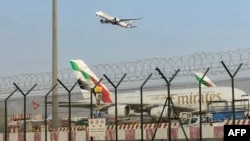
"Civil Defense teams continue their efforts to bring the fire under control. No injuries have been reported so far," it added
"All necessary measures are being taken to ensure everyone's safety," it said, adding that "the drone crash "resulted in damage to one of the fuel tanks."
Iran has fired some 1,800 missiles and drones at the United Arab Emirates, more than any other country targeted by Tehran in retaliation for the US-Israeli air strikes that began on February 28.
The crisis has devastated the emirates' tourist industry and disrupted its crucial oil-sector operations.
Iran claimed that the recent US air strike on Kharg Island originated at an American base in the UAE, which denied the accusation.
Iran Women’s Soccer Captain Becomes Latest Player To Drop Asylum Bid In Australia, Say State Media
The Iranian women’s soccer captain, Zahra Ghanbari, has withdrawn her asylum request in Australia and will return to Iran, state media said, becoming the fifth member of the national team delegation to reverse a bid for sanctuary.
Seven players and staff initially sought refuge after being branded “traitors” at home for not singing the Islamic republic's national anthem before a game during the Women’s Asian Cup.



Iranian authorities hailed Ghanbari’s decision, announced on March 15, as patriotic, but opposition media and others say players were pressured to change course through threats against their families.
Australian officials said the team members were given opportunities to pursue asylum but faced "incredibly difficult decisions."
With several already leaving for Malaysia en route to Iran, only two members of the delegation are now expected to remain in Australia.
With reporting by AFP
Interview: Iran's Use Of Chinese Doctrine And Tech Under The Spotlight
- By Ray Furlong

TEL AVIV -- The Iran war offers huge lessons for the effectiveness of Chinese military doctrine and hardware, both used by the Iranian military, according to Eran Ortal, a reserve Brigadier General in the Israel Defense Forces (IDF).
Speaking to RFE/RL from a location near Tel Aviv late on March 14, Ortal said Iranian tactics around the Strait of Hormuz were very similar to those that China would be expected to employ in a future conflict around Taiwan.
The US and Chinese military would be “taking notes” as the current conflict played out, he added.
Ortal was previously commander of the IDF’s Dado center, a military studies unit at the General Staff. He is now head of the military program at the Begin-Sadat center (BESA) at Bar-Ilan University and a visiting scholar at the American Foreign Policy Council (AFPC).
RFE/RL: Iran has blocked the Strait of Hormuz. Is there a military solution, and if so, what does it look like?
Eran Ortal: Well, that's the nature of asymmetric warfare. You can take out the Iranian fleet and the entire Iranian Navy, and the Fifth Fleet has done that. But the asymmetric capabilities, the speed boats, the unmanned boats, the mines and the coastal missiles will still be there. And this is a threat you cannot just totally remove. It's just like we have the anti-tank missile problem in Lebanon. You can take some of them out, you can have countermeasures, but they will always be able to snipe away.
You can protect the vessels going through the Hormuz Straits and you can win the war. That's basically the tactic and the strategy to maneuver around this problem. And I guess this is the American strategy.
Read more here.