



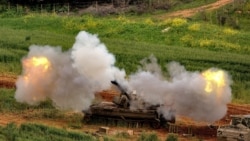
Iran Threatens To Mine Entire Persian Gulf If Attacked
Iran's Defense Council, which was established in August 2025 after the 12-day war to centralize wartime decision making, has threatened to mine the entire Persian Gulf if Iranian shores or islands come under attack.
As US President Donald Trump's deadline for Iran to fully open the Strait of Hormuz approached, the council said that, if attacked, it would mine all access routes and communication lines in the Gulf and along the coasts with various types of naval mines, including floating mines that could be released from shore.
The council added that, in such a case, the entire Gulf would effectively face a situation similar to the Strait of Hormuz for an extended period in that it would be essentially blocked.
Revolutionary Guard Says Would Hit Israeli, Regional Power Plants If Iranian Facilities Are Attacked
In a statement, Iran's Islamic Revolutionary Guards Corp (IRGC) says that in the event of an attack on Iranian power plants, it will retaliate, targeting Israeli and regional power facilities that supply electricity to US bases.
On March 21, US President Donald Trump demanded Tehran “fully open” the Strait of Hormuz within 48 hours or the US would "hit and obliterate" Iranian power plants.
Meanwhile, The Wall Street Journal has reported that Gulf Arab states have warned the US administration that targeting Iran’s power plants would trigger reprisals that could endanger their energy and water facilities.
Air Strike On Iranian Radio Station Kills 1, State Media Report
An air strike on a radio station in the Iranian port of Bandar Abbas has killed at least one person, Iranian state TV said on March 23. "The 100-kilowatt AM transmitter of the Persian Gulf Radio and Television Center was attacked by the American-Zionist terrorist army," the state-run Islamic Republic of Iran Broadcasting reported. "In this attack, which was against international laws, one of the center's security colleagues was martyred and another person was injured." No further details were immediately available.
Blasts Heard In Central Tehran After Israel Launches New Wave Of Attacks
Blasts were reported in central Tehran early on March 23 after Israel said it had begun a wide-scale wave of attacks targeting infrastructure in the capital. The Fars Iranian state news agency reported that the explosions occurred in multiple locations. Fars reported that air strikes targeted five areas of Tehran and that "terrible sounds of explosions have been reported." There were no immediate details on damages or casualties. Israel's military said it targeted a military base utilized for training and storage of missile systems; two weapons production sites; and the headquarters of the Iranian Intelligence Ministry and of the internal security forces.
IEA Chief Says Energy Crisis From Iran War A 'Major Threat' To Global Economy
The chief of the International Energy Agency (IEA) says the global economy faces a "major threat" from the energy crisis spilling out of the Middle East war and warns that "no country will be immune to its effects."
Executive Director Fatih Birol, speaking on March 23 at the National Press Club in Canberra, Australia, said the current energy crisis is worse than the two oil shocks of the 1970s and the impact of Russia's 2022 invasion of Ukraine.
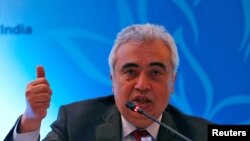
"This crisis, as things stand, is now two oil crises and one gas crash put all together," he said.
"The global economy is facing a major, major threat today, and I very much hope that this issue will be resolved as soon as possible," Birol said.
"No country will be immune to the effects of this crisis if it continues to go in this direction. So there is a need for global efforts," he said.
Birol said the IEA is consulting with governments in Asia and Europe on the possibility of releasing more stockpiled oil.
"If it is necessary, of course, we will do it. We look at the conditions, we will analyze, assess the markets and discuss with our member countries," Birol said.
"The single most important solution to this problem is opening the Hormuz Strait," he said.
On March 21, US President Donald Trump gave Tehran 48 hours to reopen the crucial waterway or said he would "obliterate" Iran's power stations.
He has also demanded that countries that benefit from oil sources shipped through the strait take the lead in ensuring safety for oil tankers through the waterway. Many countries have shown reluctance to joining such an effort but have moved closer to agreeing following pressure from Trump.
With reporting by Reuters
Lebanese Prime Minister Says IRGC Commanding Hezbollah Fighters
Lebanon's prime minister said members of Iran's hard-line Islamic Revolutionary Guard Corps (IRGC) are commanding pro-Tehran Hezbollah fighters in the country in the group's war against Israel.
Prime Minister Nawaf Salam, in an interview with the Al Hadath network on March 22, slammed Hezbollah for dragging Lebanon into the Middle East war by firing rockets toward Israel.
"It was declared that this war was in retaliation for the assassination of Khamenei, so this means this war was imposed upon us," he said, referring to the Iran's late supreme leader, Ayatollah Ali Khamenei, who was killed on the first day of US-Israeli air strikes on Iran.
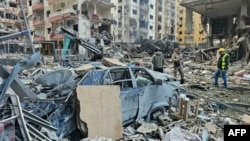
Salam said an incident in which an Iran-made drone hit a British sovereign base in Cyprus earlier this month was initiated by the "Revolutionary Guard, which is present and, unfortunately, is managing the military operation in Lebanon."
"These people have forged passports and entered the country illegally," he added.
Lebanon has banned the activities of the IRGC in the country and has imposed a ban on Hezbollah military activity.
The United States has designated Hezbollah a terrorist organization, while the EU has sanctioned the group's military wing but not its political organization in the country.
With reporting by AFP
NATO's Rutte Says More Than 20 Countries Plan To Be Involved In Strait Of Hormuz Reopening
NATO Secretary-General Mark Rutte said that more than 20 countries were planning to be involved in the reopening of the key Strait of Hormuz after US President Donald Trump pushed the alliance to increase efforts on the matter.
"I know the president was angry because he feels that European and other allies have been too slow," Rutte told Fox News on March 22. He added that NATO was now looking to work on the issue together with Japan, South Korea, Australia, New Zealand, the United Arab Emirates, and Bahrain.
"So we are now planning the military people and others amongst this group of 22 nations and with the US," Rutte said.
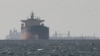
His comments came amid a heated exchange between US and Iranian officials concerning the Strait of Hormuz. Trump gave Tehran 48 hours to "fully open" the Strait of Hormuz, or the United States would "obliterate" Iran's power plants. The Iranian military command threatened to retaliate.
Backing up Trump's ultimatum, US Treasury Secretary Scott Bessent told NBC it was "the only language the Iranians understand," adding that "sometimes you have to escalate to de-escalate."
Separately, he also addressed Trump's comments about Kharg Island, a major hub for Iran's oil production. Speaking to Fox News, Bessent said that US forces have destroyed Iranian military assets on the island, adding: "We will see what happens with -- whether that eventually becomes a US asset."
Netanyahu Says Israel Will Pursue IRGC Commanders 'Personally'
Israeli Prime Minister Benjamin Netanyahu vowed on March 22 to pursue top commanders of Iran's Islamic Revolutionary Guard Corps (IRGC) "personally."
"We're going after the regime. We're going after the IRGC, this criminal gang," Netanyahu said while visiting the southern Israeli town of Arad, a day after an Iranian missile strike on the area.
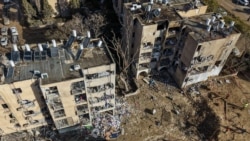

"We're going after them personally, their leaders, their installations, their economic assets. We're going after them personally," he added.
The Israeli Army said that Iran has fired more than 400 ballistic missiles at Israel since the start of the war three weeks ago and that about 92 percent of them have been intercepted.
Iran Threatens To Completely Close Strait Of Hormuz After Trump's Ultimatum
Iran's Islamic Revolutionary Guard Corps (IRGC) threatens to completely close the Strait of Hormuz after an ultimatum issued by US President Donald Trump on March 22, Iranian state broadcaster IRIB said.
The IRGC said it would consider the move if the United States attacks its energy infrastructure. It added that, in this case, the key Strait of Hormuz -- which accounts for about one-fifth of the world's oil transport -- would only be reopened once any destroyed facilities had been rebuilt.
Earlier in the day, Trump gave Tehran 48 hours to "fully open" the Strait of Hormuz, or the United States would "obliterate" Iran's power plants, marking a major escalation of tensions in a conflict.
In an almost immediate response, Iran's military command was quoted by state media as saying that if Iran's fuel and energy infrastructure is attacked, all US energy infrastructure in the region will be targeted.
Israeli Says Iran Has Fired Over 400 Missiles At Israel Since Start War
The Israeli Army announced on March 22 that Iran has fired more than 400 ballistic missiles at Israel since the start of the war, about 92 percent of which have been intercepted.
Israeli military spokesman Nadav Shoshani said the rocket attacks on Arad and Dimona in southern Israel on March 21 were "catastrophic." It had previously been reported that 175 people were treated for injuries following the attacks.
According to Arad Hospital, 31 people, including 18 children, were hospitalized in the city, at least nine of whom are in critical condition. Dozens of others were also lightly injured.
In Dimona, five people were hospitalized, including a 12-year-old boy who is reported to be in critical condition, according to the city hospital.
Israeli emergency services also announced that at least 15 people were injured in new Iranian attacks on March 22 after a cluster munition hit Tel Aviv.
An Israeli military spokesman added on March 22 that the missiles used in the recent attacks were similar to the ballistic missiles that have been used repeatedly since the start of the war.
According to the Israeli military, four direct hits have been reported on cities in the country in the past three weeks: Tel Aviv, Beit Shemesh, Arad, and Dimona.
In addition, there have been cases of rocket debris or cluster munitions hitting Israel. According to the spokesman, all casualties from Iranian rocket attacks in Israel so far have been civilians.
He said the number of rockets fired at Israel daily currently ranges from the high single digits to around 20, and Iran has repeatedly used cluster munitions against population centers, including in the recent attack on Tel Aviv.