

Rubio Says Iran Operation Expected To Be Complete In 'Weeks'
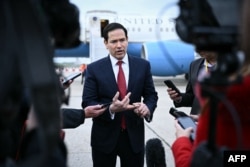
The United States expects its military operation in Iran to end in "weeks, not months," US Secretary of State Marco Rubio said after a meeting with the other Group of Seven (G7) foreign ministers in France as the US-Israeli war approached it fifth week.
Speaking before departing on March 27, Rubio also said the United States can achieve its goals in Iran without ground troops, and that Iran may seek to set up a toll system for passage through the Strait of Hormuz, which he said would not be acceptable.
He said the United States is "very confident" that it will achieve its objectives "very soon."
Rubio's remarks came as Iran warned of new attacks across the Middle East and urged civilians to avoid areas near US forces, a day after US President Donald Trump extended a deadline for Tehran to open the crucial oil-and-gas transport route until April 6.
To read the full report, click here.
G7 Leaders Call For Immediate Stop To Attacks On Civilian Infrastructure
In a joint statement issued on March 27, foreign ministers from the Group of Seven (G7) have jointly called for an immediate stop to attacks against civilian infrastructure in the US-Israeli war with Iran.
The statement, released on the second day of the G7 meeting between the United States, Britain, Canada, France, Germany, Italy, Japan, and the European Union in Paris, underlined the consequences of the conflict that have fallen on the civilian population across the Middle East.
"There can be no justification for the deliberate targeting of civilians in situations of armed conflict as well as attacks on diplomatic facilities," the foreign ministers said.
The group included US Secretary of State Marco Rubio in attendance for his first face-to-face meeting with G7 leaders since before the current conflict began on February 28. The statement said that leaders were "focused on the value of diverse partnerships, coordination, and supporting initiatives" to reduce global economic tension, "which have direct impacts on our citizens," as they reiterated the need to relaunch secure navigation in the Strait of Hormuz.
The key waterway accounts for around one-fifth of global oil shipments and is effectively closed by Iranian forces, spiking global energy prices.
To read the full report, click here.
Iran Reports Attacks On Arak Nuclear Facility, Steel Factories In Ahvaz, Isfahan
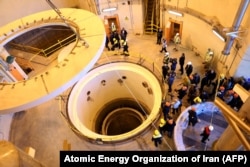
The Arak Heavy Water Complex, known as Khondab, was hit "in two stages" on March 27, according to a local government official.
"The Khondab Heavy Water Complex was targeted in two stages by aggression from the American and Zionist enemy," said Fars news agency, citing Hassan Ghamari, an official in the central Markazi Province.
The Arak Heavy Water Complex is one of Iran's major nuclear facilities and a center for heavy water production. The complex was previously targeted during the 12-day war between Israel and the United States against Iran.
The official said there no danger to the people in the vicinity.
Meanwhile, Iranian media on March 27 reported attacks on steel production plants in the cities of Ahvaz and Isfahan.
Mohammad Ali Zarei, spokesman for the Iranian Ministry of Industry, Mines and Trade, confirmed the attack on the Mobarakeh and Khuzestan Steel complexes in an interview with Tasnim News Agency, which is affiliated with Iran's Islamic Revolutionary Guards Corps (IRGC).
"Some damage has been caused to parts of these two complexes," he said. He did not provide further details about the extent of damage or possible victims.
However, Fars, which is also linked to the IRGC, reported that "an electrical substation and an alloy steel production line" were targeted in the attack on Mobarakeh Steel in Isfahan. At the Khuzestan Steel plant, the company's "storage facilities" were also hit.
Images of huge plumes of smoke rising from steel factories in Isfahan and Ahvaz were also shared on social media.
The Israeli military announced in a statement that its air force had "launched a broad wave of attacks against the infrastructure of the Iranian regime."
The US Could Seize These Three Iranian Islands, Experts Say
US President Donald Trump has warned of possible further action against Kharg Island, a key oil terminal of Iran and a major cog in the country's economic machine.
But experts say three other Iranian islands in the Persian Gulf could also be part of efforts to pressure Tehran into reopening the Strait of Hormuz, a key artery for global oil and gas supplies.
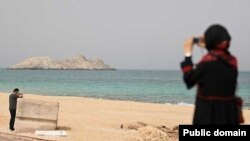
The tiny islands of Abu Musa, Greater Tunb, and Lesser Tunb sit near the mouth of the 39-kilometer-wide waterway, giving them strategic value.
Internationally recognized as part of Iran, the islands are also claimed by the United Arab Emirates (UAE). Tehran gained control of the territories just a day before the creation in 1971 of the UAE, which was until then was an informal British protectorate.
To read the full report, click here.
Iran Warns Of New Strikes Day After Trump Extended Deadline To Reopen Strait Of Hormuz
The Iranian military has warned of new attacks across the Middle East and urged civilians in the region to avoid areas near US forces, as US President Donald Trump extended the deadline for Tehran to open the key Strait of Hormuz.
In a statement released on March 27, the Islamic Revolutionary Guards Corps (IRGC) also said it would keep the waterway closed and any potential attempts at transit would face "harsh measures."
"The movement of any vessel 'to and from' ports of origin belonging to allies and supporters of the Zionist-American enemies, to any destination and through any corridor, is prohibited," said the IRGC, which is designated as a terrorist organization by the United States.
Following the IRGC's warning, media reported that three vessels of various nationalities were turned back from the Strait of Hormuz on March 27.
To read the full report, click here.
Iran War Will Reshape Dynamics Ahead Of Trump-Xi Summit, Says Former US Official
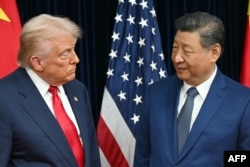
A long-awaited meeting between US President Donald Trump and Chinese leader Xi Jinping will take place in Beijing on May 14-15 after Trump said Washington asked to delay the summit originally planned for April due to the war with Iran.
The summit in Beijing comes after the two leaders met in South Korea in October 2025 and and follows successive US military action in Venezuela in January and the war with Iran, which began with US-Israeli strikes in late February. While the Trump-Xi meeting is set to focus on lingering trade and economic disputes between Beijing and Washington, the American moves against two Chinese partners add a new geopolitical backdrop.
For a better understanding of how the war in Iran will affect the upcoming summit, RFE/RL spoke with Dennis Wilder, a former top US official focused on China.
To read the full interview, click here.
Exhausted, Divided, And Waiting: Iranians On A Month Of War
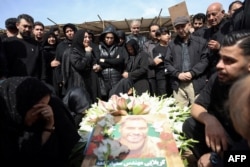
Continuing US-Israeli air strikes have left parts of Tehran in rubble and the nerves of many in the capital frayed.
As the war nears the one-month mark, US Central Command (CENTCOM) says over 10,000 targets have been struck across Iran. According to the US-based human rights group HRANA, at least 1,464 civilians -- including at least 217 children -- have been killed in Iran since fighting began on February 28.
RFE/RL's Radio Farda gathered testimonies from Iranian civilians about daily life amid the air strikes. Reaching ordinary Iranians remains very difficult amid the Iranian government's ongoing Internet blackout, which has now lasted more than 600 hours.
To read the full report, click here.

IRGC Announces Arrests Of 103 On Charges Of 'Collaborating With The Enemy'
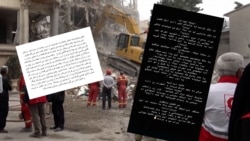
The Intelligence Organization of Iran's Islamic Revolutionary Guards Corps (IO-IRGC) said that it has arrested 103 people on charges of "collaborating with the enemy" since the beginning of the US-Israeli war with Iran.
In a statement released on March 26, the security agency of the IRGC -- which the United States has designated as a terrorist organization -- claimed that 13 of the detainees had planned to "sabotage, make the streets unsafe, and attempt to attack checkpoints," and that it had arrested 90 others on charges such as sending images to media outlets opposed to the Islamic republic.
The security agency also announced that it was taking legal action against 16 people for using the Starlink satellite Internet device and 400 people "who sold filter circumvention tools" in the past month. The IO-IRGC described sellers of VPNs and similar tools as "sellers of cyber evasion tools," using language that portrays them as aiding illegal activity.
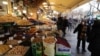
Since hostilities began on February 28, Iran's security, judicial, and law enforcement institutions have published numerous reports of widespread arrests of citizens on similar charges. For example, the National Security Forces Command announced on March 24 that 466 people had been arrested on charges of "online activities aimed at undermining national security," claiming these individuals were in contact with "enemy" networks and intended to create internal instability.
State media have also reported the arrest of more than 1,000 people on similar charges during this period.
Due to the Internet shutdown in Iran and widespread disruption in communication channels, the only source of this type of news is government-affiliated media. It is not possible to independently verify its details.
Iran Says At Least 18 Killed In Attack On Qom
The authorities of Qom Province said that at least 18 people were killed in an air strike on residential buildings in the Pardisan neighborhood of Qom city on March 27.
Following air strikes on various parts of Iran over the past 24 hours, at around 3 a.m. local time, an attack on at least three houses in Pardisan was reported.
Morteza Heydari, the deputy political and security officer for the Qom governorate, told the Tasnim news agency, which is affiliated with the Islamic Revolutionary Guards Corps, that 18 people had been killed and 10 injured in the attack.
Heydari said "three residential houses" had been targeted in the attack but did not give the identities of those killed.
The Israeli military, which usually reports few details about targets in the days following such strikes, has not yet commented on this attack.
Heydari said the search and investigation operation to find other possible bodies is continuing and it is possible that the number of casualties could rise.
Qom is a significant religious center in Iran and one of the world's most important Shi'ite pilgrimage sites. The region is also strategically important due to its industrial and nuclear facilities.
UN Human Rights Commissioner Condemns Minab School Attack
The United Nations high commissioner for human rights, Volker Turk, issued a statement on March 27 urging parties in armed conflict to shield and protect children and educational institutions from harm.
Addressing the Human Rights Council in a video statement, Turk highlighted the recent bombing of Shajareh Tayyebeh Elementary School in Minab, Iran, an attack that reportedly killed 168 students, teachers, staff, and family members.
"The images of bombed-out classrooms and grieving parents showed clearly who pays the highest price for war: civilians with no power in the decisions that led to conflict," he said. "That is why we have the laws of war: to protect children and other civilians caught up in conflict, as well as schools and all civilian infrastructure."
He said that in the case of this strike, which took place on February 28, the first day of the US-Israeli war with Iran, "the onus is on those who carried out the attack to investigate it promptly, impartially, transparently and thoroughly, to determine the facts and lay the basis for accountability."
"There must be justice for the terrible harm done," he added.
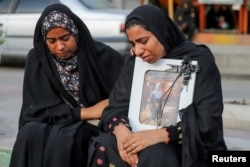
A US investigation into the strike in Minab is ongoing, although preliminary assessments indicated that US forces were likely responsible.
Turk also spoke out against strikes on populated, civilian areas. "In Iran, as the conflict has progressed, US and Israeli attacks have increasingly struck densely populated residential areas and destroyed civilian infrastructure," he said.
"Homes, medical facilities, schools, courts, transport networks, and energy installations have been hit across all 31 provinces of the country. According to the Iranian authorities, more than 1,900 civilians have been killed and tens of thousands injured."
Turk "urges all sides to halt further escalation and return to negotiations as the only the path to last peace," the UN Human Rights Council said in its post of the statement on X.