




Araqchi Says Iran Has Not Responded To US Plan Or Presented Any Conditions
Iranian Foreign Minister Abbas Araqchi said that he continues to receive indirect messages from US special envoy Steve Witkoff but that does not mean "negotiations" are taking place between Tehran and Washington.
Araqchi said in an interview with Al-Jazeera Qatar on March 31 that the messages include "warnings and counterviews" sent via various regional channels.
He stressed that "no negotiations are under way with any specific party" and that "the exchange of messages is taking place within an official framework under the supervision of the government and the Supreme National Security Council."
Araqchi also said Iran has not responded to the United States' 15-point plan and has not presented any proposals or conditions.
Iranian media announced Tehran had put forward five conditions in return, including the withdrawal of American forces from the region, payment of compensation to Iran, and control of the Strait of Hormuz by the Islamic republic.
In another part of his interview with Al-Jazeera, Araqchi said that "Tehran has not yet made a decision on the principle of negotiation, and Iran's conditions for ending the war are completely clear."
"Iran will not agree to a cease-fire and wants a complete end to the war throughout the region," he stated.
He also emphasized that Iran is "prepared for any ground confrontation" and "hopes that the enemies will not make mistakes in their calculations."
Araqchi also maintained that the Strait of Hormuz is "completely open" except to those who are participating in the war against Iran.
According to him, the Strait of Hormuz could be a "passage for peace" and the decision about it is up to the coastal countries.
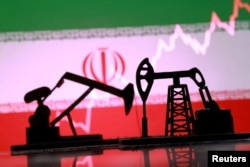
The Strait of Hormuz, through which about 20 percent of the world's oil and gas exports pass, has been effectively closed by Iran since March 30, when the United States and Israel launched massive attacks on Iran, and its traffic has decreased by 95 percent.
The closure of this strait has caused a sharp increase in energy prices worldwide.
The comments by Iran's top diplomat are the latest in a series of mixed messages from both sides about efforts to end the conflict, which began on February 28.
Iranian President Says Tehran Has 'Necessary Will' To End War But Seeks Security Guarantees
Iranian President Masud Pezeshkian says his country has the "necessary will" to end the war with the United States and Israel depending on conditions, mainly that his country's security is guaranteed.
"We possess the necessary will to end this conflict, provided that essential conditions are met -- especially the guarantees required to prevent repetition of the aggression," Pezeshkian said in a March 31 phone conversation with European Council President Antonio Costa, according to a statement from his office.
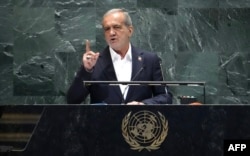
"The solution to normalizing the situation is the cessation of their aggressive attacks," Pezeshkian added.
The United States has said it put forward a 15-point plan that includes Iran dismantling its nuclear facilities, limiting its missile capabilities, and ending its support for regional proxy forces.
Senior Iranian officials have denied Tehran is in negotiations with Washington, but Iran said on March 25 that it was reviewing a 15-point US proposal and had put forward what it said were five conditions that needed to be met in order for the conflict to end.
IRGC Confirms General Eshaqi Killed In US-Israeli Strikes
Iran's Islamic Revolutionary Guards Corps (IRGC) confirmed on March 31 that IRGC Major General Jamshid Eshaqi, adviser to the Chief of Staff of the Armed Forces, had been killed along with several members of his family in US and Israeli strikes.
Ahmad Vahidi, commander-in-chief of the IRGC -- which is designated as a terrorist organization by the United States -- offered his condolences for Eshaqi in a statement but did not provide a date or further details about his death.
Eshaqi's funeral is scheduled to take place on April 1 in Tehran, along with that of Alireza Tangsiri, the commander of the IRGC's navy who was killed in an Israeli attack last week.
In February 2025, the US Treasury Department sanctioned Ishaqi and a number of individuals, entities, and vessels for what it called "an international network to facilitate the transfer of millions of barrels of Iranian crude oil worth hundreds of millions of dollars to China."
According to the United States, the proceeds from these activities have been used to finance armed groups in the region, including Hamas in Gaza, the Houthis in Yemen, and Hezbollah in Lebanon.
According to the US Treasury Department, Eshaqi previously worked for a front companies, Sepehr Energy, and coordinated with the IRGC on the sale of Iranian crude oil to China.
He is the latest senior Iranian official to be confirmed by Tehran as killed in the war.
New Executions A Sign Of Growing Repression In Iran Amid War
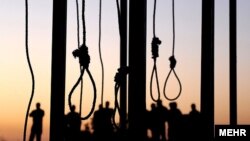
Iran announced the execution of two political prisoners on March 31, a day after the death penalty was also carried out on two others, in a sign that the clerical authorities are stepping up a crackdown on internal opposition in the country.
The men, identified as Babak Alipour and Pouya Ghobadi, were accused of membership in the Mujahedin-e Khalq (MEK), an exiled opposition group that seeks to overthrow the Islamic republic and that Tehran regards as a terrorist organization.
The executions show that despite US and Israeli strikes wiping out much of Iran's leadership and degrading its military-industrial capacities, there are no visible signs that the clerical authorities are losing control. In fact, repression appears once again to be on the rise.
To read the full report, click here.
Deploying Forces To Middle East 'Sends Message' To Iran, Says US General
WASHINGTON -- Iran is using tactical delay as a strategy in talks to end US and Israeli strikes that have decimated Tehran's military capabilities amid a continued buildup of US forces in the Middle East, retired US Army General Joseph L. Votel -- who led US Central Command from 2016 to 2019 -- told RFE/RL in an interview on March 30.
Votel outlined the risks of escalation in the conflict and warned that without a political settlement to keep Iran from blocking the Strait of Hormuz, a prolonged international military presence might be required to keep the the key oil and gas transit route open.
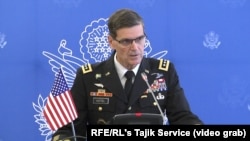
"You have to recognize, first and foremost, that part of the purpose of those deployments is a messaging to the Iranians," Votel said.
"This is also about making sure we can provide the maximum amount of options for our military leaders and our civilian leaders, so that, if the president decides something, he has an array of forces from which his military commanders can devise courses of action and approaches that he might approve."
To read the full interview, click here.
China, Pakistan Coordinate On Iran Talks As War Disrupts Global Trade
China and Pakistan vowed to "strengthen strategic communication and coordination" as they seek to help broker a deal to end the war in Iran, now in its fifth week with no clear end in sight.
Pakistani Foreign Minister Ishaq Dar met with his Chinese counterpart, Wang Yi, in Beijing on March 31 and reiterated their call for Iran and the United States to work toward ending the war, which has killed thousands across at least nine countries and is costing economies billions of dollars a day.
Chinese Foreign Ministry spokeswoman Mao Ning said both sides agreed to pursue de-escalation and that the two countries will "jointly advocate for peace and justice, and make new efforts to promote reconciliation and prevent conflict."
To read the full report, click here.
Hegseth: Next Few Days 'Decisive' in Iran War
US Defense Secretary Pete Hegseth said he visited American forces stationed in the Middle East on March 28 to observe ongoing military operations against Iran.
Speaking at a press conference on March 31, Hegseth did not disclose which country he visited.
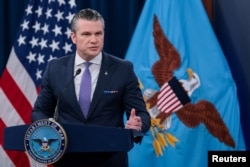
He said recent US strikes had significantly degraded Iranian military capabilities and noted that missile launches by Iran had declined in the past 24 hours.
Hegseth said the next few days would be "decisive" in the conflict.
He also cited intelligence assessments indicating that Iranian forces have been weakened, with falling morale, personnel shortages, and reports of desertion following sustained US attacks.
Hegseth emphasized that the United States currently holds the military advantage and suggested Iran’s options are becoming increasingly limited.
He added that President Donald Trump remains open to a negotiated agreement but warned that military operations would continue if no deal is reached.
Iran-US Contacts Likely Ongoing Despite Public Denials, Says Analyst
Speaking to Current Time, political analyst Anton Penkovsky said contacts between Iran and the United States are likely continuing despite public denials by Tehran.
"Despite the fact that Iran denies the existence of any contacts with the American side and claims that negotiations are conducted through intermediaries, I think it is obvious to everyone that contacts do exist in one form or another," he said. "Iran is pursuing this information strategy purely for domestic political reasons, so as not to appear weak to its internal audience, especially given that social tensions in Iran remain quite high."
He said talks appear deadlocked over several core issues:
"Even if the parties have agreed on a large number of points, the main problems remain in three areas. The first is the scope of restrictions on Iran’s nuclear program, including the dismantling of Iran’s nuclear infrastructure and the transfer of all nuclear materials to the United States -- a position on which the United States has insisted and, apparently, is not willing to make concessions or compromises. For Iran, this is a matter of sovereignty and strategic deterrence against its enemies in the region."
"The second issue is the missile program and support for allied groups -- proxy forces in the Middle East -- which primarily pose a threat, and which are, in essence, Iran’s main instrument of influence in the region. For the Iranian authorities, it would be very painful to give up these tools."
"The third point concerns sanctions and security guarantees, which Iran is now bargaining for itself. Iran is seeking the complete lifting of sanctions, but the United States will clearly not agree to this until the very end, until it is fully satisfied with Iran's actions, since sanctions pressure has been one of the main long-term levers of pressure on the Iranian authorities. It is precisely around these issues that negotiations in recent weeks have, by and large, reached a deadlock. One could even say that the decision to carry out strikes and begin military actions was made by the White House because Iran refused to make concessions on the issues listed, at the end of February."
On proposals to shift responsibility for security in the Strait of Hormuz to US allies, Penkovsky said:
"This idea appears quite logical from Washington’s point of view if they want to bring this conflict to a close relatively quickly. However, in practice, it would be a very difficult task, primarily from the standpoint of military infrastructure, since it would entail the need for demining, escorting oil tankers, and protection against direct Iranian or proxy attacks."
Energy Markets Could Take Months To Stabilize After War Ends, Expert Says
WASHINGTON -- Even if hostilities with Iran were to stop immediately, global energy markets will take a long time to recover, Mark P. Mills, executive director of the National Center for Energy Analytics, told RFE/RL.
Speaking during a briefing hosted by the State Department New York Foreign Press Center on March 30, Mills -- who served in the White House Science Office under President Ronald Reagan -- said markets would react quickly to an end in fighting but take longer to return to stability.
"Prices will relax immediately…but the trail to the equilibrium we had before is probably at least six months -- that might be a year…. We're certainly into months, not weeks," he said.
Mills said the current crisis underscores a deeper structural reality: The global economy remains tightly bound to oil. Despite years of investment aimed at reducing dependence on fossil fuels, global oil consumption has remained largely unchanged on a per capita basis since 2000.
"Every product and service is linked to oil," he said, noting that as much as 95 percent of global transportation still depends on it. Even rapid growth in electric vehicles has made only a marginal dent in overall demand.
The conflict has also revived concerns about supply vulnerabilities, particularly in key chokepoints such as the Strait of Hormuz and the Red Sea. In response, countries are already rerouting shipments, tapping strategic reserves, and even reverting to coal in some regions to ease pressure on oil and gas markets.
According to Mills, these emergency measures could buy the world "two to three months" before more severe shortages emerge if disruptions persist.
Beyond the immediate crisis, the longer-term impact may reshape global energy strategy. Governments and investors are increasingly likely to prioritize diversifying oil supply sources -- boosting production in regions such as the United States, South America, and Africa -- to reduce reliance on geopolitically sensitive areas, he said.
Trump Tells Countries To 'Go Get Your Own Oil!'
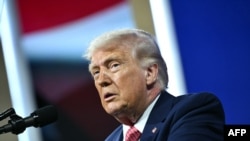
US President Donald Trump has told countries who refused to help the United States unblock the Strait of Hormuz and are now dealing with jet fuel shortages to buy American oil or go to the strategic transit route "and just take it."
In a social media post on March 31, the US leader chided countries such as the United Kingdom for "refusing to get involved" in the US-Israeli campaign in Iran.
"You’ll have to start learning how to fight for yourself, the U.S.A. won’t be there to help you anymore, just like you weren’t there for us," he said. "Iran has been, essentially, decimated. The hard part is done. Go get your own oil!"
Many countries, including close US allies such as Canada, the UK, Germany, and Japan, rejected taking part in keeping the Strait of Hormuz open, though some said they could be part of such an operation once the war with Iran ends.
In a separate post, Trump targeted France specifically, criticizing it for not allowing planes loaded with military supplies and bound for Israel, to fly over French territory. "The USA will REMEMBER," he wrote.