



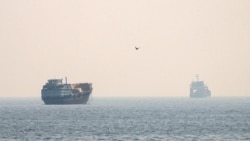

How Will The Iran War Affect You?
The impact of the US-Israeli war with Iran is beginning to extend far beyond the Middle East, with early signs of disruption across global energy markets and economies.
Israel Says It Killed Senior Hezbollah Commander
An Israeli naval strike in Beirut has killed Hezbollah Southern Front commander Hajj Yusuf Ismail Hashem, the country's military said on April 1.
Describing him as a “senior commander with over 40 years of experience and a central figure in the terror organization,” the Israel Defense Forces said his elimination "constitutes a significant blow to Hezbollah’s ability to carry out terror operations against Israeli civilians and to manage ongoing combat against IDF soldiers in southern Lebanon."
Hezbollah -- deemed a terrorist organization by Israel and the United States -- later confirmed Hashem's death in a statement on April 1, calling him a "beacon of the Islamic Resistance."
Hashem is the most senior Hezbollah commander to have been killed by Israel since intensification of hostilities amid the US-Israeli war with Iran.
With reporting by The Times of Israel and Reuters
Trump Claims Iran Has Asked For Cease-Fire
US President Donald Trump has claimed that Tehran has requested a cease-fire in the conflict with US and Israel.
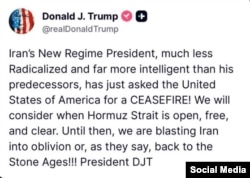
In a post on his Truth Social platform on April 1, Trump said "Iran’s New Regime President" had "just asked the United States of America for a CEASEFIRE!"
"We will consider when Hormuz Strait is open, free, and clear," he added. "Until then, we are blasting Iran into oblivion or, as they say, back to the Stone Ages!!!"
There has not yet been any response to the comments from Iranian authorities.
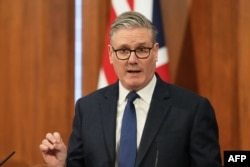
UK's Starmer Backs NATO, Plans Hormuz Talks Amid Iran Crisis
British Prime Minister Keir Starmer said the UK will convene talks with about 35 countries this week on reopening the Strait of Hormuz, as tensions in the Middle East disrupt global energy supplies.
Speaking at a news conference in London on April 1, Starmer said the meeting would "consider all feasible diplomatic and political measures to restore freedom of navigation, ensure the safety of stranded ships and seafarers, and resume the movement of vital goods."
He added that military planners would also be engaged to "make the Strait accessible and secure after the fighting ends."
Acknowledging the challenges, he said: "I have to be honest; this is not going to be easy. These are uncertain times. But we want to be more ambitious: closer economic cooperation, closer security cooperation, and a partnership that recognizes our shared values, shared interests and shared future with the European Union."
"NATO is the most effective military alliance in the history of the world, and we are fully committed to it," he continued. "Regardless of any noise, I will make decisions that are in the British national interest."
US President Donald Trump on March 31 pointedly criticized France and Britain, two of the closest allies the United States has, for failing to back the United States, telling the world to "Go get your own oil!" and "Start learning how to fight for yourself."
Trump said he is strongly considering pulling the country out of NATO, The Telegraph reported on April 1. In an interview with the British daily, Trump called the alliance a "paper tiger."
"I was never swayed by NATO. I always knew they were a paper tiger, and Putin knows that too, by the way," Trump was quoted as saying.
US Secretary of State Marco Rubio said on March 31 that "unfortunately" the Trump administration will have to "re-examine the value of NATO and that alliance for our country" once the war with Iran is over.
Rubio and other US officials have previously questioned the value of the alliance if the United States cannot freely use bases in allied countries to defend its own interests.
With Israeli Strike On A Caspian Port, Iran War Could Endanger Russia's Trade Route With Tehran
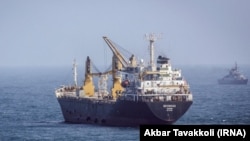
For years, the Caspian Sea was the safe zone of the alliance between Russia and Iran -- a landlocked black hole invisible to Western eyes.
While the inland waterway has served as a sanctuary for Iranian drones bound for the battlefields of Ukraine in Moscow's ongoing full-scale invasion, Israel recently launched air strikes on Bandar Anzali, an Iranian naval outpost on the Caspian.
Growing media reports based on intelligence say the corridor is now being used to transfer Russian-produced weaponry back to the Middle East, bringing Israeli air strikes closer to Moscow's backyard.
Since Russia's full-scale invasion of Ukraine began in February 2022, the Caspian Sea has served as a key corridor between two Western-sanctioned states. It links Russian ports such as Astrakhan with northern Iran, including Bandar Anzali, before cargo moves onward by rail or road toward the Persian Gulf and the Indian Ocean.
For the full report, click here.
Starmer Tells Britain Iran Conflict 'Not Our War'
British Prime Minister Keir Starmer addressed the nation on the conflict in the Middle East.
"This is not our war. We will not be drawn into the conflict," he said. "That is not in our national interest. And the most effective way we can support the cost of living in Britain is to push for de-escalation in the Middle East and a reopening of the Strait of Hormuz, which is such a vital route for energy."
"It is now clear that the impact of this war will affect the future of our country," he also said. "So today I want to reassure the British people that no matter how fierce this storm, we are well-placed to weather it and that we have a long-term plan to emerge from it a stronger, a more secure nation."
"Whatever the pressure on me and others, whatever the noise, I'm going to act in the British national interest in all the decisions that I make," he added.
Rubio Sees 'Finish Line' In Iran, Warns NATO Ties Will Be 'Reexamined'
US Secretary of State Marco Rubio said the "finish line" in the war with Iran is in sight, and once the conflict ends the United States will have to "re-examine" its relationship with NATO after a number of European countries declined to support the conflict with Iran.
Rubio said in an interview on Fox News Channel's Hannity show on March 31 that "there are talks going on" to end the war, with the possibility of a "direct meeting at some point."
"We can see the finish line. It's not today, it's not tomorrow, but it is coming," he said, but did not elaborate.
To read the full report, click here.
Australian PM Warns Of 'Economic Shocks' From Iran War
Australian Prime Minister Anthony Albanese delivered a rare speech to the nation on April 1 about the war in the Middle East. The speech comes as the monthlong Iran war has engulfed the Middle East, killing scores, disrupting energy supplies, and threatening to throw the global economy into chaos.
Albanese warned Australians that the "months ahead may not be easy" due to the repercussions of the US-Israeli war with Iran, which began on February 28. In retaliations to strikes, Iran has effectively closed the Strait of Hormuz, a critical chokepoint for global energy shipments, particularly oil and liquefied natural gas.
"The reality is, the economic shocks caused by this war will be with us for months," he said.
"The war in the Middle East has caused the biggest spike in petrol and diesel prices in history. Australia is not an active participant in this war. But all Australians are paying higher prices because of it," he said.
Albanese also announced on March 31 that the government would halve the special tax on gasoline and diesel and waive the cost of using heavy roads for three months to help households cope with rising costs caused by the war.
Australia has its highest fuel reserves in 15 years, but this is still far below the International Energy Agency's 90-day recommendation.
Trump, Starmer Also To Address Their People
Meanwhile, US President Donald Trump was also scheduled to address the American nation about the war with Iran on April 1 at 9 p.m. local time, according to the White House.
British Prime Minister Keir Starmer is also reported to be addressing the nation on April 1 at 10:15 local time, with a focus on concerns about the cost of living as energy prices in the country continue to rise due to the ongoing crisis in the Middle East.
Britain is among the countries that have not joined the United States in reopening the Strait of Hormuz, and this issue has been met with explicit criticism from Trump.
Trump Calls 'Two To Three Weeks' While Iran Again Denies Talks
US President Donald Trump said he expects the war with Iran to wrap up "in two to three weeks."
He made the remarks while signing an executive order at the White House on March 31. He also said that "France and other countries" such as China will have to "fend for themselves" when it come to trying to pass the Strait of Hormuz, which has been effectively closed by Iran in retaliation for US and Israeli strikes on the country that have taken place since February 28.
"We hit them hard. We got rid of a lot of the radicalized lunatics along the strait," he claimed, before saying that "within two weeks, maybe three...we'll leave" the region.
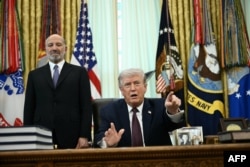
He said that "we are negotiating with them right now," adding that "we've seen regime change, although regime change was not one of the things I had as a goal."
Tehran and Washington have sent mixed messages from both sides about efforts to end the conflict.
Iranian Foreign Minister Abbas Araqchi, in an interview with Al Jazeera that aired on April 1, said that no negotiations with the United States are "ongoing" and Tehran has "not responded" to Washington's reported 15-point proposal to end the war.
"We receive messages from the Americans, some directly and some through our friends in the region, and we respond to these messages whenever necessary," he said. "There is no basis for negotiations [with the US]," adding that, of course, some messages had been exchanged directly with the US special envoy, Steve Witkoff.
Iranian Missiles Strike Israel As Houthis Launch Third Missile
Reports from Israel say 14 people, including an 11-year-old girl, were injured in a new round of rocket attacks on the country on the morning of April 1. The Israeli emergency medical service reported that the injured girl was in critical condition. Israeli police also reported damage to several locations in the center of the country.
The Israeli military had previously said that, for the first time in about 20 hours, it had detected "missiles fired from Iran toward Israeli territory," and air raid sirens had sounded across central Israel.
According to the army's Home Front Command, another warning of rocket fire was issued less than an hour later, prompting a state of alert in large parts of northern and central Israel.
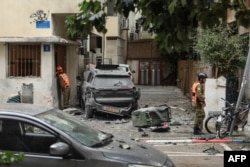
Israeli media reported that the attack used cluster munitions, a type of ammunition that explodes in the air and scatters small bombs over a wide area.
International human rights organizations had previously warned against the use of this type of ammunition in civilian and residential areas.
Meanwhile, the Iran-backed Houthi militia in Yemen say they launched a missile attack on Israel on April 1, simultaneously with Iran and Lebanon's Hezbollah, which is deemed a terrorist organization by Israel and the United States.
This is the third attack of this type by the Houthis since their entry into the Middle East war.
Yahya Saree, a spokesman for the Houthis, claimed in a video statement that they had attacked "sensitive targets" with a barrage of ballistic missiles.