



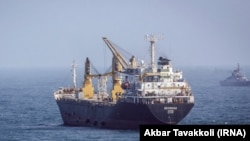
For years, the Caspian Sea was the safe zone of the alliance between Russia and Iran -- a landlocked black hole invisible to Western eyes.
While the inland waterway has served as a sanctuary for Iranian drones bound for the battlefields of Ukraine in Moscow's ongoing full-scale invasion, Israel recently launched air strikes on Bandar Anzali, an Iranian naval outpost on the Caspian.
Growing media reports based on intelligence say the corridor is now being used to transfer Russian-produced weaponry back to the Middle East, bringing Israeli air strikes closer to Moscow's backyard.
Since Russia's full-scale invasion of Ukraine began in February 2022, the Caspian Sea has served as a key corridor between two Western-sanctioned states. It links Russian ports such as Astrakhan with northern Iran, including Bandar Anzali, before cargo moves onward by rail or road toward the Persian Gulf and the Indian Ocean.
Intelligence groups have previously reported on vessels from Russia's so-called shadow fleet operating along this corridor under Iranian and Russian flags, linked to the smuggling of sanctioned oil and weapons between the two countries.
Many of these vessels have switched off their tracking signals, raising suspicions that they are carrying sanctioned goods or military cargo.
In 2024, the United States sanctioned two Russian shipping companies for transporting drone-related equipment and munitions across the Caspian Sea for use in Ukraine.
Evolving Cooperation
The recent strikes on Bandar Anzali on March 18 have come amid signs that military cooperation between Russia and Iran may be evolving.
Ukrainian President Volodymyr Zelenskyy told CNN on March 15 that Iran is hitting American bases with drones made and transferred by the Russians.
Western intelligence, cited by the Financial Times, says Russia may now be sending drones to Iran.
The Institute for the Study of War said that the Israeli forces' air strikes on Bandar Anzali earlier this month follow reports that Russia is providing Iran with Russian-produced and possibly modified Shahed drones.
Tel Aviv And Moscow
Israel announced at the time that its fighter jets had struck targets at an Iranian Navy port and base facilities where dozens of military vessels, including missile ships and guard boats, were stationed.
"If Russian interests are somehow impacted, destroyed, the Israelis are not going to scream about it because they do want to maintain cordial ties with the Russians," Alex Vatanka, director of the Iran Program at the Middle East Institute in Washington, told RFE/RL.
Russia would view any spillover of the Iran conflict into the Caspian Sea "extremely negatively," Kremlin spokesman Dmitry Peskov said of the March 18 attack.
Being a landlocked body of water, the Caspian Sea has been widely seen as outside the reach of US and Western navies. It is bordered by Russia, Iran, Azerbaijan, Kazakhstan, and Turkmenistan -- countries that have generally maintained balanced relations with Moscow.
"Our research 'largely' excludes the Caspian Sea, as the lack of regional cooperation with Western authorities makes it a closed environment where monitoring is both impractical and currently of lower priority for global enforcement," Benjamin Hilgenstock, a sanctions expert at the Kyiv-based KSE institute, told RFE/RL.
Caspian Trade On The Rise
Iran and Russia also exchange food goods via the Caspian Sea. Grain trade between Iran and Russia was halted immediately following the attack but resumed afterward, according to Reuters.
Russia, the world's largest grain exporter, has been enhancing Caspian Sea export logistics in recent years, targeting markets in Iran, Persian Gulf countries, Iraq, and Afghanistan.
"Even if this route is disturbed, there are other ways for Iran and Russia to trade," Dalga Khatinoglu, an expert on Iran's energy and macroeconomics, told RFE/RL.
The Caspian segment is part of the International North South Transport Corridor (INSTC), a 7,200-kilometer network of shipping, rail, and road routes for transporting freight between India, Iran, Azerbaijan, Russia, Central Asia, and Europe.
Isolated from the West, both Iran and Russia harbor long-term plans to expand trade via the Caspian Sea.
Russia–Iran cargo turnover via the Caspian Sea could double in 2026 to reach 10 million tons, according to Aleksandr Sharov, director of the RusIranExpo Group.
"Both Tehran and Moscow hope that the US will keep the Israelis from repeating their attack on the Caspian coast," Paul Goble, a longtime expert on Eurasia at the Jamestown Foundation, told RFE/RL.
"There is no reporting that suggests that the Caspian region would soon become such a stage. We are still talking about ground troops in the south, potentially the Americans going in the south, not in the north," Vatanka told RFE/RL.
"However, if they discover based on intelligence that, for example, Iran is producing drones or missiles in a town somewhere in the north, in the Caspian region, then obviously that place will become a target. Those are operational, logistical reasons, not a strategic" approach, he adds.