



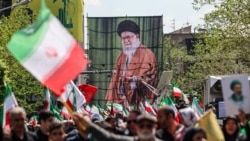
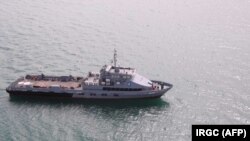
IRGC Sets Alternative Hormuz Routes To Avoid Sea Mines
Iran's hard-line Islamic Revolutionary Guards Corps (IRGC) on April 9 announced alternative routes for ships traveling through the crucial Strait of Hormuz, pointing to the risk of mines in the main zone of the waterway.
"All ships intending to transit the Strait of Hormuz are hereby notified that in order to comply with the principles of maritime safety and to be protected from possible collisions with sea mines...they should take alternative routes for traffic in the Strait of Hormuz," the IRGC was quoted by state media as saying in a statement that also provided instructions for an alternative entry and exit routes.
Washington and Tehran have agreed to a two-week cease-fire to allow further negotiations to take place for a potential peace deal.
One of the US administration's main demands is freedom of ship traffic through the strait, which Iran has largely blocked. Tehran has said it will begin allowing traffic, although it insists ships must coordinate with the Iranian military.
Some 20 percent of the world's crude oil and natural gas supplies are transported on ships through the strait.
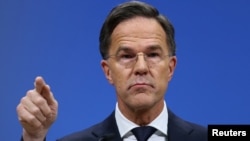
Trump Blasts NATO After Meeting With Alliance Chief Rutte
US President Donald Trump again blasted NATO, saying alliance members weren't there "when we needed them," shortly after he met in Washington with Secretary-General Mark Rutte.
"NATO wasn't there when we needed them, and they won't be there if we need them again. Remember Greenland, that big, poorly run, piece of Ice!!!" Trump posted on Truth Social in all capital letters on April 8.
Trump has long complained about the 77-year-old transatlantic alliance -- of which the United States has been the dominant partner from the start -- saying it is outdated and that members do not pay their fair share for their defense.
He has intensified his criticism since the start of the US-Israeli war with Iran, saying the alliance did not help the United States when it was needed.
Many alliance members say they weren't consulted before the start of the war or weren't asked to contribute. Some countries, such as Italy, Spain, and Britain -- where US bases are located -- expressed reluctance to allow the military facilities on their territory to be used for offensive military operations against Iran.
Trump has also expressed demands to bring Greenland under American sovereignty and sought out NATO's help in having the island transferred from alliance member Denmark's ownership to that of the United States.
The demand has raised tensions within the alliance, with members criticizing Trump's remarks and standing behind Demark's ownership.
NATO chief Rutte told CNN after the meeting with Trump that the discussions were "frank and open" but that Trump expressed disappointment with US NATO allies.
Rutte said he told the US president that "a large majority" of European countries had been helpful to the US military effort in the war with Iran.
"Well, let me be absolutely clear, [Trump] is clearly disappointed and with many NATO allies, and I can see his point," Rutte said.
"But at the same time, I was able to point to the fact that the large majority of European nations have been helpful with basing, with logistics, with overflights, with making sure that they live up to [their] commitments."
Rutte added that "there is also widespread support for the fact that degrading the nuclear- and...ballistic-missile capacity for Iran was really crucial, and that only the US was able at this point to do that."
Asked if Trump had repeated during the meeting his suggestion that the United States could leave NATO, Rutte said: "Well, as I said, there is a disappointment, clearly, but at the same time, he was also listening careful to my arguments of what's happening, and I also pointed him to the fact that it was his leadership which brought about the Hague spending commitment."

On April 1, Trump told Reuters he was "absolutely" considering withdrawing the United States from NATO for what he considers the alliance's lack of support for US objectives in Iran.
In an interview with the British newspaper The Telegraph, he called the military alliance a “paper tiger” and said leaving NATO was “beyond reconsideration.”
Experts say it is not clear whether Trump could unilaterally pull the United States out of the transatlantic alliance without congressional approval.
The Wall Street Journal reported that Trump is considering a plan to punish some NATO members that he believes were unhelpful to US and Israeli forces during the Iran war.
Citing unnamed administration officials, the WSJ said proposals would involve moving US troops out of NATO member countries deemed unhelpful to the war effort and base them instead in countries that were more supportive of the US military campaign.
In Separate Calls, Macron Tells Trump, Pezeshkian Cease-Fire Must Include Lebanon
French President Emmanuel Macron said he spoke separately with Iranian President Massud Pezeshkian and US leader Donald Trump, telling them both that "their decision to accept a cease-fire was the best one possible."
He also said he wanted the cease-fire to cover all areas of conflict, including Lebanon, where Israel has continued to strike at sites of Hezbollah, the Iran-backed group that has been deemed a terrorist organization by Israel and the United States.

"I expressed my hope that the cease-fire will be fully respected by each of the belligerents, across all areas of confrontation, including in Lebanon. This is a necessary condition for the ceasefire to be credible and lasting," Macron wrote on X.
"Any agreement will have to address the concerns raised by Iran’s nuclear and ballistic missile programs, as well as its regional policy and its actions obstructing navigation through the Strait of Hormuz."
Macron said he also held discussions with the leaders of Qatar, the United Arab Emirates, Lebanon, and Iraq.
A temporary truce between the United States and Iran wobbled less than a day after being agreed as Israel launched massive attacks on Iranian proxies in Lebanon, while Tehran launched strikes at oil centers in several Persian Gulf countries after claiming its energy facilities were targeted.
Vance Says Iran Misunderstood Truce Deal, Israel Has Offered To Show Restraint In Lebanon
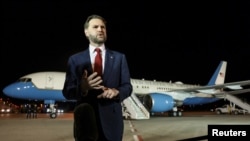
US Vice President JD Vance said he suspects Iran misunderstood the terms of the cease-fire deal reached with Pakistan’s mediation, believing that the truce included Lebanon when it did not.
In comments to reporters on an airport tarmac in Budapest before a flight back to the United States on April 8, Vance also repeated that Iran must open the Strait of Hormuz, a key oil and gas transport artery, to shipping.
“I urge the Iranians to come to the table seriously,” said Vance, who is to lead the US delegation at planned talks in Islamabad on April 10, warning that if Tehran violates the agreement, it will see “serious consequences.”
Among the key aspects of the deal, he said, was that the United States agreed to a cease-fire and negotiations and Iran agreed to open the Strait of Hormuz, that Tehran essentially blocked after the US and Israel launched air strikes on Iran on February 28.
Vance spoke amid questions over whether the agreement reached by the United States and Iran late on April 7 will hold, with signs that shipping through the strait is heavily restricted, amid Iranian claims that the deal has been violated, in part by major Israeli attacks on Lebanon. Iran’s Press TV reported late on April 8 that the waterway was fully closed.
"I think this comes from a legitimate misunderstanding. I think the Iranians thought that the cease-fire included Lebanon, and it just didn't," Vance said. "If Iran wants to let this negotiation fall apart... over Lebanon…that's ultimately their choice," he said.
Without providing details, he said: “The Israelis, as I understand it...have actually offered to, frankly, to check themselves a little bit in Lebanon, because they want to make sure that our negotiation is successful."
Heavy Israeli Strikes On Lebanon Add Uncertainty Hours After US-Iran Cease-Fire Deal
Lebanese officials say dozens of people have been killed in the heaviest Israeli strikes on the country since the war in Iran broke out five weeks ago.
The strikes on April 8, which a Lebanese Health Ministry spokesman told Reuters killed 89 people and wounded 700 others, came amid contradictory claims about whether the Pakistan-brokered US-Iranian agreement on a two-week cease-fire included Lebanon.
The strikes, which Israel’s military said targeted over 100 command centers and military sites of the Iran-backed militant group Hezbollah in Beirut, the Bekaa Valley, and southern Lebanon, appeared to threaten the cease-fire agreement reached late on April 7 and shipping traffic in the Strait of Hormuz, which resumed under the deal after being blocked by Iran for weeks.
Citing an Iranian ministry statement, AFP reported that Iranian Foreign Minister Abbas Araqchi “discussed [Israel’s] violations of the cease-fire in Iran and Lebanon" with a senior Pakistani military leader on April 8.
Iran’s Tasnim news agency cited an unnamed source as saying Iran would withdraw from the cease-fire agreement if Israel continues to attack Lebanon. Fars, a semi-official Iranian news agency, reported that Iran halted oil tanker traffic through the Strait of Hormuz over the Israeli bombardments.
Pakistani Prime Minister Shehbaz Sharif has said the cease-fire agreement included Lebanon, while Israeli Prime Minister Benjamin Netanyahu said it did not.
A White House correspondent for US public broadcaster PBS said on X that US President Donald Trump told her on April 8 that Lebanon was “not included in the deal” because of the presence there of Hezbollah, which has been designated by the United States as a terror group.
UPDATE: Lebanon's Health Ministry said the Israeli strikes on April 8 killed 182 people and wounded 890, adding that the updated toll was not final.
With reporting by Reuters and AFP
Pakistani PM Warns Of Truce Violations Less Than A Day After Its Agreement
Pakistani Prime Minister Shehbaz Sharif has noted violations of the temporary truce between the United States and Iran and warned all parties involved in the conflict to respect the two-week cease-fire to allow a chance for a diplomatic solution to end the war. "Violations of cease-fire have been reported at few places across the conflict zone which undermine the spirit of peace process. I earnestly and sincerely urge all parties to exercise restraint and respect the cease-fire for two weeks, as agreed upon, so that diplomacy can take a lead role towards peaceful settlement of the conflict," he said in a social media post on April 8, a day after the truce was agreed. He did not elaborate on the violations, but several Gulf states have said they were the targets of Iran-launched ordinance. Tehran claimed it launched attacks on Kuwait and the United Arab Emirates after air strikes targeted oil facilities on Iran's Lavan island. The United States and Iran agreed to the two-week cease-fire late on April 7.
Ships Begin Moving Through Key Strait As Fragile US-Iran Truce Holds
A fragile cease-fire appeared to be holding hours after being agreed to by the United States and Iran, with ships moving through the Strait of Hormuz and heavy bombing runs halted for the first time in more than a month.
The straight is a key shipping lane through which some 20 percent of the world's oil and gas passes. According to data from maritime monitor Marine Traffic, two ships had already passed through the waterway by midday on April 8.
"Early signs of vessel activity are emerging in the Strait of Hormuz following a ceasefire announcement, which includes a temporary reopening of the strategic waterway to allow for negotiations," the monitor said in a post on X, noting a Greek-owned bulk carrier and a Liberian-flagged vessel had already crossed through the strait.
To read the full report, click here.
Trump Says US To Work 'Closely' With Iran After 'Very Productive Regime Change'
President Donald Trump said the United States will work "closely" with Iran after reaching an agreement to suspend fighting for two weeks to work on a full peace deal.
"The United States will work closely with Iran, which we have determined has gone through what will be a very productive Regime Change! There will be no enrichment of Uranium, and the United States will, working with Iran, dig up and remove all of the deeply buried (B-2 Bombers) Nuclear “Dust,” Trump wrote in a social media post.
"We are, and will be, talking Tariff and Sanctions relief with Iran," he added.
Kuwait, UAE Report Missile And Drone Attacks
Hours after the United States announced a temporary cease-fire with Iran, Kuwait and the United Arab Emirates (UAE) said they were fending off Iranian missile and drone attacks.
Separately, Iran announced that its oil facilities on Lavan Island were targeted in the morning of April 8.
The UAE Defense Ministry issued a statement on April 8, saying: "The UAE's air defense is countering missile and drone attacks originating from Iran."
The Kuwaiti military also announced that the country's air defenses had countered a "compact wave" of drone attacks by the Islamic republic starting at 8 a.m. local time. According to the statement, a total of 28 drones targeting Kuwait were intercepted.
According to the Kuwaiti Armed Forces, a number of these drones targeted vital oil facilities and power plants in the south of the country, resulting in "extensive material damage" to oil infrastructure, power plants, and desalination facilities.
The Kuwaiti Army General Staff emphasized that all necessary measures have been taken to monitor and counter these attacks.
Meanwhile, the National Iranian Oil Refining and Distribution Company announced that the Lavan Oil Refinery facility, located on Lavan Island, was attacked at around 10 a.m. local time.
According to the company's statement, there were no casualties in the attack, and safety and firefighting teams were controlling and extinguishing the fire and securing the facility.
There has been no report yet on the source of these attacks, but the Tasnim news agency, which is affiliated with the Islamic Revolutionary Guards Corps, reported the two attacks in a short news report as follows: "The missile and drone attacks on the UAE and Kuwait took place hours after the oil facilities on Lavan Island in Iran were targeted."
Iran Confirms Participation In Islamabad Talks With US
Iranian President Masud Pezeshkian has confirmed to Pakistani Prime Minister Shehbaz Sharif that Iran will participate in upcoming negotiations with the United States, scheduled to be held in Islamabad on April 10.
According to a statement from the Sharif's office, the two leaders held a "warm and cordial conversation" lasting over 45 minutes on April 8.
"President Pezeshkian reaffirmed Iran's participation in the upcoming negotiations and expressed appreciation for Pakistan's efforts," Sharif wrote in a post on X following the phone call with the Iranian president.
Earlier, Sharif said he had invited US and Iranian delegations to Islamabad on April 10 "to further negotiate for a conclusive agreement to settle all disputes."
Iran's semiofficial ISNA news agency reported that the country's conservative parliament speaker, Mohammad Baqer Qalibaf, is expected to lead the Iranian negotiating team, while US Vice President JD Vance is anticipated to represent the United States at the talks in the Pakistani capital.
However, these details have not yet been officially confirmed by either the US or Iranian governments.